 Apollo Hospitals, Opp.iim 154/11,bannerghatta Road. Bannerghatta Road.bangalore-560076
 6366 229563
 Posted on June 6, 2026
Primary Angioplasty in Acute MI: Why Every Minute Matters During a Heart Attack
A heart attack can happen suddenly, but the damage it causes depends greatly on how quickly the blocked artery is opened.
In medical terms, a heart attack is called acute myocardial infarction, or acute MI. It usually occurs when a blood clot suddenly blocks one of the coronary arteries that supplies blood to the heart muscle. When blood flow stops, the heart muscle starts suffering within minutes.
This is why doctors often say:
Time is muscle.
The faster the blood flow is restored, the more heart muscle can be saved.
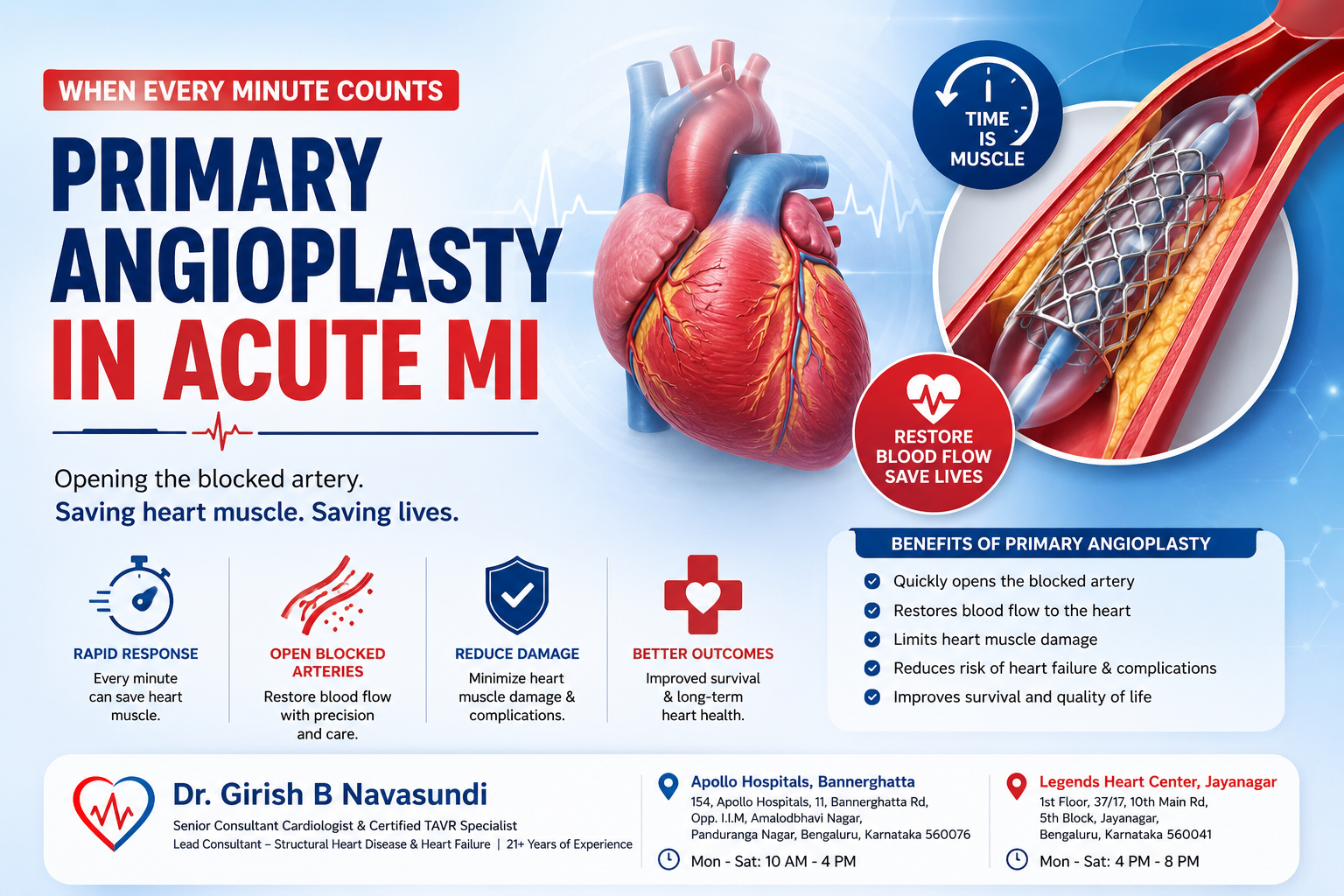
One of the most effective emergency treatments for a major heart attack is primary angioplasty, also known as primary PCI or primary percutaneous coronary intervention.
Primary angioplasty is not an elective heart procedure. It is an emergency life-saving intervention performed during an acute heart attack to open the blocked artery quickly and restore blood supply to the heart.
What Is Acute Myocardial Infarction?
Acute myocardial infarction means a part of the heart muscle is injured because its blood supply has been suddenly reduced or completely blocked.
The heart receives oxygen-rich blood through coronary arteries. Over time, cholesterol, calcium and inflammatory deposits can build up inside these arteries. This is called plaque.
Sometimes, a plaque can suddenly rupture. When this happens, a blood clot forms at that site. If the clot blocks the artery completely, the heart muscle beyond that blockage does not receive enough oxygen.
This can lead to:
Severe chest pain
Breathlessness
Sweating
Vomiting or nausea
Fall in blood pressure
Dangerous rhythm disturbances
Heart failure
Sudden cardiac arrest
Acute MI is a medical emergency. Delaying treatment can lead to permanent heart damage.
What Is Primary Angioplasty?
Primary angioplasty is an emergency procedure done to open a blocked coronary artery during a heart attack.
It is called “primary” because it is used as the first major reperfusion treatment instead of giving clot-dissolving injections first.
During primary angioplasty, a cardiologist inserts a thin tube called a catheter through an artery, commonly from the wrist or groin. This catheter is guided to the heart artery. A coronary angiogram is performed to identify the blocked artery. Then a balloon is used to open the blockage, and in most cases, a stent is placed to keep the artery open.
The goal is simple but critical:
Restore blood flow to the heart muscle as early as possible.
Why Is Primary Angioplasty Important During a Heart Attack?
In a major heart attack, the blocked artery is the main problem. Medicines can help reduce clotting and support the heart, but the most important goal is to reopen the artery.
Primary angioplasty helps by:
Opening the blocked artery quickly
Restoring blood flow to the heart muscle
Reducing the amount of heart muscle damage
Lowering the risk of heart failure
Reducing the risk of dangerous heart rhythms
Improving survival when performed on time
Reducing recurrent heart attack risk
When performed in a well-equipped cardiac centre by an experienced interventional cardiologist, primary angioplasty can be one of the most important treatments in acute MI care.
The Meaning of “Golden Hour” in Heart Attack
The first few hours after the onset of heart attack symptoms are extremely important.
Many patients make the mistake of waiting at home, assuming chest pain is due to gas, acidity, stress or tiredness. This delay can be dangerous.
The earlier the blocked artery is opened, the better the chance of saving heart muscle.
A patient who reaches the hospital early may recover with better heart function. A patient who reaches late may have more permanent heart muscle damage, even if the artery is opened later.
That is why chest pain should never be ignored, especially in people with risk factors such as diabetes, high BP, smoking, high cholesterol, obesity or family history of heart disease.
Symptoms That Should Not Be Ignored
A heart attack may not always look dramatic. Some people have severe chest pain. Others may have mild or confusing symptoms.
Common warning signs include:
Chest pain, heaviness, tightness or pressure
Pain spreading to the left arm, both arms, jaw, neck, back or shoulder
Shortness of breath
Cold sweating
Nausea or vomiting
Dizziness or fainting
Extreme tiredness
Burning sensation in the chest that does not settle
Uneasiness or a feeling of impending danger
In elderly patients, women and people with diabetes, symptoms may be less typical. Some may only feel breathlessness, sweating, fatigue, indigestion-like discomfort or sudden weakness.
If symptoms suggest a heart attack, the safest action is to reach an emergency cardiac care centre immediately.
How Is Acute MI Diagnosed?
When a patient reaches the emergency department with suspected heart attack symptoms, quick diagnosis is essential.
Doctors usually use:
ECG
Blood tests such as Troponin
Clinical examination
Blood pressure and oxygen monitoring
Echocardiogram when needed
Coronary angiography in appropriate cases
The ECG is especially important. In some heart attacks, the ECG shows ST elevation. This is called STEMI, or ST-elevation myocardial infarction. STEMI usually means that a coronary artery is completely blocked and needs urgent reperfusion treatment.
In such cases, primary angioplasty is often the preferred treatment when it can be done quickly in a PCI-capable centre.
Step-by-Step: What Happens During Primary Angioplasty?
Many patients and families feel anxious when they hear the word angioplasty. Understanding the procedure can reduce fear.
1. Emergency assessment
The patient is first assessed in the emergency department. ECG, vitals and blood tests are done quickly. If acute MI is confirmed, the cath lab team is activated.
2. Medicines are started
The patient is usually given blood-thinning medicines, antiplatelet medicines and other emergency drugs depending on the condition. These medicines help reduce clot formation and support the procedure.
3. Artery access is taken
The cardiologist inserts a thin catheter through an artery. In many cases, the wrist artery is preferred. Sometimes the groin artery may be used depending on the patient’s condition and technical needs.
4. Coronary angiography is performed
A dye is injected into the coronary arteries and X-ray images are taken. This shows the exact location of the blockage.
5. The blocked artery is opened
A thin wire is passed across the blockage. A small balloon may be inflated to open the artery.
6. A stent is placed
In most cases, a stent is placed at the blockage site. The stent acts like a scaffold and helps keep the artery open.
7. Blood flow is checked
The cardiologist confirms whether blood flow has improved. The patient is then shifted to the cardiac ICU or monitoring area.
The entire process is focused on one goal: restoring blood flow as safely and quickly as possible.
Primary Angioplasty vs Clot-Dissolving Injection
Some patients ask whether medicines can dissolve the clot instead of angioplasty.
Clot-dissolving injections, also called thrombolytic therapy or fibrinolysis, can help in some situations. They are usually considered when primary angioplasty cannot be performed within the recommended time window.
However, primary angioplasty has important advantages when available on time:
It directly identifies the blocked artery
It mechanically opens the artery
It allows stent placement
It gives information about other blockages
It is often more reliable in restoring blood flow
It may reduce the risk of recurrent blockage compared with clot-dissolving treatment
The best treatment depends on the patient’s condition, time from symptom onset, hospital facilities and clinical judgement.
Who Needs Primary Angioplasty?
Primary angioplasty is commonly considered for patients with STEMI, especially when they present within the early hours of symptom onset.
It may also be needed in patients with:
Ongoing chest pain
Cardiogenic shock
Severe heart failure
Dangerous rhythm problems
Persistent ECG changes
Large area of heart muscle at risk
Failed clot-dissolving therapy
High-risk acute coronary syndrome
Even patients who come late may need urgent angiography and revascularisation if they continue to have chest pain, shock, severe heart failure or life-threatening rhythm disturbances.
Why Experience and Cath Lab Readiness Matter
Primary angioplasty is time-sensitive and technically demanding.
A good outcome depends not only on the procedure itself, but also on the entire heart attack care system.
This includes:
Emergency team readiness
Fast ECG interpretation
Rapid cath lab activation
Experienced interventional cardiologist
Trained cath lab staff
Availability of stents, balloons and devices
ICU support
Management of complications
Post-angioplasty monitoring
Structured follow-up care
In complex cases, the patient may have multiple blockages, calcified arteries, left main disease, kidney dysfunction, poor heart pumping function or shock. These situations require advanced decision-making and experience.
This is where a specialist with expertise in complex coronary interventions and structural heart disease can help guide safe and effective treatment.
What Happens After Primary Angioplasty?
Opening the artery is only the first step. Recovery after a heart attack requires careful monitoring and long-term prevention.
After primary angioplasty, the patient is usually monitored in a cardiac care unit. Doctors watch for rhythm problems, heart failure, BP changes, bleeding risk, kidney function and response to medicines.
The patient may be advised:
Antiplatelet medicines
Statins
BP medicines
Diabetes control
Lifestyle changes
Cardiac rehabilitation
Diet modification
Smoking cessation
Follow-up echocardiogram
Regular cardiology review
Medicines should not be stopped without medical advice, especially blood thinners after stent placement. Stopping them suddenly can increase the risk of stent clotting, which can be life-threatening.
Life After a Heart Attack
Many patients feel worried after a heart attack. They ask whether life can become normal again.
The answer depends on how much heart muscle was damaged, how early treatment was received and how well the patient follows long-term care.
With timely primary angioplasty, proper medicines, lifestyle changes and follow-up, many patients can return to a good quality of life.
However, a heart attack should be treated as a strong warning signal. It means the patient needs long-term heart protection.
Important steps include:
Taking medicines regularly
Not missing follow-up visits
Controlling BP and diabetes
Reducing LDL cholesterol aggressively
Avoiding tobacco completely
Eating a heart-healthy diet
Doing safe exercise after medical clearance
Managing stress
Maintaining healthy weight
Sleeping well
Recognising warning symptoms early
Recovery is not just about surviving the heart attack. It is about preventing the next one.
Common Mistakes Patients Make During Heart Attack Symptoms
Many heart attack complications happen because of delay.
Common mistakes include:
Waiting for pain to settle
Taking acidity medicines repeatedly
Driving alone to the hospital
Visiting a small clinic without ECG facility
Ignoring symptoms because the pain is mild
Assuming diabetes-related symptoms are not serious
Waiting for family members to arrive
Trying home remedies
Delaying because it is late at night
In heart attack care, delay can cost heart muscle.
If chest pain or suspicious symptoms last more than a few minutes, especially with sweating, breathlessness, nausea or radiation to the arm/jaw/back, immediate emergency evaluation is important.
Can Primary Angioplasty Prevent Future Heart Attacks?
Primary angioplasty treats the artery that is blocked during the heart attack. It saves heart muscle and stabilises the immediate emergency.
But it does not remove the underlying tendency for plaque formation.
This is why long-term prevention is essential.
After angioplasty, patients must focus on:
Cholesterol control
Diabetes control
Blood pressure control
Weight management
Smoking cessation
Physical activity
Diet improvement
Medication adherence
Regular cardiology follow-up
Some patients may have blockages in other arteries also. The cardiologist decides whether these require medicines, staged angioplasty or further evaluation.
When Should You See a Cardiologist After Angioplasty?
Follow-up after primary angioplasty is very important.
Patients should visit their cardiologist as advised, especially if they have:
Chest discomfort
Breathlessness
Palpitations
Swelling of legs
Dizziness
Bleeding due to medicines
Uncontrolled BP or diabetes
Difficulty tolerating medicines
Reduced exercise capacity
Even if the patient feels well, follow-up is needed to adjust medicines, review reports and reduce future risk.
Primary Angioplasty in Bangalore
Bangalore has advanced cardiac care facilities, but patients and families must understand that heart attack treatment depends heavily on speed.
The key is not only choosing the right doctor, but also reaching the right emergency facility at the right time.
For patients with acute MI, primary angioplasty can be life-saving when performed promptly in a PCI-capable centre.
Patients with known heart disease, diabetes, high BP, smoking history, high cholesterol or family history should already know where to go in an emergency. Planning ahead can save time during a crisis.
Final Message
Primary angioplasty is one of the most important emergency treatments for acute myocardial infarction.
A heart attack happens when a coronary artery suddenly gets blocked. The longer the artery remains blocked, the greater the damage to the heart muscle.
Primary angioplasty helps open the blocked artery, restore blood flow and reduce heart muscle damage.
But success depends on speed.
Do not ignore chest pain.
Do not wait for symptoms to become severe.
Do not assume it is gas or acidity.
Do not delay emergency care.
When it comes to acute MI, every minute matters.
Consult Dr. Girish B Navasundi
Dr. Girish B Navasundi
Senior Consultant Cardiologist & Certified TAVR Specialist
Lead Consultant – Structural Heart Disease & Heart Failure
21+ Years of Experience
Apollo Hospitals, Bannerghatta
154, Apollo Hospitals, 11, Bannerghatta Rd, Opp. I.I.M, Amalodbhavi Nagar, Panduranga Nagar, Bengaluru, Karnataka 560076
Timings: Mon – Sat: 10 AM – 4 PM
Legends Heart Center, Jayanagar
1st Floor, 37/17, 10th Main Rd, 5th Block, Jayanagar, Bengaluru, Karnataka 560041
Timings: Mon – Sat: 4 PM – 8 PM
For patients with chest pain, heart attack symptoms, coronary artery disease, previous angioplasty, heart failure or high cardiac risk, timely evaluation by a cardiologist can help guide the right treatment.
FAQs
1. What is primary angioplasty?
Primary angioplasty is an emergency procedure used to open a blocked coronary artery during a heart attack. It restores blood flow to the heart muscle.
2. Is primary angioplasty the same as stenting?
Angioplasty means opening the blocked artery, often with a balloon. In most heart attack cases, a stent is also placed to keep the artery open.
3. When is primary angioplasty needed?
It is commonly needed in STEMI heart attacks, where a coronary artery is completely blocked and urgent reperfusion is required.
4. Why is timing important in heart attack treatment?
The heart muscle starts getting damaged when blood flow stops. The faster the artery is opened, the more heart muscle can be saved.
5. Can medicines alone treat a heart attack?
Medicines are important, but in many major heart attacks, the blocked artery needs to be opened urgently. The treatment choice depends on the patient and facility availability.
6. Is primary angioplasty painful?
The procedure is usually done under local anaesthesia at the access site. Patients may feel pressure or mild discomfort, but it is not like open-heart surgery.
7. How long does recovery take after primary angioplasty?
Recovery varies depending on the heart attack severity, heart pumping function and other health conditions. Many patients recover well with medicines, follow-up and lifestyle changes.
8. Can a heart attack happen again after angioplasty?
Yes, it can happen if risk factors are not controlled. Medicines, lifestyle changes, cholesterol control, BP control, diabetes management and regular follow-up are essential.
9. What symptoms should I not ignore after angioplasty?
Chest pain, breathlessness, fainting, palpitations, swelling of legs, severe weakness or unusual sweating should be reported immediately.
10. Should I stop blood thinners after stent placement?
No. Blood thinners should not be stopped unless your cardiologist advises it. Stopping them suddenly can be dangerous.