 Apollo Hospitals, Opp.iim 154/11,bannerghatta Road. Bannerghatta Road.bangalore-560076
 6366 229563
 Posted on August 20, 2026
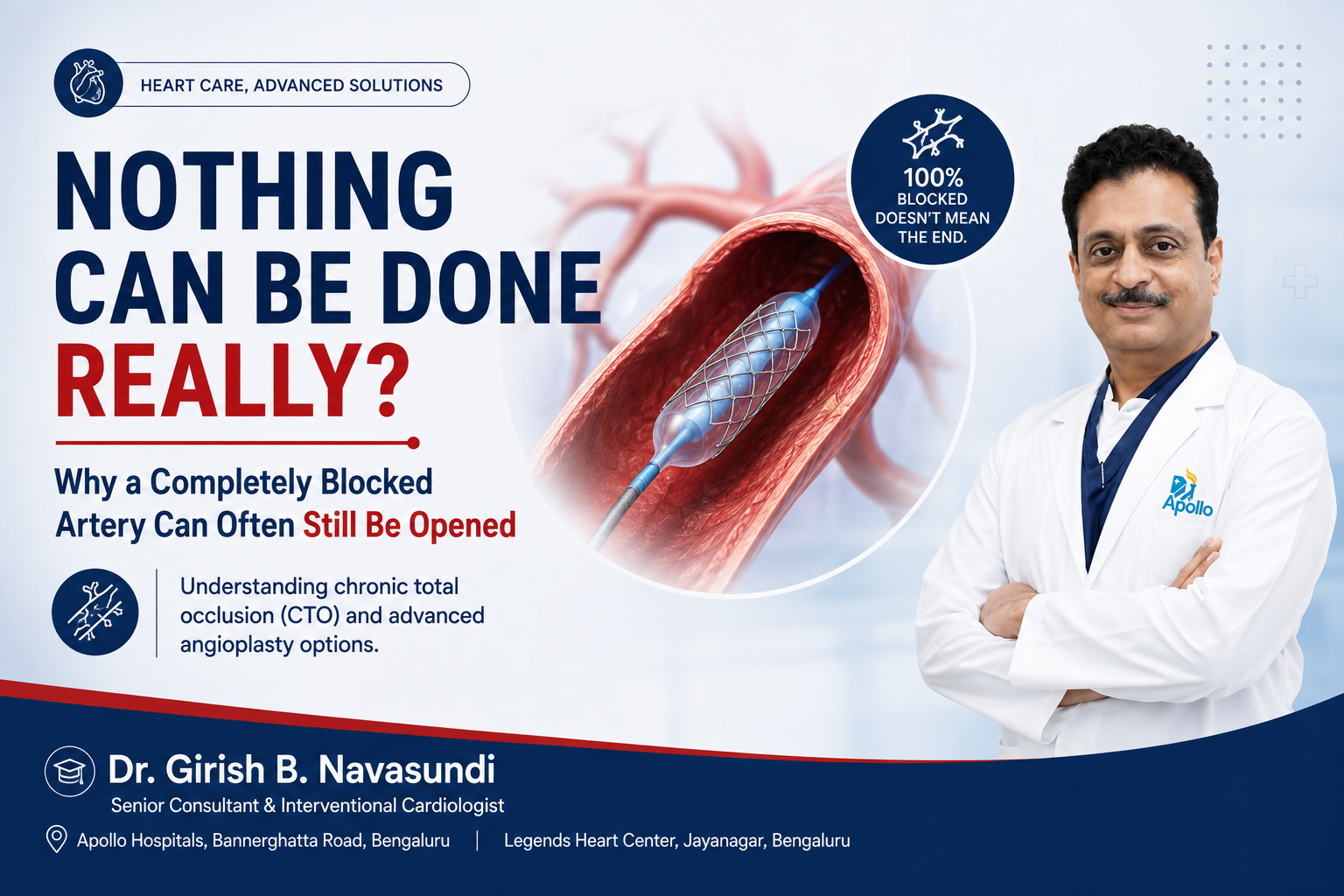
“Nothing Can Be Done” — Why a Completely Blocked Artery Can Often Still Be Opened
Being told that one of your heart arteries is 100% blocked can be frightening. Some patients are told:
“The artery is completely closed.”
“A stent cannot be passed.”
“Nothing more can be done.”
But a completely blocked coronary artery does not automatically mean that treatment is impossible.
In some patients, the blockage is what cardiologists call a Chronic Total Occlusion, or CTO. These are among the most challenging coronary blockages to treat, but with specialised equipment, advanced imaging and experienced CTO techniques, selected patients may still be candidates for angioplasty.
The important question is not simply “Is the artery 100% blocked?”
It is:
“Can opening this artery safely improve this patient’s symptoms, heart function or quality of life?”
What Is a Chronic Total Occlusion?
A Chronic Total Occlusion is a coronary artery that has become completely blocked for an extended period of time, generally for at least several months.
Unlike a fresh clot during a heart attack, a CTO usually develops gradually.
Over time, the blockage can become:
- Hard and fibrotic
- Calcified
- Long or irregular
- Difficult for a conventional angioplasty wire to cross
Interestingly, the heart sometimes develops tiny alternative blood vessels called collaterals that supply some blood around the blocked artery.
These collateral vessels can help protect the heart, but they may not always provide enough blood when you walk, climb stairs or exercise.
That is why some patients with a completely blocked artery continue to experience symptoms.
What Symptoms Can a Completely Blocked Artery Cause?
Not every CTO causes obvious chest pain.
Patients may experience:
Chest pressure or heaviness
Especially during walking, climbing stairs or physical activity.
Shortness of breath
Some patients think they are simply getting older or becoming less fit.
Unusual fatigue
Activities that were previously easy may start feeling exhausting.
Reduced exercise capacity
You may find yourself walking slower, stopping more frequently or avoiding physical activity.
Chest discomfort despite medicines
Symptoms may continue even while taking appropriate heart medications.
In some people, a CTO may also contribute to reduced heart pumping function.
Why Are Some Patients Told the Artery Cannot Be Opened?
CTO angioplasty is very different from routine angioplasty.
In a standard narrowing, there is still a small channel through which a guidewire can often pass.
With a CTO, the artery may be completely sealed.
A cardiologist therefore has to carefully find a safe route through or around the blockage.
This can require:
- Specialised guidewires
- Microcatheters
- Advanced coronary imaging
- Multiple angiographic views
- Special crossing techniques
- Considerably more procedural planning
- Greater operator experience
Because CTO procedures can be technically demanding, not every cardiac centre routinely performs complex CTO interventions.
So when an earlier attempt fails, it does not necessarily mean that another carefully planned attempt is impossible.
How Can Doctors Open a 100% Blocked Artery?
There is no single technique for every CTO.
The approach depends on:
- Where the blockage starts
- How long the blockage is
- How much calcium is present
- The condition of the artery beyond the blockage
- Whether collateral vessels are available
- Whether the patient has undergone previous bypass surgery
- Previous angioplasty attempts
The cardiologist studies the angiogram and chooses the safest strategy.
1. Antegrade Wire Escalation
This is often the first approach.
The guidewire is advanced from the beginning of the blocked artery toward the other side.
Specialised wires with different properties may be used to carefully navigate the blockage.
Think of it as trying to find a safe microscopic pathway through a completely closed tunnel.
2. Antegrade Dissection and Re-entry
Sometimes the wire cannot travel directly through the centre of the blockage.
In selected cases, specialised techniques allow the cardiologist to travel around part of the blockage and then safely re-enter the true artery channel beyond it.
This requires expertise and dedicated CTO equipment.
3. Retrograde Approach
Some CTOs cannot be crossed from the front.
In carefully selected cases, the cardiologist may reach the blocked artery from the opposite direction using tiny collateral vessels that naturally connect coronary arteries.
The wire approaches the blockage from behind.
This technique has significantly expanded the number of complex CTOs that can potentially be treated.
Imaging Can Make Complex Angioplasty More Precise
Advanced coronary imaging may be particularly valuable during difficult procedures.
IVUS — Intravascular Ultrasound
A miniature ultrasound probe travels inside the coronary artery.
It can help the cardiologist understand:
- Vessel size
- Calcium
- Plaque burden
- The location of the true vessel channel
- Appropriate stent diameter
- Whether the final stent has expanded adequately
OCT — Optical Coherence Tomography
OCT provides extremely detailed images of the inside of the coronary artery.
In selected cases it can help assess:
- Stent expansion
- Stent positioning
- Calcium
- Vessel wall characteristics
- Final angioplasty results
These technologies allow complex angioplasty to be planned and optimized beyond what can be seen from angiography alone.
If the Artery Is Completely Blocked, Why Hasn’t the Heart Muscle Died?
This is one of the most common questions patients ask.
A CTO usually develops slowly.
As the artery gradually narrows, the heart may develop collateral circulation—small alternative blood vessels that provide some blood to the affected heart muscle.
As a result, the heart muscle beyond the blockage may still be alive.
Before attempting a difficult CTO procedure, doctors may therefore evaluate:
- Heart pumping function
- Evidence of ischemia
- Whether the affected heart muscle is viable
- Symptoms
- How much heart muscle is supplied by the blocked artery
Opening an artery is most meaningful when there is a reasonable likelihood that the patient will actually benefit.
What Improvement Can Patients Expect?
The goal of CTO angioplasty is not simply to make an angiogram look better.
For appropriately selected patients, successful treatment may help:
Reduce angina
Chest pressure or heaviness during activity may decrease.
Improve breathing during exertion
Patients may be able to walk or climb stairs with less discomfort.
Improve exercise capacity
Activities that previously required frequent stops may become easier.
Improve quality of life
For some people, being able to return to normal daily activities is the most meaningful benefit.
However, results vary from patient to patient.
A successful procedure does not guarantee that every symptom will disappear.
Does Every 100% Blockage Need Angioplasty?
No.
This is extremely important.
Finding a completely blocked artery does not automatically mean that it should be opened.
Some patients may do very well with medication alone.
Others may benefit more from bypass surgery.
The decision depends on factors such as:
- Severity of symptoms
- Number of blocked arteries
- Location of the CTO
- Heart pumping function
- Diabetes
- Kidney function
- Previous bypass surgery
- Previous angioplasty
- Amount of viable heart muscle
- Surgical risk
- Overall health
The objective should always be to choose the treatment that offers the patient the best balance of benefit and safety.
When Should You Consider a CTO Specialist Opinion?
A second evaluation may be reasonable if you have been told:
“The artery is 100% blocked, so angioplasty isn’t possible.”
Some CTOs may still be technically treatable.
“We tried angioplasty before but couldn’t cross the blockage.”
A second procedure may use a completely different strategy.
“You’ll simply have to live with the symptoms.”
Persistent chest discomfort, breathlessness or significant activity limitation deserves reassessment.
“Bypass surgery is your only option.”
Bypass may absolutely be the best treatment for some patients, particularly those with extensive multivessel disease. But in selected high-risk or complex patients, advanced PCI options may also deserve evaluation.
Had a Previous CTO Angioplasty Attempt That Failed?
A previous unsuccessful attempt does not automatically rule out another procedure.
Before a re-attempt, the cardiologist can review the previous angiogram to understand:
- Where the wire stopped
- Whether the blockage is heavily calcified
- The length of the occlusion
- Whether another entry point is possible
- Whether a retrograde route exists
- Whether intravascular imaging would help
- Which specialised CTO equipment may be required
The second procedure should ideally be approached as a newly planned strategy, rather than simply repeating the first attempt.
Questions to Ask Before CTO Angioplasty
If you are considering treatment, ask your cardiologist:
1. Is my blockage definitely a chronic total occlusion?
2. Is the heart muscle supplied by this artery still viable?
3. Are my symptoms likely to improve if the artery is opened?
4. Would medication, angioplasty or bypass surgery be better for me?
5. How complex is my CTO?
6. Has my previous angiogram been reviewed specifically for CTO treatment options?
7. Will IVUS, OCT or other advanced guidance be useful?
8. What are the potential risks and chances of technical success in my individual case?
These questions help shift the conversation from simply “Can the artery be opened?” to the more important question:
“Should it be opened, and will doing so meaningfully help me?”
Been Told “Nothing Can Be Done”?
Before accepting that conclusion, complex coronary disease can sometimes benefit from a specialist review.
Dr. Girish B. Navasundi evaluates patients with complex coronary artery disease, chronic total occlusions, multivessel disease, previous failed angioplasty attempts and high-risk PCI requirements.
If you have an angiogram showing a 100% blocked artery, bring your previous:
- Coronary angiogram/CD
- Angioplasty reports
- Bypass surgery records, if any
- Echocardiogram
- Recent blood investigations
- Current medication list
A detailed review can help determine whether further intervention is technically possible—and, more importantly, whether it is likely to benefit you.
Consult Dr. Girish B. Navasundi
Senior Consultant & Interventional Cardiologist
Apollo Hospitals, Bannerghatta Road, Bengaluru
Legends Heart Center, Jayanagar, Bengaluru
Have you been told your artery is “too blocked to treat”?
Request a specialist evaluation of your angiogram before assuming there are no further options.
Treatment decisions must be individualized after reviewing your angiogram, symptoms, heart function and overall medical condition.