 Apollo Hospitals, Opp.iim 154/11,bannerghatta Road. Bannerghatta Road.bangalore-560076
 6366 229563
 By Dr. Girish B Navasundi
Posted on August 25, 2026
By Dr. Girish B Navasundi
Posted on August 25, 2026
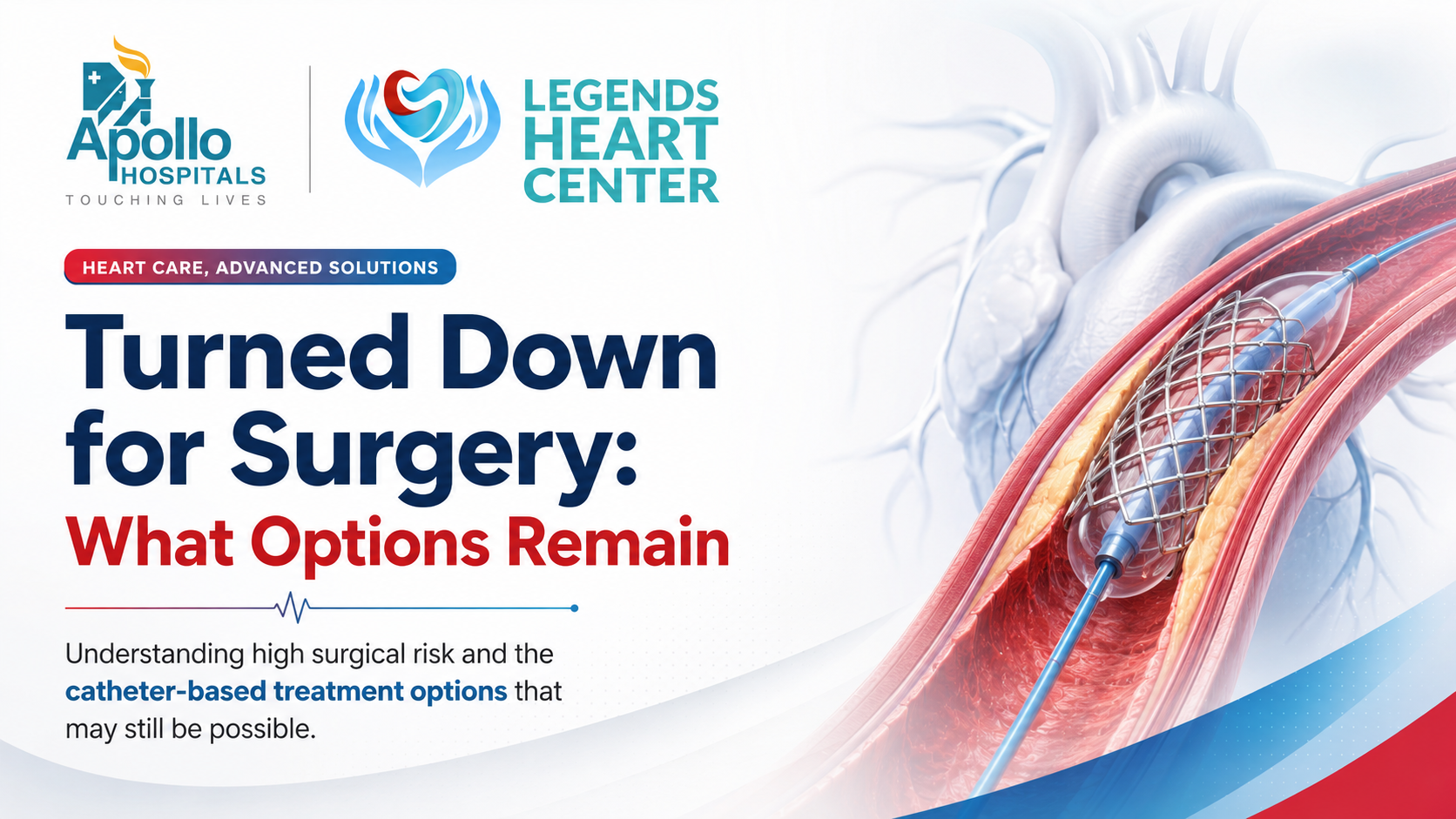
Turned Down for Surgery: What Options Remain?
Being told that you are “too high-risk for surgery” can feel like the end of the road.
For many patients, the conversation starts with a serious heart problem—multiple blocked arteries, severe valve disease, a completely blocked artery, poor heart pumping function, advanced age, kidney disease, lung disease, or several medical conditions at the same time.
Then comes the difficult sentence:
“Open-heart surgery would be too risky.”
But being declined for surgery does not always mean that nothing more can be done.
Modern interventional cardiology has created catheter-based treatment options for selected patients who may not be suitable candidates for conventional surgery. The right approach depends on the exact heart problem, the patient’s overall condition, expected benefit, and procedural risk.
The more useful question is often not:
“Can I undergo surgery?”
but rather:
“What is the safest and most effective treatment available for my situation?”
What Does “Too High-Risk for Surgery” Actually Mean?
When a cardiac surgical team considers an operation, they are not looking only at the blockage or valve problem.
They are evaluating whether the patient is likely to safely tolerate:
- General anaesthesia
- Opening the chest
- Cardiopulmonary bypass when required
- The physical stress of major surgery
- A longer hospital stay
- Recovery and rehabilitation
Two patients with the same heart condition may therefore receive very different recommendations.
A relatively healthy 60-year-old with multiple blocked arteries may be an excellent candidate for bypass surgery.
An 82-year-old with the same coronary anatomy but severe lung disease, kidney dysfunction and poor heart pumping function may face a very different level of risk.
So when a doctor says surgery is “high-risk,” it usually means that the overall risk of the operation may be greater than the expected benefit.
Why Might Someone Be Turned Down for Surgery?
Several factors can increase surgical risk.
These may include advanced age, severe heart weakness, significant kidney disease, chronic lung disease, previous stroke, frailty, diabetes with complications, previous heart surgery, extensive calcification of the aorta, cancer, severe vascular disease or multiple medical conditions occurring together.
The decision is rarely based on one factor alone.
Doctors usually look at the complete clinical picture.
How Is Surgical Risk Assessed?
There is no single test that decides whether a patient can or cannot undergo surgery.
The heart team may consider:
Heart function: How strongly is the heart pumping?
Coronary anatomy: How many vessels are blocked, where are the blockages, and how complex are they?
Valve disease: How severe is the narrowing or leakage?
Kidney function: Can the kidneys tolerate surgery, medications and changes in blood circulation?
Lung function: Is there significant COPD, pulmonary fibrosis or another serious lung condition?
Previous procedures: Has the patient already had bypass surgery, valve surgery or multiple angioplasties?
Frailty: Can the patient walk independently, perform daily activities and recover from major surgery?
Other illnesses: Diabetes, stroke history, cancer, liver disease and vascular disease can all influence treatment planning.
Risk-scoring systems may also be used, but they are only part of the decision.
A careful Heart Team assessment remains extremely important.
If Surgery Is Too Risky, Does That Mean Treatment Stops?
Not necessarily.
For some patients, the safest treatment may indeed be medications and close follow-up.
But other patients may be candidates for catheter-based treatment, which can often be performed without opening the chest.
The appropriate option depends entirely on the underlying heart condition.
High-Risk Angioplasty for Complex Coronary Disease
One of the most important alternatives for selected patients with blocked heart arteries is high-risk or complex PCI—Percutaneous Coronary Intervention.
During PCI, a catheter is usually introduced through an artery in the wrist or groin.
The cardiologist reaches the coronary arteries using thin tubes and guidewires, treats the blockage and, when appropriate, places a stent.
The procedure does not require opening the chest.
For relatively straightforward disease, angioplasty is routine.
However, patients who have been declined for bypass surgery often have far more complex coronary anatomy.
Their treatment may involve:
- Multiple blocked arteries
- Left main coronary artery disease
- Severe calcification
- Long blockages
- Completely blocked arteries
- Previous bypass grafts
- Very poor heart pumping function
- Previous failed angioplasty
- Difficult vessel anatomy
These situations require significantly more planning than routine angioplasty.
Multiple Blocked Arteries: Can Angioplasty Replace Bypass Surgery?
Bypass surgery remains an excellent treatment for many patients with extensive coronary artery disease.
Being high-risk for surgery does not automatically mean that angioplasty is better.
However, when surgery is considered prohibitively risky, cardiologists may reassess whether the most important coronary arteries can be treated using PCI.
Instead of focusing only on the number of blockages, the interventional cardiologist may ask:
Which blockages are actually reducing blood flow?
Which artery supplies the largest amount of heart muscle?
Can the highest-risk lesion be treated safely?
Should treatment be completed in one procedure or in stages?
The goal is to create a treatment strategy tailored to the individual patient rather than simply trying to place a stent in every narrowing.
What If the Arteries Are Severely Calcified?
Calcium can make coronary angioplasty particularly difficult.
A heavily calcified artery may not expand properly when a balloon is inflated.
If a stent is placed without adequate preparation, it may not fully expand.
Modern interventional cardiology offers specialised techniques to modify calcium before stenting.
Depending on the anatomy, these may include intravascular lithotripsy, specialised balloons or atherectomy techniques.
The appropriate technology is chosen only after careful evaluation of the lesion.
What If One Artery Is 100% Blocked?
A completely blocked artery may be a Chronic Total Occlusion or CTO.
CTO angioplasty is considerably more complex than routine PCI because a guidewire must cross an artery that may have been completely closed for months or years.
Specialised CTO techniques can sometimes allow these arteries to be treated even when a previous procedure was unsuccessful.
For selected symptomatic patients, successful CTO treatment may improve blood flow and reduce angina or activity limitation.
But not every CTO should be opened.
The expected clinical benefit must justify the complexity and risk of the procedure.
Advanced Imaging Can Help Guide Complex Procedures
In difficult cases, the angiogram alone may not provide all the information required.
Advanced intravascular imaging can help cardiologists understand the artery from the inside.
IVUS — Intravascular Ultrasound
IVUS can help assess vessel size, plaque burden, calcium, lesion length and final stent expansion.
OCT — Optical Coherence Tomography
OCT provides very detailed images of the artery and may help evaluate calcium, plaque morphology and how well a stent has expanded and attached to the vessel wall.
These technologies may allow treatment to be planned and optimized with greater precision.
FFR and Physiology: Does Every Narrowing Need Treatment?
A narrowing may look significant on an angiogram but may not always reduce blood flow enough to require intervention.
Physiology-based measurements such as FFR or related pressure-wire assessments can help determine whether a particular lesion is actually limiting blood flow.
This can be particularly valuable in patients with multiple narrowed arteries.
Rather than treating everything visible on the angiogram, the cardiologist can focus on the lesions most likely to benefit from intervention.
What If the Heart Is Very Weak?
Patients with severely reduced heart pumping function can present one of the greatest challenges.
These patients may need treatment because critical blockages are contributing to poor blood supply.
At the same time, their weakened heart may have limited ability to tolerate a complicated procedure.
For carefully selected patients, the procedure may therefore be planned as high-risk PCI with additional haemodynamic monitoring.
In certain cases, temporary mechanical circulatory support may also be considered.
Mechanical Circulatory Support During High-Risk PCI
Mechanical support devices are not required for every complex angioplasty.
However, in selected extremely high-risk patients, they may provide temporary assistance to the circulation while critical coronary blockages are treated.
Depending on the situation, cardiologists may consider devices such as:
IABP — Intra-Aortic Balloon Pump
A balloon temporarily assists circulation and can reduce the workload on the heart in specific clinical situations.
Impella
A catheter-based pump can temporarily support blood flow in selected high-risk cases.
ECMO
In very unstable patients, extracorporeal membrane oxygenation can temporarily support both the heart and circulation.
The decision to use any mechanical support device requires careful assessment because these devices also carry risks.
What About Severe Aortic Stenosis?
Some patients are turned down for surgical aortic valve replacement because open-heart surgery is considered too risky.
For selected patients, **TAVR or TAVI—Transcatheter Aortic Valve Replacement/Implantation—**may provide an alternative.
During TAVR, a replacement valve is delivered to the heart through a catheter, usually through an artery in the groin.
The chest generally does not need to be opened.
TAVR has transformed the treatment of severe aortic stenosis, particularly for older adults and patients in whom conventional surgery may carry increased risk.
Suitability depends on valve anatomy, vascular access, overall health and several other factors.
What About Severe Valve Leakage?
Some patients have severe mitral or tricuspid valve leakage but are considered too high-risk for conventional valve surgery.
Selected patients may be evaluated for transcatheter valve repair or replacement technologies.
These procedures are not appropriate for every type of valve disease, but they have expanded treatment possibilities for patients who previously had very limited options.
A Previous Bypass Surgery Can Make Decisions More Complex
Patients who have already undergone CABG may later develop:
- Blockages in their bypass grafts
- New blockages in their native coronary arteries
- Completely blocked native vessels
- Degenerated vein grafts
Repeat bypass surgery may sometimes carry greater risk than the first operation.
In suitable cases, complex PCI may therefore be considered as an alternative.
The cardiologist must decide whether to treat the native coronary artery, the bypass graft or another vessel entirely.
Being “High-Risk” Does Not Mean Every Procedure Should Be Attempted
Advanced technology can expand treatment possibilities, but it does not remove risk.
There are situations where intervention may not provide meaningful benefit.
For example, a procedure may not be advisable if the heart muscle supplied by an artery is already extensively damaged, the coronary anatomy cannot be treated safely or another serious illness is likely to determine the patient’s overall prognosis.
The purpose of a second opinion should therefore not be to find someone willing to perform a procedure at any cost.
The purpose is to determine whether there is a reasonable, evidence-based alternative that offers more benefit than risk.
When Should You Consider a Complex Cardiology Opinion?
If you have been declined for cardiac surgery, a specialist interventional cardiology review may be valuable particularly when you have been told that you have complex multivessel disease, left main disease, severe calcification, a chronic total occlusion, poor heart function, previous failed angioplasty, previous bypass surgery or severe valve disease.
For the consultation, bring your coronary angiogram images or CD, angiography report, echocardiogram, previous angioplasty or bypass records, current medication list, kidney-function reports and any recent heart investigations.
Seeing the actual angiogram images can be especially important.
Two written reports containing the words “severe disease” may represent very different technical situations.
Questions to Ask After Being Turned Down for Surgery
Patients and families can ask:
Why exactly is surgery considered too high-risk for me?
Is the risk related to my heart, lungs, kidneys, age or the complexity of the operation?
Would medical therapy alone be reasonable?
Can any of my coronary blockages be treated with angioplasty?
Would IVUS, OCT or physiology guidance help?
Would a staged procedure be safer than treating everything at once?
Do I require mechanical circulatory support during PCI?
If I have valve disease, is a catheter-based valve procedure possible?
What improvement should I realistically expect from treatment?
The answers should help you understand not only what can technically be done, but whether doing it is likely to improve your symptoms, function or quality of life.
A Second Opinion Can Sometimes Change the Conversation
Being declined for surgery can be discouraging.
But cardiovascular treatment has changed dramatically.
Today, selected patients who once had only surgical options may be considered for complex PCI, CTO angioplasty, calcium-modification techniques, image-guided intervention, mechanical-support-assisted PCI or transcatheter valve procedures.
That does not mean every patient can or should undergo an intervention.
It means that the phrase “too high-risk for surgery” should trigger a broader discussion about all appropriate treatment options—not automatically end the discussion.
Have You Been Told Surgery Is Too Risky?
Dr. Girish B. Navasundi evaluates patients with complex coronary artery disease, high-risk multivessel disease, CTOs, severe coronary calcification, poor heart function, previous bypass surgery and other challenging coronary conditions.
Dr. Girish B. Navasundi
Senior Consultant & Interventional Cardiologist
Apollo Hospitals, Bannerghatta Road, Bengaluru
Legends Heart Center, Jayanagar, Bengaluru
If you or a family member has been turned down for cardiac surgery, consider bringing the complete angiogram and previous medical records for a specialist review.
The goal is not simply to find another procedure.
It is to determine whether there is a safer path forward—and whether that path can meaningfully improve the patient’s life.
This article is for patient education and does not replace an individual evaluation by a cardiologist or multidisciplinary Heart Team.