 Apollo Hospitals, Opp.iim 154/11,bannerghatta Road. Bannerghatta Road.bangalore-560076
 6366 229563
 Posted on May 4, 2026
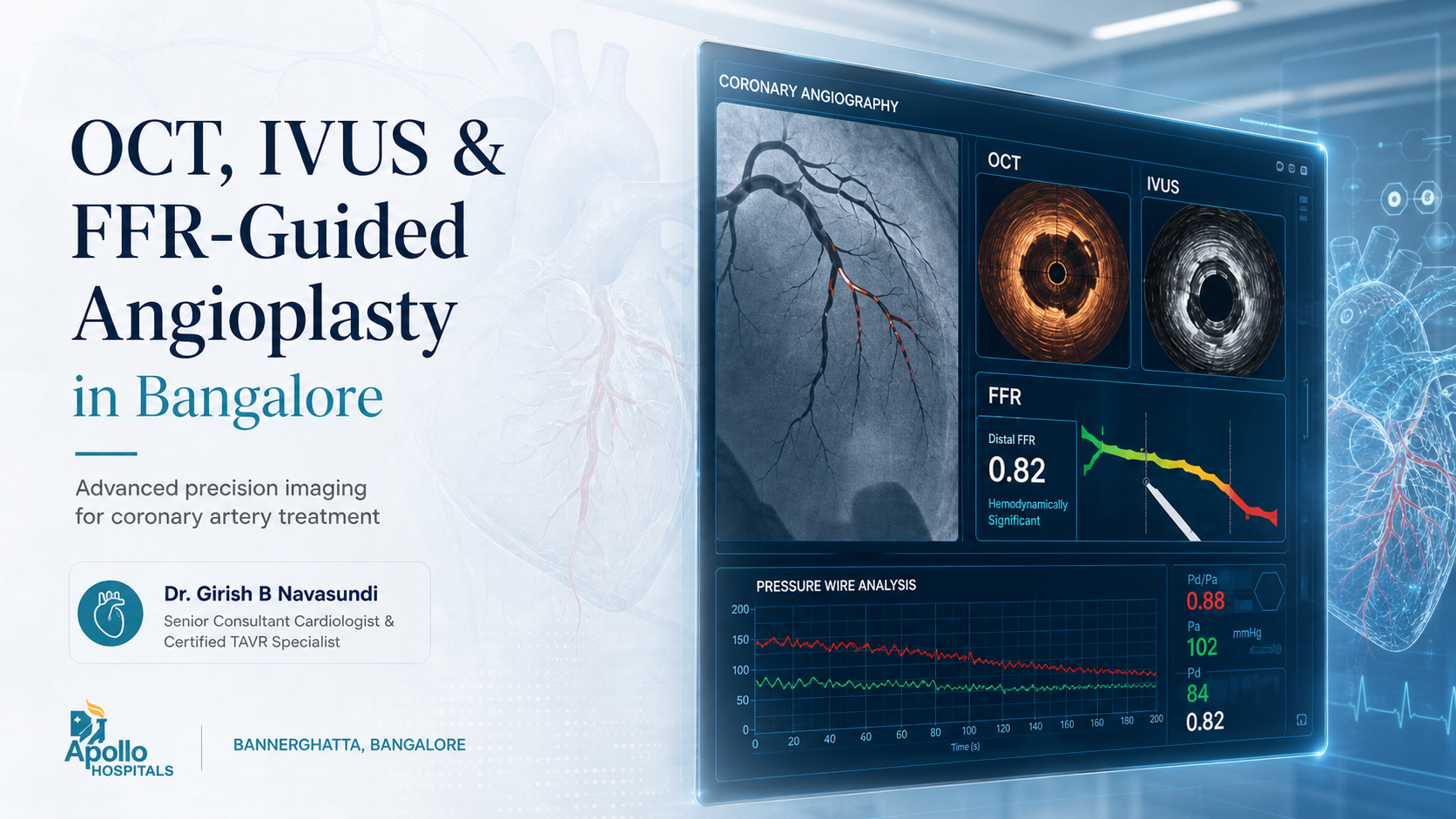
OCT-, IVUS-, and FFR-Guided Angioplasty in Bangalore: A More Precise Way to Treat Coronary Blockages
By Dr. Girish B Navasundi
Senior Consultant Cardiologist & Certified TAVR Specialist
Lead Consultant – Structural Heart Disease & Heart Failure
Apollo Hospitals Bannerghatta, Bangalore
Coronary artery disease is one of the most common causes of chest pain, breathlessness, heart attacks, and reduced heart function. In many patients, the problem begins when fatty deposits, calcium, or plaque build up inside the coronary arteries and reduce blood flow to the heart muscle.
Traditionally, coronary angiography has been the main test used to identify these blockages. An angiogram gives doctors an outline of the coronary arteries and helps detect narrowing or obstruction. However, in some cases, an angiogram alone may not show the complete picture.
A blockage may look moderate but still reduce blood flow significantly. Another blockage may look severe but may not require immediate stenting. Some arteries may have hidden calcium, under-expanded old stents, plaque rupture, or complex disease that needs deeper assessment.
This is where advanced technologies like OCT, IVUS, and FFR help.
These tools allow cardiologists to look beyond the surface image of an angiogram. They help understand the artery from inside, measure the true effect of a blockage, and guide angioplasty with greater precision.
For patients searching for OCT-guided angioplasty in Bangalore, IVUS-guided angioplasty in Bangalore, or FFR-guided angioplasty in Bangalore, these advanced methods can play an important role in planning safer and more personalized coronary treatment.
Why Modern Angioplasty Needs More Precision
Angioplasty is no longer just about opening a blocked artery. Today, the goal is to treat the right blockage, place the right-sized stent, optimize the result, and reduce the risk of future complications.
Every coronary blockage is different.
Some blockages are soft.
Some are heavily calcified.
Some are long and diffuse.
Some involve artery branches.
Some are inside previously placed stents.
Some are present in critical areas like the left main coronary artery.
Because of this complexity, visual estimation alone may not always be enough. Advanced imaging and physiology-based assessment can help answer key questions before and during angioplasty:
Is this blockage truly reducing blood flow?
Does this patient really need a stent?
What is the exact size of the artery?
Where should the stent start and end?
Is there calcium that needs special preparation?
Has the stent expanded properly?
Is the stent well-positioned against the artery wall?
Is there any risk at the stent edges?
When these questions are answered accurately, angioplasty becomes more planned, more precise, and more patient-specific.
This is the foundation of precision PCI or precision angioplasty.
What Is OCT-Guided Angioplasty?
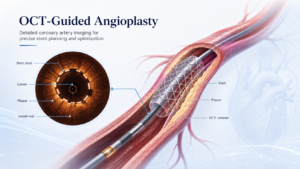
OCT, or Optical Coherence Tomography, is an advanced intravascular imaging technique that uses light-based imaging to create highly detailed pictures from inside the coronary artery.
During OCT-guided angioplasty, a very thin imaging catheter is passed into the coronary artery. It captures high-resolution cross-sectional images of the artery wall, plaque, calcium, clot, and stent.
OCT is especially useful when the cardiologist needs very fine detail inside the artery. It can help identify:
Plaque rupture
Thin calcium deposits
Stent under-expansion
Stent malapposition
Small edge dissections
Clot formation
Tissue protrusion inside the stent
Precise stent coverage
In simple terms, OCT acts like a high-resolution internal camera for the artery. It gives the cardiologist a clear view of what is happening inside the vessel before and after stent placement.
For patients with complex coronary disease, OCT-guided angioplasty in Bangalore may help improve treatment planning and stent optimization, especially when detailed assessment is needed.
What Is IVUS-Guided Angioplasty?
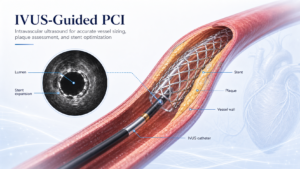
IVUS, or Intravascular Ultrasound, is another advanced imaging technique used during angioplasty. Unlike OCT, which uses light, IVUS uses ultrasound waves to examine the artery from inside.
During IVUS-guided angioplasty, a small ultrasound catheter is passed through the coronary artery. It gives a 360-degree cross-sectional view of the vessel wall, plaque burden, calcium, and artery size.
IVUS is particularly useful in complex coronary procedures because it helps the cardiologist understand the deeper structure of the artery. It is commonly used in:
Left main coronary artery disease
Large coronary vessels
Long blockages
Bifurcation lesions
Heavily calcified arteries
Previously stented arteries
Restenosis after earlier angioplasty
Chronic total occlusion cases
Complex multivessel disease
One of the major advantages of IVUS is accurate vessel sizing. Choosing the right stent size is critical in angioplasty. A stent that is too small may not open the artery properly. A stent that is too large may increase the risk of injury. IVUS helps reduce guesswork by providing accurate vessel measurements.
For patients looking for IVUS-guided angioplasty in Bangalore, this technology can be valuable when the coronary anatomy is complex or when the cardiologist wants to ensure optimal stent placement.
What Is FFR-Guided Angioplasty?
FFR, or Fractional Flow Reserve, is different from OCT and IVUS.
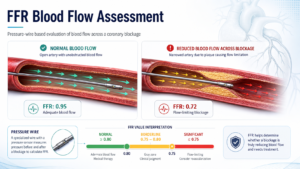
OCT and IVUS show the structure of the artery. FFR measures the functional importance of a blockage. In other words, FFR helps determine whether a narrowing is actually reducing blood flow to the heart muscle.
During FFR assessment, a special pressure wire is passed across the coronary blockage. It measures pressure before and after the narrowing. This helps the cardiologist understand whether the blockage is significant enough to require angioplasty or stenting.
This is very important because not every blockage seen on an angiogram needs a stent.
Some moderate blockages may be safely managed with medicines, lifestyle changes, and regular follow-up. Some blockages that look uncertain on angiography may actually be causing significant blood-flow restriction and may need intervention.
FFR-guided decision-making helps avoid unnecessary stenting and supports more accurate treatment planning.
For patients searching for FFR-guided angioplasty in Bangalore, this approach can be especially helpful when angiogram findings are unclear or when multiple blockages are present.
OCT vs IVUS vs FFR: How Are They Different?
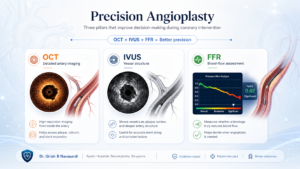
Although OCT, IVUS, and FFR are often discussed together, they are not the same. Each technology answers a different question.
OCT answers: What does the inside surface of the artery look like in very fine detail?
IVUS answers: What is the vessel size, plaque burden, and deeper artery structure?
FFR answers: Is this blockage actually reducing blood flow enough to need treatment?
A simple way to understand it:
OCT gives a high-resolution close-up view.
IVUS gives a deeper ultrasound map of the artery.
FFR gives a pressure-based blood-flow measurement.
In many cases, these technologies complement each other. For example, FFR may help decide whether angioplasty is needed. If angioplasty is required, IVUS or OCT may help plan and optimize stent placement.
This combination makes modern angioplasty more scientific and less dependent on visual estimation alone.
When May OCT-, IVUS-, or FFR-Guided Angioplasty Be Recommended?
Your cardiologist may consider these technologies in several clinical situations, especially when the coronary artery disease is complex or when the angiogram does not provide enough clarity.
They may be useful in:
Intermediate coronary blockages
Left main coronary artery disease
Long coronary artery narrowing
Bifurcation lesions
Heavily calcified arteries
Multivessel coronary artery disease
Previously placed stents
Recurrent narrowing inside a stent
Unclear angiogram findings
High-risk coronary anatomy
Diabetic patients with diffuse disease
Patients with reduced heart function
Complex angioplasty planning
The decision to use OCT, IVUS, or FFR depends on the patient’s symptoms, angiogram findings, heart function, kidney function, age, risk factors, and overall health condition.
Not every patient needs all three technologies. The cardiologist chooses the right tool based on the specific clinical need.
Benefits of OCT-, IVUS-, and FFR-Guided Angioplasty
The biggest advantage of these technologies is better decision-making.
They help the cardiologist plan treatment more accurately before placing a stent and confirm the result after the stent is placed.
Potential benefits include:
More accurate diagnosis of coronary blockages
Better understanding of plaque and calcium
Improved stent size selection
Better stent placement and expansion
Reduced chance of under-expanded stents
Identification of hidden complications
Avoidance of unnecessary stenting in selected cases
Better planning in complex arteries
More personalized treatment strategy
Greater confidence in procedural results
For patients, this means the treatment is based not only on what the blockage looks like but also on how it behaves and how it affects blood flow.
This is especially important in a city like Bangalore, where patients often seek advanced cardiac care for complex coronary artery disease, diabetes-related heart disease, and high-risk cardiac conditions.
Is OCT-, IVUS-, and FFR-Guided Angioplasty Safe?
OCT, IVUS, and FFR are used during coronary catheterization and angioplasty procedures. These tools are commonly used in advanced interventional cardiology when additional information is needed.
Like any cardiac procedure, angioplasty has potential risks. These may include bleeding, artery injury, contrast-related issues, rhythm disturbances, allergic reactions, or procedure-related complications. However, when performed by an experienced interventional cardiologist in an advanced cardiac care setting, these technologies can help improve planning and procedural precision.
The most important factor is proper patient selection.
Some patients may need only medical treatment.
Some may need angioplasty.
Some may need bypass surgery.
Some may need further evaluation before deciding.
A detailed consultation with an experienced cardiologist helps determine the best treatment approach.
Why Choose Dr. Girish B Navasundi for Advanced Angioplasty in Bangalore?
Dr. Girish B Navasundi is a Senior Consultant Cardiologist and Certified TAVR Specialist with more than 21 years of experience in cardiac care. He is also Lead Consultant – Structural Heart Disease and Heart Failure at Apollo Hospitals Bannerghatta, Bangalore.
His clinical expertise includes:
Complex coronary angioplasty
OCT-guided angioplasty
IVUS-guided angioplasty
FFR-guided coronary assessment
Structural heart disease treatment
TAVR/TAVI procedures
Heart failure management
High-risk cardiac interventions
Advanced cardiac evaluation
In complex heart disease, technology alone is not enough. What matters is how the technology is used, how the findings are interpreted, and how the treatment is personalized for each patient.
Dr. Girish B Navasundi’s approach focuses on precision, safety, clinical judgment, and long-term patient outcomes.
For patients seeking a coronary angioplasty specialist in Bangalore, especially for complex or high-risk coronary artery disease, advanced imaging- and physiology-guided angioplasty can provide a more detailed and individualized treatment pathway.
Patient-Centered Heart Care: Treating the Person, Not Just the Blockage
A coronary blockage is not just a number on a report. It affects a person’s daily life, confidence, activity levels, and long-term health.
Many patients ask:
Do I really need a stent?
Can medicines treat my blockage?
Is my blockage dangerous?
Why do I still have chest pain?
What is the safest option for me?
Can my old stent be checked?
How can I prevent another heart problem?
OCT, IVUS, and FFR help make these conversations clearer. They give the cardiologist more information and help patients understand why a certain treatment is recommended.
This makes the treatment more transparent, more personalized, and more aligned with the patient’s condition.
Conclusion
OCT-, IVUS-, and FFR-guided angioplasty represents a modern, precise, and patient-focused approach to coronary artery disease treatment.
Instead of relying only on angiogram appearance, these technologies help cardiologists understand the artery from inside, measure the true impact of a blockage, and optimize stent placement when angioplasty is required.
For patients looking for OCT-guided angioplasty in Bangalore, IVUS-guided angioplasty in Bangalore, FFR-guided angioplasty in Bangalore, advanced angioplasty in Bangalore, or heart blockage treatment in Bangalore, consulting an experienced interventional cardiologist is important.
At Apollo Hospitals Bannerghatta, Bangalore, Dr. Girish B Navasundi offers advanced cardiac evaluation and treatment with a focus on precision, safety, and individualized care.
Looking for Advanced Angioplasty in Bangalore?
Consult Dr. Girish B Navasundi, Senior Consultant Cardiologist & Certified TAVR Specialist, at Apollo Hospitals Bannerghatta, Bangalore, for expert evaluation and treatment of coronary artery disease.
Book an appointment today for advanced heart blockage assessment and personalized cardiac care.
FAQs
1. What is OCT-guided angioplasty?
OCT-guided angioplasty uses high-resolution imaging from inside the coronary artery to help the cardiologist study plaque, calcium, stent expansion, and stent positioning during angioplasty.
2. What is IVUS-guided angioplasty?
IVUS-guided angioplasty uses ultrasound imaging from inside the artery to assess vessel size, plaque burden, calcium, and stent placement. It is especially useful in complex coronary artery disease.
3. What is FFR-guided angioplasty?
FFR-guided angioplasty measures blood pressure and flow across a coronary blockage to determine whether the narrowing is actually reducing blood supply to the heart muscle.
4. Which is better: OCT, IVUS, or FFR?
Each tool has a different role. OCT gives detailed surface imaging, IVUS shows deeper vessel structure, and FFR measures blood-flow impact. The cardiologist chooses the right tool based on the patient’s condition.
5. Is advanced angioplasty required for every heart blockage?
No. Not every blockage needs angioplasty or stenting. Some blockages can be managed with medicines and lifestyle changes. Advanced tools like FFR can help decide whether a stent is truly needed.
6. Who should consider OCT-, IVUS-, or FFR-guided angioplasty?
Patients with complex coronary artery disease, unclear angiogram findings, left main disease, calcified arteries, recurrent stent narrowing, or multiple blockages may benefit from advanced assessment.
7. Where can I consult for OCT-, IVUS-, and FFR-guided angioplasty in Bangalore?
You can consult Dr. Girish B Navasundi at Apollo Hospitals Bannerghatta, Bangalore, for evaluation of coronary artery disease and advanced angioplasty planning.