 Apollo Hospitals, Opp.iim 154/11,bannerghatta Road.
 Posted on July 21, 2026
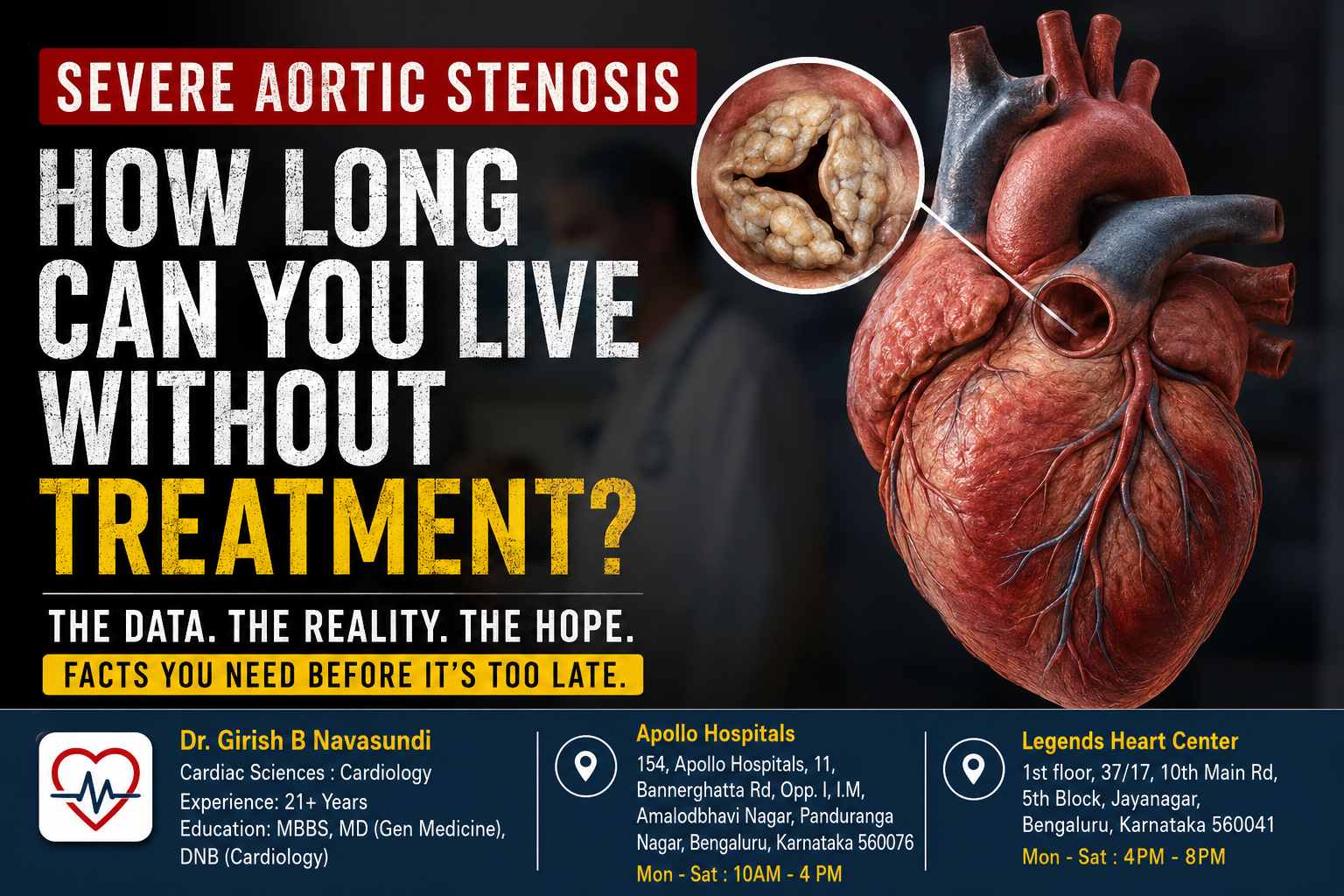
Severe Aortic Stenosis Life Expectancy Without Surgery: What the Data Shows
Severe aortic stenosis can remain silent for some time, but the outlook changes significantly once symptoms begin. In people with symptomatic severe aortic stenosis who do not receive valve replacement, studies show a very high risk of death, with more than half potentially dying within approximately two years. This is an average across groups—not a personal deadline. Age, heart function, other health conditions and the type of symptoms all influence an individual’s outlook. Most importantly, severe aortic stenosis is treatable, and timely valve replacement can improve both survival and quality of life.
What Does “Severe” Aortic Stenosis Actually Mean?
The aortic valve is the main outlet valve of the heart. It opens with every heartbeat to allow oxygen-rich blood to travel from the heart to the rest of the body.
In aortic stenosis, the valve becomes narrowed and cannot open fully. This forces the heart to generate greater pressure to push blood through the smaller opening.
An echocardiogram usually assesses the severity of aortic stenosis using three measurements:
- Aortic valve area: The size of the valve opening. The smaller the opening, the tighter the valve.
- Mean gradient: The average pressure difference across the valve while the heart pumps. A higher gradient means the heart is working harder.
- Peak velocity: The maximum speed of blood crossing the valve. Faster flow through a narrow opening generally indicates more severe obstruction.
| Aortic stenosis severity | Peak velocity | Mean gradient | Aortic valve area |
|---|---|---|---|
| Mild | 2.0–2.9 m/s | Below 20 mmHg | Above 1.5 cm² |
| Moderate | 3.0–3.9 m/s | 20–39 mmHg | 1.0–1.5 cm² |
| Severe | 4.0 m/s or higher | 40 mmHg or higher | 1.0 cm² or smaller |
These figures are a simplified guide. In some patients—particularly those with reduced blood flow from the heart—the valve area, velocity and gradient may not agree. A cardiologist may need additional imaging, stress echocardiography or CT calcium scoring to determine whether the stenosis is truly severe.
The Most Important Dividing Line: Have Symptoms Started?
The phrase “severe aortic stenosis life expectancy without surgery” can be misleading because not every person with severe disease has the same outlook.
The most important dividing line is whether symptoms have started.
A person with severe aortic stenosis who is genuinely asymptomatic, has preserved heart function and has no high-risk findings may be monitored closely for a period of time.
However, this is not passive waiting. It requires:
- Planned cardiology follow-ups
- Repeat echocardiograms
- Careful symptom monitoring
- Exercise testing when appropriate
- Clear instructions about when to seek medical attention
Once symptoms appear and are caused by the narrowed valve, the condition enters a more dangerous phase. Current guidelines recommend valve intervention for most patients with symptomatic severe aortic stenosis when treatment is expected to improve survival and quality of life.
Symptoms can also remain hidden. Some people gradually walk more slowly, avoid stairs or stop activities that make them breathless. Because their lifestyle has adjusted to the disease, they may describe themselves as “fine” even though their actual exercise capacity has declined.
Untreated Aortic Stenosis Survival Rate After Symptoms Begin
The natural history of symptomatic severe aortic stenosis has been recognised for decades.
The classic symptom-based pattern described the following average survival periods after major symptoms appeared:
| Main symptom | Historical average survival without valve replacement |
| Chest pain or pressure during activity | Around 5 years |
| Fainting or near-fainting, particularly with exertion | Around 3 years |
| Breathlessness, swelling or other heart-failure symptoms | Around 2 years |
These numbers come from historical population observations and should never be interpreted as a countdown for one person. Modern patients may be older, diagnostic methods have improved, and other medical conditions can significantly affect risk.
Recent untreated patient groups have continued to show substantial early mortality, supporting the same central message: the appearance of symptoms is a major turning point in severe aortic stenosis.
The hopeful part is equally important. These survival figures describe the natural course of the condition without valve replacement. They do not describe the expected outlook after successful TAVR or surgical aortic valve replacement.
What Happens if Aortic Stenosis Is Not Treated?
A narrowed aortic valve creates pressure overload inside the heart.
To keep blood moving through the body, the left ventricle—the heart’s main pumping chamber—must generate much higher pressure.
At first, the heart adapts by thickening its muscle. This may maintain the pumping function for a period of time, which is why someone can have severe aortic stenosis without immediately recognising symptoms.
Over time, however, the thickened heart muscle can become stiff. The heart may struggle to relax and fill properly. Pressure can rise inside the heart and lungs, causing breathlessness and reduced exercise capacity.
The heart muscle may eventually develop fibrosis, or scarring. Pumping function can begin to fall, increasing the risk of:
- Heart failure
- Abnormal heart rhythms
- Recurrent hospitalisation
- Fainting
- Sudden deterioration
- Premature death
This is why waiting has its own cost.
A valve procedure can remove the obstruction, but advanced heart-muscle damage may not always reverse completely after the valve has been replaced. The objective is therefore not simply to treat the valve eventually—it is to treat it at the right time, before avoidable damage becomes permanent.
This should not create panic. It should encourage timely assessment. A cardiologist can determine whether the heart is still compensating safely or whether the balance has shifted toward treatment.
Symptoms People Often Mistake for Normal Aging
Aortic stenosis commonly affects older adults, so its early warning signs are frequently blamed on age, reduced fitness, weight gain, arthritis or simply “slowing down.”
Symptoms that should not be ignored include:
- Breathlessness while climbing stairs or walking uphill
- Difficulty carrying groceries or completing normal household activities
- Unusual fatigue or needing more rest than before
- Chest pressure, tightness or heaviness during activity
- Dizziness or light-headedness
- Fainting or feeling as though you may faint
- Swelling around the ankles or lower legs
- A noticeable reduction in walking speed
- Waking at night feeling short of breath
- Needing additional pillows to breathe comfortably while sleeping
The change may happen gradually.
A useful question is not only:
“Do I have symptoms?”
It is also:
“Can I still perform the same activities at the same pace as I could six or twelve months ago?”
Patients sometimes unconsciously reduce their activity to avoid symptoms. Supervised exercise testing may help reveal symptoms or an abnormal blood-pressure response in someone who initially believes they are asymptomatic.
New fainting, chest pain at rest, severe breathlessness or rapidly worsening symptoms require urgent medical evaluation.
Aortic Stenosis Life Expectancy by Stage
There is no single life-expectancy number that applies to every stage of aortic stenosis.
Mild Aortic Stenosis
Mild disease generally does not carry the same immediate risk as severe symptomatic disease.
Many patients remain stable for years, although progression differs significantly from person to person. Regular clinical review helps determine whether the valve is narrowing and how quickly that change is occurring.
Moderate Aortic Stenosis
Moderate disease is not simply “halfway severe.”
It can still place additional strain on the heart and requires structured follow-up, especially when a patient has symptoms, reduced heart function or another cardiac condition.
Moderate aortic stenosis does not create a fixed countdown, but it should not be ignored.
Severe Aortic Stenosis Without Symptoms
Some patients with severe aortic stenosis can be monitored safely when they are genuinely asymptomatic and the heart remains well compensated.
Current guidance recommends careful reassessment, often approximately every six months, because symptoms or high-risk features may appear between appointments.
Severe Aortic Stenosis With Symptoms
This is the stage associated with the poorest prognosis without treatment.
Breathlessness, chest pain, fainting, reduced exercise tolerance and signs of heart failure usually shift the discussion from monitoring to valve replacement.
What Changes the Outlook?
The treatment that changes the course of severe aortic stenosis is aortic valve replacement.
There are two main approaches.
TAVR or TAVI
Transcatheter aortic valve replacement—also called transcatheter aortic valve implantation—is a minimally invasive procedure.
A replacement valve is delivered through a catheter, most commonly through an artery in the groin. TAVR does not require traditional open-heart surgery and may offer a faster recovery for appropriately selected patients.
Surgical Aortic Valve Replacement
During surgical aortic valve replacement, the diseased valve is removed and replaced through heart surgery.
The decision between TAVR and surgery is not based on age alone. The Heart Team considers:
- The patient’s age
- Overall health and frailty
- Expected longevity
- Surgical risk
- Valve anatomy
- Blood-vessel anatomy
- Other heart conditions
- The need for additional cardiac surgery
- The patient’s preferences and treatment goals
Current guidelines recommend that these decisions be made through individual assessment and shared decision-making.
Medicines may still be important for controlling blood pressure, fluid retention, heart rhythm problems or other conditions.
However, no medication has been convincingly shown to open a severely narrowed calcified valve or reliably stop aortic stenosis from progressing. Tablets may manage related problems, but they do not replace treatment of the valve when intervention is indicated.
Learn more about TAVR for severe aortic stenosis.
When Is “Watch and Wait” Reasonable?
Close monitoring may be appropriate when:
- Severe aortic stenosis has been confirmed, but the patient is genuinely symptom-free
- Left-ventricular pumping function remains preserved
- Exercise testing does not reveal hidden symptoms
- There is no abnormal fall in blood pressure during exercise
- The valve has not reached the very severe range
- There is no rapid progression on repeat echocardiograms
- Cardiac biomarkers are not markedly elevated
- The patient can attend regular reviews and report new symptoms promptly
Monitoring should always be active rather than casual.
Current European guidance recommends follow-up approximately every six months for asymptomatic severe aortic stenosis when valve replacement is not yet planned.
When Is Waiting No Longer Considered Safe?
A prompt valve assessment is usually needed when severe aortic stenosis is accompanied by:
- Breathlessness
- Chest pain or pressure
- Fainting or near-fainting
- Reduced exercise tolerance
- Weakening of left-ventricular pumping function
- Symptoms during supervised exercise testing
- An abnormal fall in blood pressure during exercise
- Very severe obstruction
- Rapid progression on repeat echocardiograms
- Markedly elevated BNP or NT-proBNP levels
- Evidence of developing heart-muscle damage
Very severe aortic stenosis may include a peak velocity above 5 m/s or a mean gradient of at least 60 mmHg. Rapid progression, reduced heart function and abnormal exercise testing may also support earlier intervention, even when a person does not report obvious symptoms.
The decision remains individual.
A person should not delay evaluation because symptoms seem “mild.” At the same time, patients should not assume that treatment automatically means open-heart surgery. For many appropriately selected patients, TAVR provides a less invasive route to valve replacement.
The Bottom Line
Severe aortic stenosis life expectancy without surgery or TAVR depends most strongly on whether symptoms have begun and whether the heart has started to deteriorate.
Severe disease without symptoms may sometimes be monitored carefully. Once symptoms develop, untreated survival becomes significantly worse, and delaying treatment may allow irreversible heart damage to progress.
The reason to seek timely care is not that every patient is facing immediate danger. The reason is that severe aortic stenosis is treatable—and the best results usually come from addressing it before the heart becomes permanently weakened.
Ask a Cardiologist Whether Your Aortic Stenosis Needs Treatment Now
Consultation With Dr Girish B. Navasundi
Cardiology | 21+ years of experience
Qualifications: MBBS, MD in General Medicine, DNB in Cardiology
Apollo Hospitals
154, Apollo Hospitals, 11, Bannerghatta Road, Opp. IIM, Amalodbhavi Nagar, Panduranga Nagar, Bengaluru, Karnataka 560076
Consultation hours: Monday–Saturday, 10:00 AM–4:00 PM
Legends Heart Center
1st Floor, 37/17, 10th Main Road, 5th Block, Jayanagar, Bengaluru, Karnataka 560041
Consultation hours: Monday–Saturday, 4:00 PM–8:00 PM
Continue Reading
- Post 2: What happens after severe aortic stenosis is diagnosed?
- Post 3: Understanding your treatment options for aortic stenosis
- TAVR treatment for severe aortic stenosis
- Aortic stenosis glossary: Valve area, gradient, ejection fraction and more
This article is intended for general education and does not replace an individual medical consultation. Treatment decisions should be based on symptoms, echocardiographic findings, overall health and assessment by a qualified cardiologist or multidisciplinary Heart Team.