 Apollo Hospitals, Opp.iim 154/11,bannerghatta Road.
 Posted on August 4, 2026
MitraClip vs Mitral Valve Surgery: Which Is Right for You?
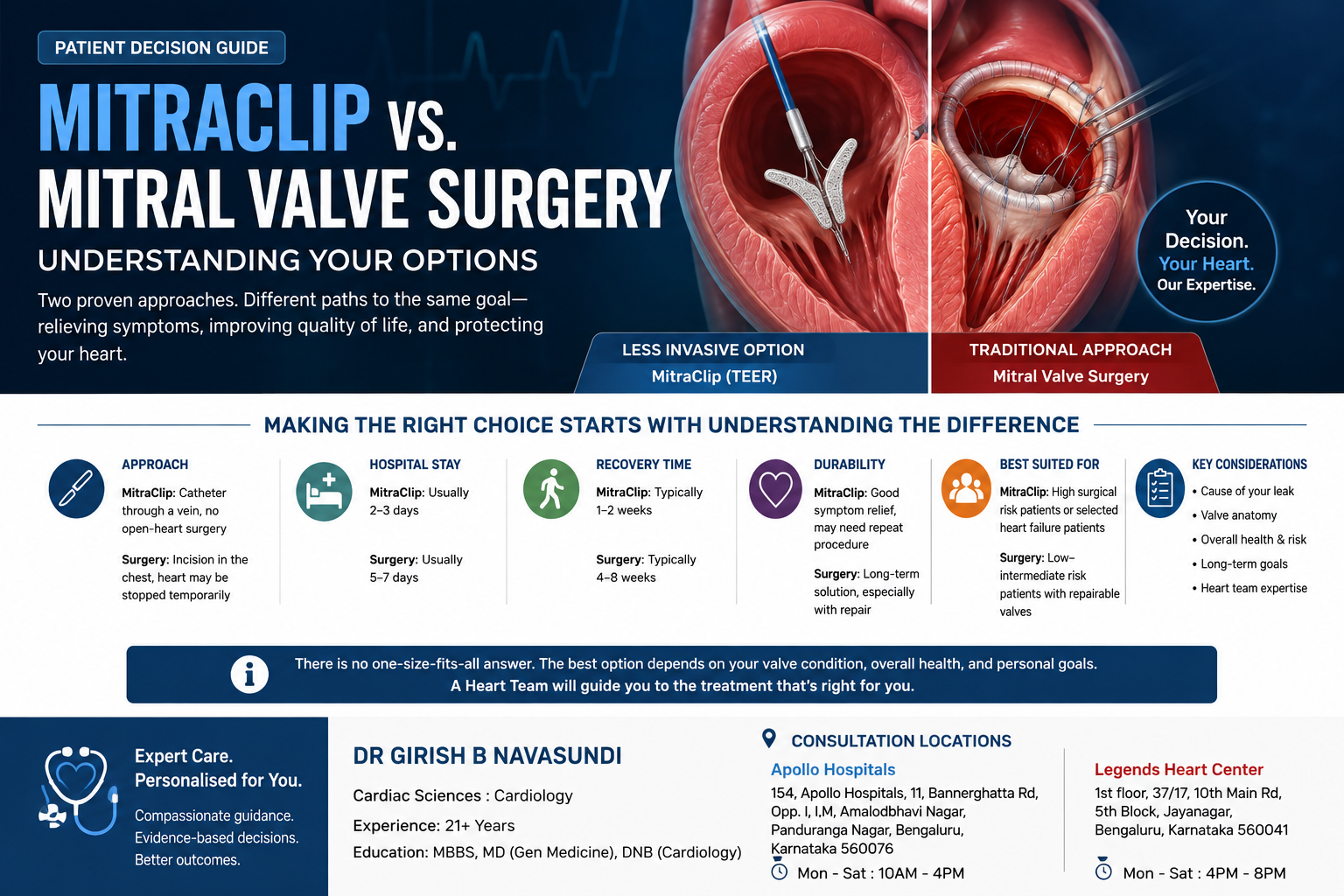
If you have severe mitral regurgitation, the choice between MitraClip and mitral valve surgery depends mainly on why your valve is leaking, whether the valve can be repaired, your surgical risk and the condition of your heart.
For most patients with degenerative mitral regurgitation who can safely undergo an operation, surgical mitral valve repair remains the most complete and durable treatment. MitraClip offers a less invasive alternative for people at high or prohibitive surgical risk and for selected patients whose leakage is caused by heart failure.
Both treatments can be valuable. The right option is the one that best matches your valve anatomy, overall health and long-term treatment needs.
What Is Mitral Regurgitation?
The mitral valve sits between the heart’s left upper chamber and left lower pumping chamber.
When the valve closes normally, it prevents blood from flowing backwards. In mitral regurgitation, the valve does not close completely, allowing some blood to leak back into the upper chamber with every heartbeat.
Severe leakage can make the heart work harder and may eventually lead to:
- Breathlessness
- Fatigue
- Reduced exercise capacity
- An irregular heartbeat
- Enlargement of the heart
- Fluid accumulation in the lungs
- Heart failure
Before comparing MitraClip vs mitral valve surgery, it is essential to determine what is causing the leak.
Primary and Secondary Mitral Regurgitation Are Not the Same
Mitral regurgitation is generally divided into two major categories.
Primary or Degenerative Mitral Regurgitation
In primary mitral regurgitation, the problem begins in the valve itself.
Possible causes include:
- Mitral valve prolapse
- A flail valve leaflet
- Torn or stretched supporting cords
- Degenerative valve tissue
- Previous infection affecting the valve
When a durable repair is technically possible and the patient is an acceptable surgical candidate, surgical mitral valve repair remains the preferred treatment for severe primary mitral regurgitation.
Secondary or Functional Mitral Regurgitation
In secondary mitral regurgitation, the valve leaflets may not be primarily diseased.
Instead, a weakened or enlarged heart pulls the valve apart, preventing the leaflets from meeting properly. This commonly occurs in people with:
- Heart failure
- Previous heart attack
- Dilated cardiomyopathy
- Ischaemic heart disease
- Enlargement of the left ventricle
- Enlargement of the left atrium associated with atrial fibrillation
For secondary mitral regurgitation, treatment usually begins with optimising heart-failure medicines, cardiac resynchronisation therapy when appropriate, coronary treatment and rhythm management.
If severe leakage and symptoms remain despite appropriate treatment, MitraClip may become an important option for selected patients.
What Is MitraClip?
MitraClip is a device used during a procedure called mitral transcatheter edge-to-edge repair, commonly abbreviated as M-TEER or TEER.
The procedure is performed through a blood vessel, usually a vein in the groin.
A catheter is guided to the right side of the heart and then through the wall separating the heart’s upper chambers. The clip is positioned above the mitral valve using continuous imaging.
The clip grasps the front and back mitral valve leaflets and brings them closer together. This creates a stronger seal and reduces the amount of blood leaking backwards.
The heart is not stopped, the breastbone is not opened and a heart-lung machine is usually not required.
MitraClip repairs the valve by improving how its existing leaflets meet. It does not remove the diseased valve or provide the same full reconstruction that can be achieved surgically.
What Happens During Mitral Valve Surgery?
Mitral valve surgery may involve either repair or replacement.
Surgical Mitral Valve Repair
During repair, the surgeon preserves the patient’s own valve and corrects the specific cause of the leakage.
This may involve:
- Reshaping or removing abnormal leaflet tissue
- Replacing torn supporting cords
- Bringing leaflet edges together
- Implanting an annuloplasty ring to restore the valve’s shape
- Repairing additional parts of the valve apparatus
For degenerative mitral regurgitation, a successful surgical repair is generally preferred over replacing the valve because it preserves the natural valve and can provide durable correction.
Mitral Valve Replacement
If the valve cannot be repaired reliably, it may need to be replaced with:
- A biological tissue valve
- A mechanical valve
A mechanical valve can last for many years but generally requires lifelong anticoagulation with warfarin. A tissue valve usually avoids lifelong warfarin unless there is another indication, but it can deteriorate over time.
Mitral surgery may be performed through a traditional sternotomy or, in selected patients and experienced centres, through a smaller minimally invasive incision. The 2025 European valve guidelines recognise that minimally invasive mitral surgery can reduce hospital stay and accelerate recovery in appropriately selected patients.
MitraClip vs Mitral Valve Surgery: Quick Comparison
| Consideration | MitraClip or TEER | Mitral valve surgery |
|---|---|---|
| Approach | Catheter inserted through a vein, usually in the groin | Chest incision through traditional or minimally invasive surgery |
| Breastbone opened | No | Sometimes, depending on the surgical approach |
| Heart stopped | Usually no | Usually yes |
| Heart-lung machine | Usually not required | Commonly required |
| Main objective | Reduce leakage by clipping the leaflets together | Fully reconstruct, repair or replace the valve |
| Hospital stay | Usually shorter | Usually longer |
| Initial recovery | Generally faster | Usually several weeks |
| Reduction of leakage | Often substantial, but some residual leakage may remain | Usually more complete when a durable repair is achieved |
| Durability evidence | Good medium-term evidence in selected patients; less lifetime evidence | Extensive long-term evidence for surgical repair |
| Reintervention risk | Can be higher, particularly when significant leakage remains | Generally lower after a successful durable repair |
| Major bleeding | Generally lower | Higher because it is an operation |
| Atrial fibrillation | Lower early postoperative risk | More common after surgery |
| Anatomy | Requires suitable leaflet length, valve opening and clip position | Can treat a wider range of complex valve problems |
| Other heart procedures | Cannot routinely perform bypass or repair other valves simultaneously | Other heart problems can be treated during the same operation |
| Most commonly favoured for | High-risk patients and selected secondary MR patients | Operable patients with repairable degenerative MR |
These are general differences. An individual patient’s risk may be very different depending on age, heart function, frailty, kidney function, lung disease and valve anatomy.
Which Treatment Reduces the Leak More Completely?
Surgery generally provides the most complete reduction of degenerative mitral regurgitation when an expert surgeon can perform a durable repair.
The landmark EVEREST II trial directly compared the original MitraClip procedure with surgery in patients who were candidates for an operation.
At one year, the trial’s main effectiveness outcome favoured surgery. Patients treated with MitraClip were more likely to need mitral surgery, particularly during the first year, because the leakage had not been reduced sufficiently.
At five years, the combined effectiveness outcome continued to favour surgery. However, MitraClip had fewer early major adverse events, largely because patients required fewer blood transfusions. Both groups experienced improvements in symptoms and quality of life.
This trial used an earlier generation of the MitraClip system, and current devices provide more clip sizes and greater flexibility. Even so, modern guidelines continue to favour surgical repair for operable patients with primary degenerative mitral regurgitation when a durable repair is likely.
The practical difference is:
Surgery aims to restore the complete structure of the valve. MitraClip aims to reduce the leak enough to improve symptoms and reduce strain on the heart without exposing the patient to major surgery.
Is MitraClip Safer Than Mitral Valve Surgery?
MitraClip is less invasive, but “less invasive” does not mean “risk-free.”
Potential risks of MitraClip include:
- Bleeding or injury at the catheter-entry site
- Stroke
- Damage to the heart or blood vessels
- Fluid accumulating around the heart
- Partial detachment of the clip from one leaflet
- Significant residual mitral regurgitation
- Narrowing of the mitral valve after clip placement
- Need for an additional clip
- Need for urgent or later mitral valve surgery
- Complications related to anaesthesia or transoesophageal echocardiography
Surgical risks can include:
- Major bleeding
- Infection
- Stroke
- Kidney injury
- Atrial fibrillation
- Lung complications
- Need for blood transfusion
- Complications related to the heart-lung machine
- Longer physical recovery
EVEREST II reported fewer early major adverse events with MitraClip, although much of the difference was related to blood transfusion. When transfusions were excluded, the difference between the groups was smaller.
The safest procedure is therefore not determined by the size of the incision alone. It depends on whether the chosen treatment can achieve a meaningful and lasting reduction in leakage without creating an unacceptable procedural risk.
Which Treatment Has the Faster Recovery?
MitraClip generally provides the faster early recovery.
After an uncomplicated procedure, many patients can begin walking relatively soon and return home after a short hospital stay. Because the breastbone is not opened, there are fewer restrictions related to lifting, driving and upper-body movement.
Recovery after mitral valve surgery takes longer.
Patients need time to recover from the operation, anaesthesia and the chest incision. Recovery may be faster after minimally invasive surgery than after a full sternotomy, but it remains a major heart operation.
A faster recovery can be especially important for:
- Older adults
- Frail patients
- People with serious lung disease
- Patients with kidney disease
- People who have undergone previous heart surgery
- Patients unlikely to regain independence easily after open surgery
However, choosing a less invasive procedure that leaves substantial leakage may not provide the best long-term result. Early convenience must be balanced against the quality and durability of the repair.
Which Option Lasts Longer?
Surgical mitral valve repair has the longest and most established durability record, especially when performed for suitable degenerative disease at an experienced valve centre.
A well-performed surgical repair can correct:
- Prolapsed or flail leaflets
- Torn supporting cords
- An enlarged valve ring
- Multiple leaking segments
- More complex valve abnormalities
An annuloplasty ring also stabilises the valve opening, something MitraClip alone does not do.
MitraClip durability depends heavily on:
- The original cause of the leakage
- Whether the valve anatomy was suitable
- How much regurgitation remained after the procedure
- The number and position of clips
- Whether the heart continues to enlarge
- Progression of the underlying heart disease
EVEREST II found that most additional surgeries after MitraClip occurred during the first year. Patients with a good initial result were less likely to experience later failure, but surgery remained more effective at completely eliminating mitral regurgitation.
This makes the quality of the immediate result important. Leaving moderate or severe leakage after the procedure may reduce the expected benefit.
When Might MitraClip Be the Better Option?
MitraClip may be preferred when:
- The patient has severe symptoms
- Mitral regurgitation remains significant
- The risk of surgery is high or prohibitive
- Valve anatomy is suitable for clipping
- The patient is older or frail
- Previous heart surgery makes another operation more difficult
- Serious lung, kidney or liver disease increases surgical risk
- Recovery from open-heart surgery is unlikely to be well tolerated
- The patient has selected secondary mitral regurgitation despite optimised heart-failure treatment
For severe primary mitral regurgitation, American guidelines describe TEER as a reasonable option when surgical risk is high or prohibitive and the valve anatomy is favourable. The 2025 European guidelines similarly strengthened the role of TEER for symptomatic high-risk patients.
When Might Mitral Valve Surgery Be the Better Option?
Surgery may be preferred when:
- The patient has degenerative mitral regurgitation and acceptable surgical risk
- A successful and durable repair is highly likely
- The patient is young and has a long life expectancy
- Several parts of the valve are abnormal
- The valve opening is too small for safe clip placement
- Heavy calcium makes clipping difficult
- The leaflets cannot be grasped securely
- Another valve also requires treatment
- Coronary bypass surgery is needed
- A surgical maze procedure for atrial fibrillation may be beneficial
- The patient has infective endocarditis
- MitraClip is unlikely to reduce the leak adequately
For severe primary degenerative mitral regurgitation, guidelines recommend surgical repair rather than valve replacement when a successful and durable repair is technically feasible.
Why Secondary Mitral Regurgitation Requires a Different Discussion
MitraClip evidence in secondary mitral regurgitation should not be interpreted as proof that MitraClip is better than surgery.
The most important trials in this area compared MitraClip plus optimal heart-failure treatment with optimal medical treatment alone—not with mitral valve surgery.
In the COAPT trial, selected patients with symptomatic heart failure and severe secondary mitral regurgitation experienced fewer heart-failure hospitalisations and lower mortality with MitraClip plus guideline-directed therapy than with medical therapy alone. Benefits were sustained through five years.
RESHAPE-HF2 also found that MitraClip reduced the combined burden of cardiovascular death and recurrent heart-failure hospitalisation, with much of the benefit coming from fewer hospital admissions.
Not every patient with secondary mitral regurgitation will receive the same benefit.
The Heart Team must consider:
- The severity of the leak
- The size and function of the left ventricle
- Pulmonary artery pressure
- Right-heart function
- Previous heart-failure admissions
- Whether medicines have been fully optimised
- Whether cardiac resynchronisation is indicated
- Whether coronary disease needs treatment
- Whether the valve anatomy is suitable for TEER
Treating the clip without treating the underlying heart failure is not enough.
Can You Have Surgery After MitraClip?
Surgery may still be possible after a previous MitraClip procedure.
However, the presence of one or more clips can affect the valve leaflets. In some cases, the valve may still be repairable. In others, valve replacement may be more likely.
For a younger patient who is otherwise a good surgical candidate, it is important to consider whether choosing MitraClip first could make a later surgical repair more complex.
The first procedure should therefore be selected as part of a long-term valve strategy rather than based only on the shortest immediate recovery.
What Tests Are Needed Before Choosing?
A complete evaluation may include:
Transthoracic Echocardiogram
This assesses:
- Severity of the leakage
- Heart size
- Pumping function
- Pulmonary pressure
- Other valve problems
Transoesophageal Echocardiogram
A specialised ultrasound probe is passed into the oesophagus to provide detailed images of:
- Valve leaflets
- Location of the leak
- Leaflet length
- Calcium
- Valve opening
- Suitability for clip placement
Coronary Angiogram or CT Imaging
These tests may be needed to evaluate coronary artery disease, previous bypass grafts or other structural concerns.
Surgical-Risk and Frailty Assessment
Risk calculators can estimate operative risk, but numbers alone are insufficient. The Heart Team should also assess mobility, nutrition, previous operations, kidney and lung function, cognitive health and the patient’s likelihood of regaining independence.
The 2025 European guidelines reinforce shared, patient-centred decisions by a multidisciplinary Heart Team and recommend that complex procedures be performed at centres with appropriate expertise and procedural volume.
Questions to Ask Your Heart Team
Before choosing MitraClip or mitral valve surgery, ask:
- Do I have primary or secondary mitral regurgitation?
- What is causing my valve to leak?
- Can my valve be repaired surgically, or would it need replacement?
- What is the likelihood of a durable surgical repair?
- What makes me high, intermediate or low risk for surgery?
- Is my anatomy suitable for MitraClip?
- How much leakage do you expect to remain after MitraClip?
- Could the clip make my valve too narrow?
- What is the likelihood that I will need another procedure?
- Can another heart problem be treated during surgery?
- What recovery should I expect from each option?
- Which procedure would provide the best lifetime strategy for me?
A good recommendation should explain both why one treatment is preferred and why the alternative may be less suitable.
The Bottom Line
The choice between MitraClip and mitral valve surgery should not be based only on which procedure sounds easier.
For most operable patients with severe degenerative mitral regurgitation and a valve that can be repaired, surgery provides the most complete and established long-term solution.
For patients at high or prohibitive surgical risk, MitraClip can reduce leakage without open-heart surgery and may provide meaningful improvements in symptoms and quality of life.
For selected patients with heart-failure-related secondary mitral regurgitation, MitraClip can also reduce heart-failure hospitalisations when symptoms persist despite properly optimised treatment.
The best decision comes from understanding the cause of the leak, the possibility of a durable repair, the patient’s surgical risk and the result each procedure is realistically expected to achieve.
Ask a Cardiologist Which Mitral Valve Treatment Is Right for You
If you have severe mitral regurgitation and have been advised to consider an intervention, a detailed valve assessment can help determine whether MitraClip, surgical repair or valve replacement is the most appropriate option.
Book an appointment with Dr Girish B. Navasundi
Dr Girish B. Navasundi
Cardiac Sciences: Cardiology
Experience: 21+ years
Qualifications: MBBS, MD in General Medicine, DNB in Cardiology
Apollo Hospitals
154, Apollo Hospitals, 11, Bannerghatta Road, Opp. IIM, Amalodbhavi Nagar, Panduranga Nagar, Bengaluru, Karnataka 560076
Monday–Saturday: 10:00 AM–4:00 PM
Legends Heart Center
1st Floor, 37/17, 10th Main Road, 5th Block, Jayanagar, Bengaluru, Karnataka 560041
Monday–Saturday: 4:00 PM–8:00 PM
Continue Reading
- What is MitraClip and how is the procedure performed?
- Mitral regurgitation symptoms you should not ignore
- When does a leaking mitral valve require treatment?
- MitraClip treatment in Bengaluru
- Heart valve terminology explained
This article is intended for general education and does not replace an individual consultation. Treatment must be selected after reviewing the cause and severity of mitral regurgitation, valve anatomy, heart function, surgical risk and the patient’s preferences.