 Apollo Hospitals, Opp.iim 154/11,bannerghatta Road.
 Posted on July 14, 2026
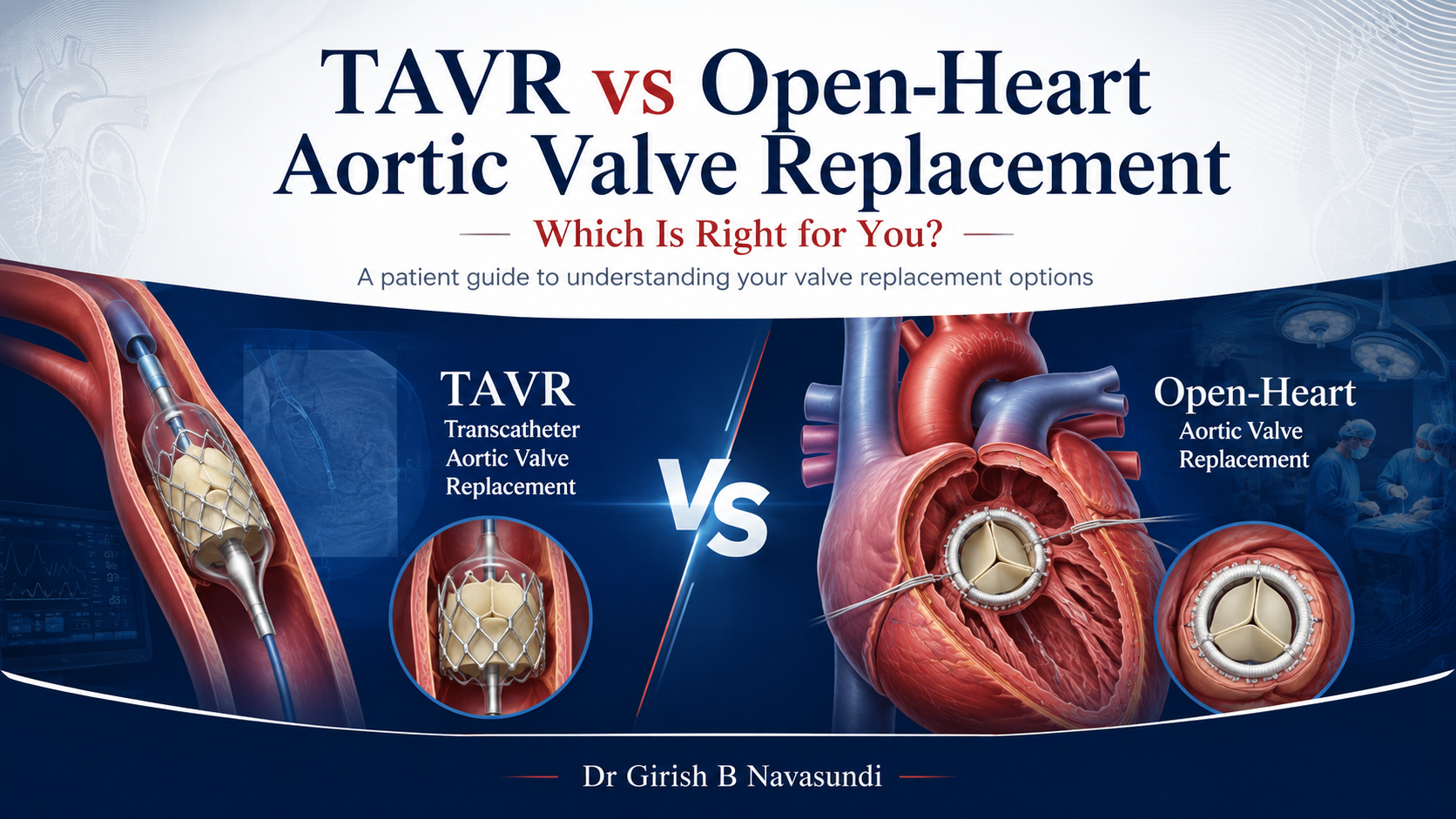
TAVR vs Open-Heart Aortic Valve Replacement: Which Is Right for You?
If you have been diagnosed with severe aortic stenosis, both TAVR and open-heart aortic valve replacement can effectively replace the narrowed valve. TAVR is less invasive and generally offers a shorter hospital stay and faster initial recovery. Surgical aortic valve replacement may be more suitable for younger patients, people with a bicuspid valve, those needing bypass surgery or another heart procedure, and patients whose lifetime treatment plan requires a more durable or flexible solution.
There is no single procedure that is best for everyone. The right choice depends on your age, life expectancy, valve anatomy, general health, surgical risk and what other treatment your heart may need.
What Are TAVR and Surgical Aortic Valve Replacement?
Both procedures are designed to achieve the same essential goal: replace the diseased aortic valve so that blood can flow more freely from the heart to the body.
The difference is how the replacement valve is implanted.
What Is TAVR?
Transcatheter aortic valve replacement, also called TAVI or transcatheter aortic valve implantation, is a minimally invasive procedure.
A compressed tissue valve is placed on a catheter and guided to the heart, most commonly through an artery in the groin. Once positioned inside the diseased aortic valve, the new valve is expanded and immediately begins controlling blood flow.
The old valve is not surgically removed. Instead, its leaflets are pushed aside, and the replacement valve functions inside it.
Because the chest usually does not need to be opened and the heart does not normally need to be stopped, patients often mobilise sooner and leave hospital earlier.
What Is Surgical Aortic Valve Replacement?
Surgical aortic valve replacement, or SAVR, is performed through an incision in the chest.
During the procedure, the surgeon removes the diseased valve and replaces it with either:
- A biological tissue valve
- A mechanical valve
Traditional SAVR involves opening the breastbone, temporarily stopping the heart and using a heart-lung machine. In selected patients, surgery may be performed through a smaller incision, but it remains a surgical operation.
Surgery also gives the team direct access to the heart. This is important when a patient needs coronary artery bypass grafting, repair of an enlarged aorta, treatment of another heart valve or correction of another structural heart condition.
TAVR vs Open-Heart Surgery: Quick Comparison
| Consideration | TAVR/TAVI | Surgical valve replacement |
|---|---|---|
| Approach | Catheter-based, usually through the groin | Chest incision; full or minimally invasive sternotomy |
| Diseased valve | New valve is expanded inside the existing valve | Diseased valve is surgically removed |
| Heart-lung machine | Usually not required | Usually required |
| Anaesthesia | May use conscious sedation or general anaesthesia | General anaesthesia |
| Hospital stay | Usually shorter | Usually longer |
| Initial recovery | Often days to a few weeks | Commonly several weeks |
| Chest-bone healing | No breastbone incision with transfemoral TAVR | Breastbone may require six to eight weeks to heal |
| Pacemaker risk | Can be higher, depending on the valve and the patient’s electrical system | Generally lower than with some TAVR valve platforms |
| Major bleeding | Generally lower | Generally higher |
| New atrial fibrillation | Generally less common | More common after surgery |
| Paravalvular leakage | More common than after surgery, although newer valves have reduced the risk | Usually less common |
| Valve choices | Biological tissue valve | Biological or mechanical valve |
| Long-term durability evidence | Encouraging medium-term and selected ten-year data, but less lifetime evidence in young patients | Decades of experience, particularly important for younger patients |
| Other heart procedures | Cannot routinely perform bypass surgery or repair the aorta at the same time | Other cardiac problems can be treated during the same operation |
| Most commonly favoured for | Older adults, frail patients and people at increased surgical risk with suitable anatomy | Younger patients, bicuspid valves, complex anatomy or patients needing additional heart surgery |
Hospital stay and recovery vary according to the patient’s health, complications, access route and the centre’s recovery protocol. Randomised studies and large observational analyses consistently report a shorter hospital stay after transfemoral TAVR than after SAVR.
Which Procedure Has the Better Recovery?
For most patients, TAVR provides the easier early recovery.
After uncomplicated transfemoral TAVR, patients may be able to stand and walk within hours or by the following day. Because there is no large chest incision, there are fewer restrictions related to lifting, driving and upper-body movement.
Many patients return to ordinary daily activities within a few weeks, although older or frail patients may need more time to rebuild strength.
Recovery after SAVR is more gradual. Patients need time to recover from the operation, anaesthesia and, when a sternotomy is performed, healing of the breastbone. Fatigue can continue for several weeks, and cardiac rehabilitation may be recommended.
However, the easier recovery associated with TAVR does not automatically make it the better long-term choice. A few weeks of faster recovery must be balanced against the patient’s expected lifespan, anatomy, valve durability and possible need for future procedures.
Does TAVR Have a Higher Pacemaker Risk?
A permanent pacemaker may be needed if the heart’s electrical conduction system is disturbed during valve implantation.
The electrical pathways of the heart lie close to the aortic valve. When a TAVR valve expands, it can place pressure on these pathways and cause a slow or unreliable heartbeat.
The pacemaker risk is influenced by:
- The type of TAVR valve used
- How deeply the valve is implanted
- The patient’s existing heart rhythm
- Pre-existing right bundle branch block
- Calcium distribution around the valve
- Individual anatomy
The risk should not be represented by one universal percentage. It varies considerably between valve technologies and patient groups.
In studies involving some self-expanding TAVR systems, pacemaker implantation has occurred more often after TAVR than after surgery. One analysis from the Evolut Low Risk programme reported rates of approximately 20% after TAVR and 8% after surgery. Other trials using balloon-expandable valves have reported smaller differences.
Needing a pacemaker does not necessarily mean that the valve procedure has failed. However, it is an important lifelong consideration and should be discussed before treatment, particularly in younger patients.
Which Valve Lasts Longer?
This is one of the most important questions—and one of the most difficult to answer with a single number.
Surgical biological valves have been used and monitored for decades. TAVR is a newer treatment, so there is less evidence covering the entire remaining lifespan of a patient treated at a young age.
Available evidence is reassuring.
Five-year results from both the PARTNER 3 and Evolut Low Risk trials found similar major clinical outcomes between TAVR and surgery in selected patients at low surgical risk. Valve performance was also favourable in both treatment groups.
The NOTION trial has reported ten-year outcomes after TAVR and surgery in an older, relatively low-risk population. The combined risk of death, stroke or heart attack was identical at ten years, and the trial did not show a clear disadvantage in bioprosthetic valve durability with TAVR. However, the study was relatively small and used earlier-generation valves. Its results should not be assumed to prove lifetime durability in a patient who receives TAVR in their 50s or early 60s.
The practical question is therefore not simply:
“Will the valve last?”
It is:
“Is this valve likely to last for the patient’s expected lifetime, and what options will remain if it eventually wears out?”
Why Age Matters—but Should Not Make the Decision Alone
Age is used as a practical guide because it is related to life expectancy, valve durability and the likelihood of needing another valve procedure.
Current guidelines do not use exactly the same age thresholds.
The 2025 European ESC/EACTS guidelines recommend TAVI for anatomically suitable patients aged 70 or older with severe tricuspid aortic valve stenosis. The recommendation also emphasises Heart Team assessment, life expectancy, anatomy and lifetime planning.
The 2020 American ACC/AHA guidelines generally favour:
- SAVR for patients younger than 65 or with a life expectancy above 20 years
- Either transfemoral TAVR or SAVR for many patients aged 65–80
- TAVR for many patients older than 80 when meaningful survival and quality-of-life improvement are expected
These are guides rather than automatic rules.
A healthy 72-year-old with a long life expectancy may require a different plan from a frail 72-year-old with several medical conditions. Likewise, a patient’s anatomy may make one procedure safer even when their age appears to favour the other.
Why the Surgical Risk Score Is Not Enough
Patients are often described as being at low, intermediate, high or prohibitive surgical risk.
The Society of Thoracic Surgeons Predicted Risk of Mortality score, commonly called the STS score, estimates the risk of death after surgery using factors such as age, kidney function, lung disease and previous heart procedures.
This is useful, but it cannot capture everything.
A Heart Team must also assess:
- Frailty
- Ability to walk and perform daily activities
- Previous chest radiation
- Liver disease
- Severe calcification of the aorta
- Chest deformity
- Previous bypass grafts
- Cognitive health
- Nutrition
- Likelihood of recovering independence
- The patient’s priorities and preferences
Modern guideline recommendations therefore do not select TAVR or surgery using the risk score alone.
When TAVR May Be the Better Option
TAVR may be favoured when:
- The patient is older
- Surgical risk is high or prohibitive
- The patient is frail
- Previous heart surgery makes another operation more complex
- Recovery from open-heart surgery would be difficult
- The aortic valve has three leaflets and suitable anatomy
- The arteries are large and healthy enough for transfemoral access
- No additional cardiac surgery is required
- The patient values faster recovery after understanding the long-term considerations
TAVR may also be reasonable for selected lower-risk patients, particularly when their anatomy is favourable and their anticipated lifespan is compatible with the available durability evidence.
When Open-Heart Surgery May Be the Better Option
SAVR may be favoured when:
- The patient is young and has a long life expectancy
- A mechanical valve is being considered
- The patient has a bicuspid aortic valve with challenging anatomy
- The aortic root or ascending aorta is enlarged
- Coronary bypass surgery is also needed
- Another heart valve needs to be repaired or replaced
- The coronary arteries may be difficult to access after TAVR
- The arteries are unsuitable for safe catheter access
- There is active infection of the heart valve
- The anatomy creates a higher risk of coronary obstruction or poor TAVR positioning
Surgery may involve a more demanding initial recovery, but it can solve several heart problems during one procedure and may provide a more practical lifetime strategy.
What About Bicuspid Aortic Stenosis?
A normal aortic valve generally has three leaflets. A bicuspid valve has two and is present from birth.
Bicuspid valves can be more challenging for TAVR because they may be:
- Asymmetrical
- Heavily calcified
- Associated with enlargement of the aorta
- More difficult to seal evenly
TAVR can be performed successfully in selected patients with bicuspid aortic stenosis, especially older patients with favourable CT findings. However, younger low-risk patients with bicuspid disease were underrepresented in the landmark randomised TAVR trials.
Surgery may therefore remain the more appropriate option when the patient is young, the valve anatomy is complex or the aorta also requires treatment.
Can a Second TAVR Be Performed Later?
Sometimes, a new TAVR valve can be placed inside a previous tissue valve. This is known as a valve-in-valve procedure.
This possibility is attractive, but it cannot be guaranteed for every patient.
The feasibility of a future valve-in-valve procedure depends on:
- The size of the first valve
- The patient’s aortic root anatomy
- The height of the coronary arteries
- The design and position of the first valve
- The risk of blocking coronary blood flow
- The expected opening size after placing one valve inside another
Repeated procedures can create layers of valve frames. These may reduce the available opening or make future access to the coronary arteries more difficult.
For younger patients, the first procedure should therefore be chosen as part of a lifetime valve plan, not as an isolated decision.
Questions to Ask Before Choosing TAVR or Surgery
Before deciding, consider asking your Heart Team:
- Is my aortic valve tricuspid or bicuspid?
- Is transfemoral TAVR technically suitable for me?
- Do I need bypass surgery or treatment of another valve?
- Is my aorta enlarged?
- What is my individual pacemaker risk?
- Which TAVR or surgical valve would be used?
- How long is that valve expected to last in someone my age?
- What procedure could be performed if this valve eventually deteriorates?
- Will my coronary arteries remain accessible?
- How do my frailty, kidney function and lung health affect the choice?
- What recovery should my family and I prepare for?
- Why does the Heart Team recommend this option specifically for me?
A recommendation should make sense not only for the next month, but also for the coming years.
Is TAVR Safer Than Open-Heart Surgery?
It is more accurate to say that the procedures have different risk profiles.
TAVR generally offers:
- Less major bleeding
- Less new atrial fibrillation
- Less acute kidney injury in many patient groups
- Shorter hospitalisation
- Faster early recovery
Surgery generally offers:
- Lower risk of paravalvular leakage
- Lower pacemaker rates than some TAVR platforms
- The ability to implant a mechanical valve
- The ability to treat coronary, aortic and other valve disease at the same time
- More extensive long-term evidence in younger patients
Randomised trials show that TAVR and surgery can produce comparable medium-term survival and disabling-stroke outcomes in carefully selected patients. These results do not mean the procedures are interchangeable for every anatomy or every age group.
The Bottom Line
TAVR is not automatically better because it is less invasive. Open-heart surgery is not automatically better because it has been performed for longer.
The correct choice depends on the complete patient.
For an older adult with suitable anatomy who does not need another cardiac operation, TAVR may provide effective valve replacement with a shorter recovery.
For a younger patient, someone with complex bicuspid anatomy, an enlarged aorta, significant coronary artery disease or another valve problem, surgery may provide the stronger lifetime solution.
The decision should be made after CT imaging, echocardiography, coronary assessment and discussion by a multidisciplinary Heart Team. The goal is not merely to select the easiest procedure today—it is to choose the treatment most likely to provide a safe recovery, lasting valve function and appropriate future options.
Ask a Cardiologist Which Valve Procedure Is Right for You
If you have severe aortic stenosis and have been advised to consider valve replacement, an individual evaluation can help determine whether TAVR or surgical treatment is more appropriate.
Book an appointment with Dr Girish B. Navasundi
Dr Girish B. Navasundi
Cardiac Sciences: Cardiology
Experience: 21+ years
Qualifications: MBBS, MD in General Medicine, DNB in Cardiology
Apollo Hospitals
154, Apollo Hospitals, 11, Bannerghatta Road, Opp. IIM, Amalodbhavi Nagar, Panduranga Nagar, Bengaluru, Karnataka 560076
Monday–Saturday: 10:00 AM–4:00 PM
Legends Heart Center
1st Floor, 37/17, 10th Main Road, 5th Block, Jayanagar, Bengaluru, Karnataka 560041
Monday–Saturday: 4:00 PM–8:00 PM
Continue Reading
- How long can you live with severe aortic stenosis without treatment?
- How is TAVR performed? A step-by-step patient guide
- TAVR treatment in Bengaluru
- Understanding aortic stenosis test results
This article is provided for general education and does not replace an individual medical consultation. Suitability for TAVR or surgery must be determined by a qualified multidisciplinary Heart Team after reviewing the patient’s health, imaging, anatomy and treatment goals.