 By Dr. Girish B Navasundi
Posted on November 4, 2026
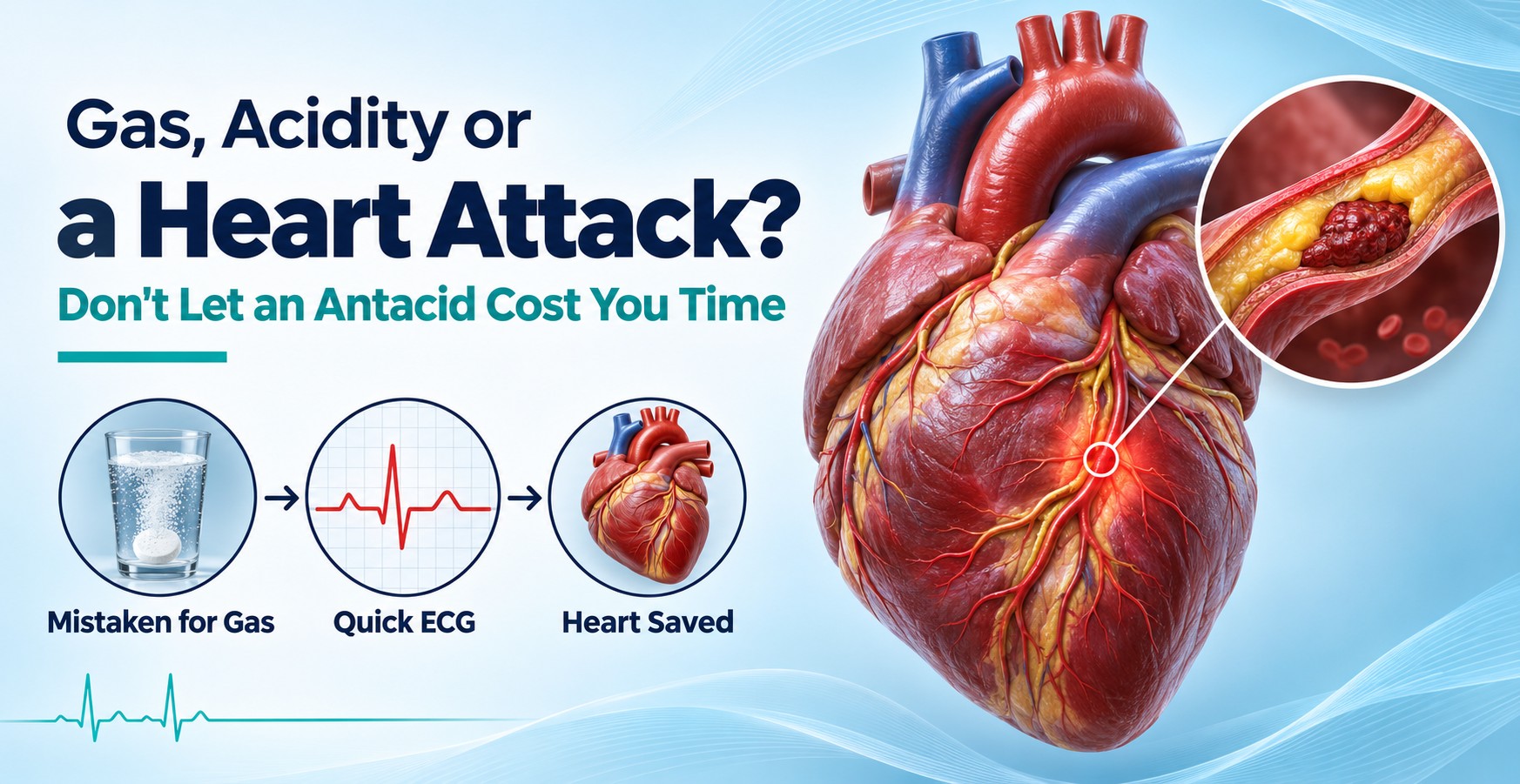
Gas, Acidity or a Heart Attack? Why an Antacid Can Cost You Precious Hours
The 11:40 PM Question
“It’s just gas. I ate too much biryani. Let me take an antacid and sleep.”
Few sentences are spoken more often in Bengaluru homes at night — and few are more dangerous when they are wrong. A heart attack does not always feel like crushing chest pain. Sometimes it feels exactly like acidity. Here’s how to tell the difference, and why the safest answer often takes just one ten-minute ECG.
⏱ 8 min read•✍️ Dr. Girish B. Navasundi, Interventional Cardiologist
At a glance
🍽️
Feels like “gas”
Heart attack pain can sit in the upper stomach, with burping and nausea.
⏳
Time is muscle
Every hour spent waiting for an antacid to “work” can cost heart muscle.
📈
10-minute answer
An ECG is quick, painless and available round the clock in emergency departments.
🚑
Call 108
Don’t drive yourself. Don’t wait till morning.
1A Story Many Bengaluru Families Will Recognise
The following is a composite of situations cardiologists see regularly — the names and details are illustrative, but the pattern is very real.
SUNDAY, 11:40 PM
Ravi, 52, a bank manager in JP Nagar, feels a heavy, burning discomfort in his upper stomach after a family dinner. He burps a little and feels slightly better. “Acidity,” he says.
11:50 PM
He takes an antacid sachet. His wife notices he is sweating, although the fan is on. He says he is “just tired”.
12:30 AM
The discomfort comes back, now spreading to his left arm and jaw. He takes a second antacid and tries to sleep sitting up.
3:15 AM
He wakes up breathless and frightened. The family finally calls for help.
3:55 AM
The ECG in the emergency department shows a heart attack in progress. Four precious hours have already passed.
Ravi’s family did nothing “wrong” — they did what most families would do. The problem is that the upper stomach and the heart share overlapping nerve pathways, so the brain often cannot tell exactly where the pain is coming from. A heart attack, especially one affecting the lower (inferior) wall of the heart, can feel uncannily like indigestion.
In the emergency room, the most expensive words are often “I thought it was gas.” The antacid did not harm the patient — the waiting did.
— Dr. Girish B. Navasundi
2Gas vs Heart Attack: Clues That Point Each Way
No checklist can rule out a heart attack at home. But some features should make you much more suspicious that the problem is the heart and not the stomach:
🍽️ More likely acidity / gas
Burning that clearly rises up into the throat with a sour taste
Settles quickly and completely after an antacid
Linked to a spicy meal, with no other symptoms
Gets worse lying flat right after eating
You have had the exact same pattern many times before
Pain changes with pressing on the stomach
❤️ Think heart — get an ECG
Heaviness, pressure, squeezing or tightness — even if mild
Comes back, lingers beyond a few minutes, or keeps returning
Comes with sweating, breathlessness, giddiness or unusual tiredness
Spreads to the arm, shoulder, jaw, neck or back
It feels new, different or “not like my usual acidity”
Brought on by walking, climbing stairs or stress
💡 Important: feeling better after an antacid does NOT prove it was gas. Heart pain often comes and goes on its own — the relief may simply be a coincidence of timing.
3Who Is Most Likely to Mistake a Heart Attack for Acidity?
Some people are far more likely to have “atypical” symptoms — and these are precisely the people who should have the lowest threshold for an ECG:
1
People with diabetes
Diabetes can dull the nerves that carry pain signals, so a heart attack may cause only mild discomfort, breathlessness or tiredness — sometimes called a “silent” heart attack.
2
Women
Women more often describe nausea, upper back or jaw pain, breathlessness and exhaustion instead of classic chest pain.
3
People above 60
Older adults may simply feel weak, confused, breathless or “off” rather than in pain.
4
Smokers, and people with high BP or cholesterol
Each risk factor raises the chance that “gas” is actually the heart.
5
Anyone with a family history
A parent or sibling with a heart attack at a young age (men under 55, women under 65) is an important warning sign.
Bengaluru’s high rates of diabetes and long, sedentary workdays mean this is not a rare problem in our city. If your cholesterol report looks fine, read why a “normal” cholesterol report may not mean your heart is safe.
4Myths That Cost Precious Hours
✗ MYTH
“I’m too young for a heart attack.”
✓ FACT
Heart attacks in people in their 30s and 40s are seen regularly in Indian cities, especially with smoking, diabetes, family history and stress.
✗ MYTH
“If it were the heart, the pain would be unbearable.”
✓ FACT
Many heart attacks begin as mild discomfort. Severity of pain does not tell you how serious the blockage is.
✗ MYTH
“Let me wait till morning and see the family doctor.”
✓ FACT
A major heart attack is time-critical. Opening the artery early saves heart muscle — and lives.
✗ MYTH
“I’ll take a Sorbitrate from the medicine box to check.”
✓ FACT
Never take someone else’s heart tablets. Some can drop blood pressure dangerously, especially in certain heart attacks or if you take medicines for erectile dysfunction.
5What To Do If You Are Not Sure — Your 5-Step Plan
1
Stop and sit down
Stop all activity. Don’t walk around “to let the gas pass”, and don’t climb stairs.
2
Call for help early
Call 108 or your nearest hospital’s emergency number. If you must go by car, let someone else drive — never drive yourself.
3
Ask about aspirin
If you are not allergic and have no bleeding problem, the emergency doctor may advise you to chew an aspirin. Follow their advice; do not take other heart tablets on your own.
4
Go to a hospital with a cath lab
For a confirmed heart attack, the best treatment is often emergency (primary) angioplasty. Going straight to a centre that can do this saves time.
5
Carry your reports
Take old ECGs, your medicine list and any previous heart reports — they help the team decide faster.
Why does speed matter so much? Once an artery is completely blocked, heart muscle begins to die within minutes to hours. Guidelines aim to open the artery within about 90 minutes of reaching medical care. Read more in why every minute matters during a heart attack.
🚨 Call 108 immediately if you notice
• Chest, upper stomach or arm discomfort lasting more than a few minutes
• Sweating, cold clammy skin or a sense of doom
• Breathlessness or fainting
• Pain spreading to the jaw, neck, back or left arm
• Sudden severe weakness or giddiness
• Symptoms that keep coming back after an antacid
An ECG costs a few minutes. A missed heart attack can cost a lifetime. When in doubt, check it out.
6“But I Don’t Want to Rush to Hospital for Nothing”
This is the real reason most people wait — embarrassment. Nobody wants to wake the family, travel across the city at 2 AM through Hosur Road or Bannerghatta Road, and be told it was only acidity.
Here is the honest truth from the emergency department: doctors are never upset when a “heart scare” turns out to be acidity. A normal ECG and blood test (troponin) is a happy outcome. The patients we worry about are the ones who arrive too late. Being “wrong” about gas is safe. Being wrong about the heart is not.
If you have to ask yourself, “Is this gas or my heart?” — that question itself is reason enough to get an ECG.
📝 Key takeaways
→ A heart attack can feel exactly like gas or acidity, especially in people with diabetes, women and older adults.
→ Relief after an antacid does not rule out a heart attack.
→ Sweating, breathlessness, or pain spreading to the arm, jaw or back are red flags.
→ Call 108, don’t drive yourself, and go to a hospital with a cath lab.
→ A quick ECG and troponin test give a clear answer — waiting does not.
?Frequently Asked Questions
Can a heart attack cause burping?
Yes. Burping, bloating and nausea can occur during a heart attack. Burping that brings temporary relief does not prove the problem is the stomach.
Is upper stomach pain a sign of a heart attack?
It can be. Pain in the upper middle abdomen (just below the breastbone) can come from the lower part of the heart, especially in people with diabetes.
Can a smartwatch ECG rule out a heart attack?
No. Smartwatches mainly detect rhythm problems and a single-lead tracing can miss a heart attack. A proper 12-lead ECG and blood tests in hospital are needed.
How quickly should I go to hospital if I suspect a heart attack?
Immediately. If symptoms last more than a few minutes or keep returning, call 108 rather than waiting to see if they settle.
Where can I get emergency heart care in South Bengaluru?
Hospitals with a 24×7 cath lab can perform emergency angioplasty. Apollo Hospitals, Bannerghatta Road, serves patients from JP Nagar, Jayanagar, BTM Layout, HSR Layout, Electronic City and nearby areas.
I have had acidity for years. Should I get my heart checked?
If your “acidity” has changed in character, comes on with exertion, or you have diabetes, BP, smoking or a family history, a heart evaluation is a sensible step.
Not sure if your “acidity” is really acidity?
If you have recurring upper stomach or chest discomfort, especially with diabetes, BP or a family history, a heart evaluation with Dr. Girish B. Navasundi can give you clarity. For sudden, ongoing symptoms, call 108 and go to the nearest emergency department.
Apollo Hospitals, Bannerghatta Road · Legends Heart Center, Jayanagar, Bengaluru
GN
Dr. Girish B. Navasundi
Senior Consultant & Interventional Cardiologist · 21+ years
Senior Consultant Cardiologist with a special focus on emergency heart attack care, primary angioplasty and complex coronary intervention at Apollo Hospitals and Legends Heart Center, Bengaluru.
This article is for patient education only and does not replace a personal consultation. Treatment is individualised after full clinical evaluation. References: ACC/AHA Guideline for the Management of Patients With Acute Coronary Syndromes; ESC Guidelines for the Management of Acute Coronary Syndromes.
 Apollo Hospitals, Opp.iim 154/11,bannerghatta Road. Bannerghatta Road.bangalore-560076
 6366 229563