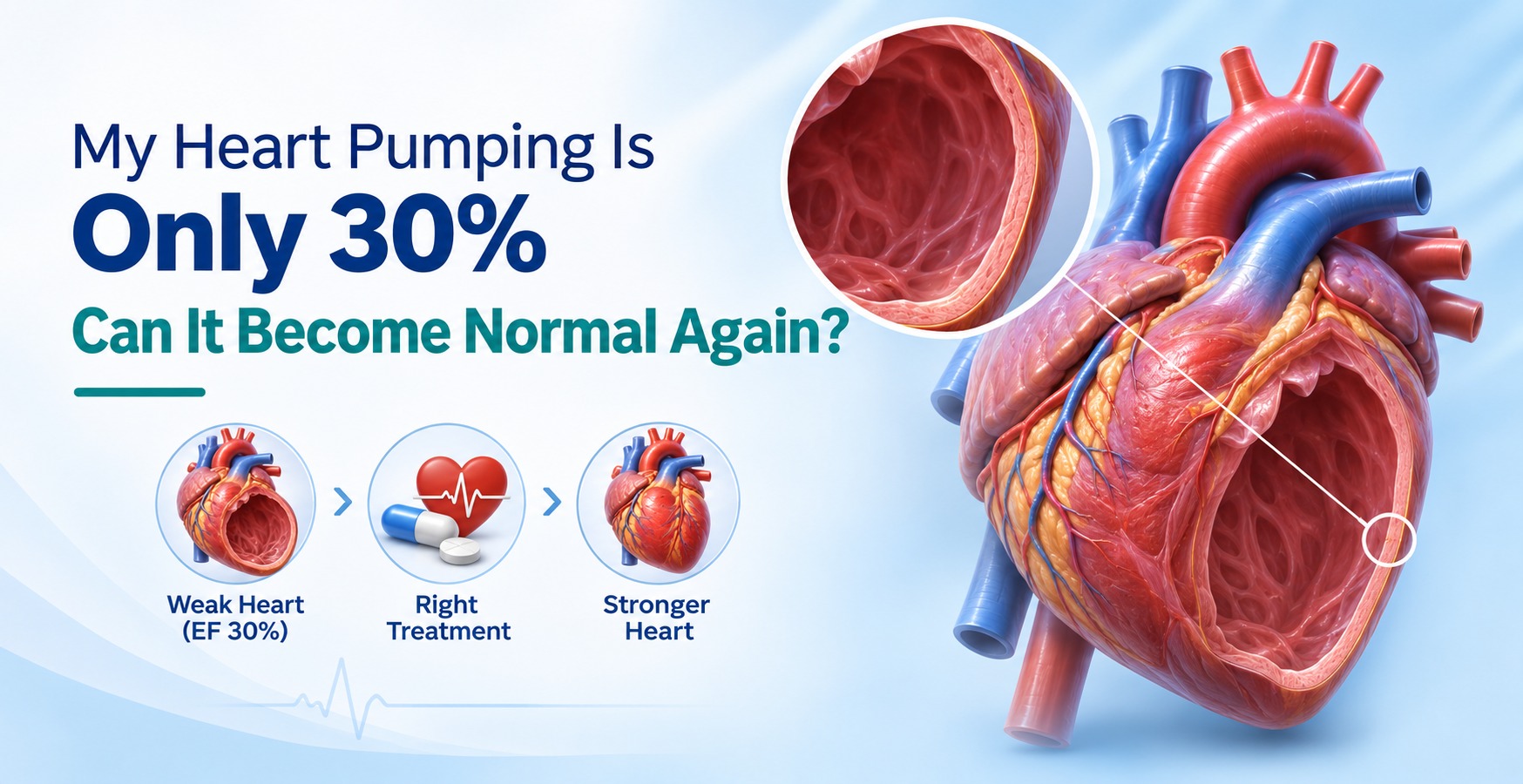
My Heart Pumping Is Only 30% — Can It Become Normal Again?
By Dr. Girish B Navasundi Posted on October 31, 2026
My Heart Pumping Is Only 30% — Can It Become Normal Again?
Understanding Your Echo Report
“The report says EF 30%. Does that mean only 30% of my heart is working?”
Few lines on a medical report cause more fear. But a low EF is not a final verdict. In many patients, the right diagnosis and treatment can make the heart pump stronger again. Here’s what the number really means, and what you can do about it.
⏱ 7 min read•✍️ Dr. Girish B. Navasundi, Interventional Cardiologist
At a glance
📉
EF 30% = weak pump
Not a “70% dead” heart. The muscle is weaker than normal.
📈
Recovery is possible
Many patients see their EF improve with the right treatment.
🔍
Cause decides outcome
Blocked arteries, rhythm problems, valves and more. Finding the cause is step one.
💊
4 key medicines
Modern “four pillar” therapy helps people live longer and feel better.
1What Does “30% Pumping” Actually Mean?
The number on your echo report is the ejection fraction (EF): the percentage of blood the main pumping chamber (the left ventricle) pushes out with each heartbeat. Even a perfectly healthy heart never pumps out 100%.
Where does 30% sit? Ejection fraction scale
You: 30%
0%40%50%70%100%
40% or below: reduced EF
41 to 49%: mildly reduced
About 50 to 70%: normal range
✗ MYTH
EF 30% means 70% of my heart is dead.
✓ FACT
It means the heart muscle is pumping weaker than normal. Much of that muscle may still be alive and able to recover.
✗ MYTH
Once the heart is weak, it can never get better.
✓ FACT
Many patients improve. Doctors even have a name for it: “heart failure with improved ejection fraction”.
✗ MYTH
If I feel better, I can stop my heart medicines.
✓ FACT
Stopping can make the heart weaken again. Never stop without your cardiologist’s advice.
In heart failure with reduced EF, the left ventricle often becomes enlarged and pumps weakly.
2Can a Weak Heart Become Stronger Again?
In many patients, yes. How much the heart recovers depends mainly on why it became weak, and how early treatment starts. Causes where meaningful recovery is often possible:
🫀
Blocked heart arteries
If the muscle is “hibernating” rather than scarred, restoring blood flow with angioplasty or bypass can help it recover.
💓
Fast or irregular rhythm
A heart tired out by a racing rhythm (e.g. atrial fibrillation) can recover once the rhythm is controlled.
🚪
Valve disease
Treating a tight or leaking valve in time, sometimes with TAVR, can relieve the strain.
🩸
High blood pressure
Long-standing uncontrolled BP weakens the heart. Control helps it heal.
🍷
Alcohol
Alcohol-related weakness can improve when alcohol is stopped completely.
🦠
Myocarditis or pregnancy
Weakness after a viral infection or after pregnancy often improves over time.
💡 If the weakness is from a large old heart attack with extensive scarring, the EF may improve less, but treatment still reduces symptoms, hospital visits and risk.
3Your Road to a Stronger Heart
1
Find the cause
Echo, ECG and Holter, coronary angiogram or CT, cardiac MRI and blood tests including NT-proBNP.
2
Start the right medicines early
Begin the “four pillars” and adjust doses step by step to the target levels.
3
Fix what can be fixed
Open blocked arteries, treat valve disease, control rhythm problems.
4
Re-check the echo
Usually after about 3 months of optimised treatment, to measure recovery.
5
Consider devices if needed
If EF stays low, a CRT or ICD may be advised to improve pumping or protect against dangerous rhythms.
4The “Four Pillars” of Heart Failure Treatment
These four medicine groups have been shown to help patients live longer, stay out of hospital and, in many cases, improve the EF:
1️⃣
ARNI / ACE inhibitor / ARB
e.g. sacubitril-valsartan. Reduces strain on the heart.
2️⃣
Beta-blockers
e.g. metoprolol succinate, bisoprolol, carvedilol. Protect and slow the heart.
3️⃣
MRA
e.g. spironolactone, eplerenone. Reduce scarring and fluid.
4️⃣
SGLT2 inhibitors
e.g. dapagliflozin, empagliflozin. Benefit the heart, with or without diabetes.
💡 Diuretics (“water tablets”) may also be given to relieve breathlessness and swelling. Never stop or change doses on your own, even when you feel well.
5Your Daily Heart-Care Checklist
✓Weigh yourself every morning. A gain of 2 kg or more in 2 to 3 days may mean fluid build-up. Call your doctor.
✓Cut the salt: skip pickles, papad, packaged snacks and extra salt at the table.
✓Follow your fluid limit if your doctor has given one.
✓Keep moving gently: regular, comfortable walks as advised.
✓Avoid painkillers like diclofenac and ibuprofen unless your cardiologist approves.
✓No smoking. No alcohol.
✓Get your flu and pneumonia vaccines as advised.
🚨 Get urgent help if you notice
• Breathlessness at rest
• Needing to sit up to breathe at night
• Sudden swelling of legs or abdomen
• Chest pain, fainting, or a very fast or irregular heartbeat
Do not wait. Go to the nearest emergency department or call an ambulance (108).
?Frequently Asked Questions
How long does it take for EF to improve?
Improvement usually becomes visible over 3 to 6 months of consistent treatment, and can continue for a year or more in some patients.
If my EF becomes normal, can I stop my medicines?
Usually not. Studies show the heart can weaken again when heart failure medicines are stopped. Changes should only be made by your cardiologist.
Is EF 30% the same as a heart attack?
No. EF measures pumping strength. A heart attack is one possible cause of a low EF, but there are many others.
Can I live a normal life with a low EF?
Many people with a reduced EF live active, productive lives with the right treatment and regular follow-up.
Will I definitely need an ICD or pacemaker?
Not necessarily. Devices are considered only if the EF stays low after about 3 months of optimised medicines, or for specific ECG findings.
⭐ Key Takeaways
→ EF 30% means a weak pump, not a dead heart.
→ Many hearts get stronger once the cause is found and treated early.
→ The “four pillar” medicines are the foundation. Take them faithfully.
→ Daily weight, low salt and quick action on warning signs keep you out of hospital.
Has your echo shown a low EF?
A detailed heart failure evaluation with Dr. Girish B. Navasundi can find the cause and the treatments most likely to help your heart recover. Bring your echo reports, ECGs and current medicines.
Apollo Hospitals, Bannerghatta Road · Legends Heart Center, Jayanagar, Bengaluru
GN
Dr. Girish B. Navasundi
Senior Consultant & Interventional Cardiologist · 21+ years
Senior Consultant Cardiologist with a special focus on heart failure, structural heart disease, TAVR and complex coronary intervention at Apollo Hospitals and Legends Heart Center, Bengaluru.
This article is for patient education only and does not replace a personal consultation. Treatment is individualised after full clinical evaluation. References: ACC/AHA/HFSA Guideline for the Management of Heart Failure; ESC Guidelines for the Diagnosis and Treatment of Heart Failure.
 Apollo Hospitals, Opp.iim 154/11,bannerghatta Road. Bannerghatta Road.bangalore-560076
 6366 229563
 Posted on October 31, 2026