 Apollo Hospitals, Opp.iim 154/11,bannerghatta Road. Bannerghatta Road.bangalore-560076
 6366 229563
 Posted on October 9, 2026
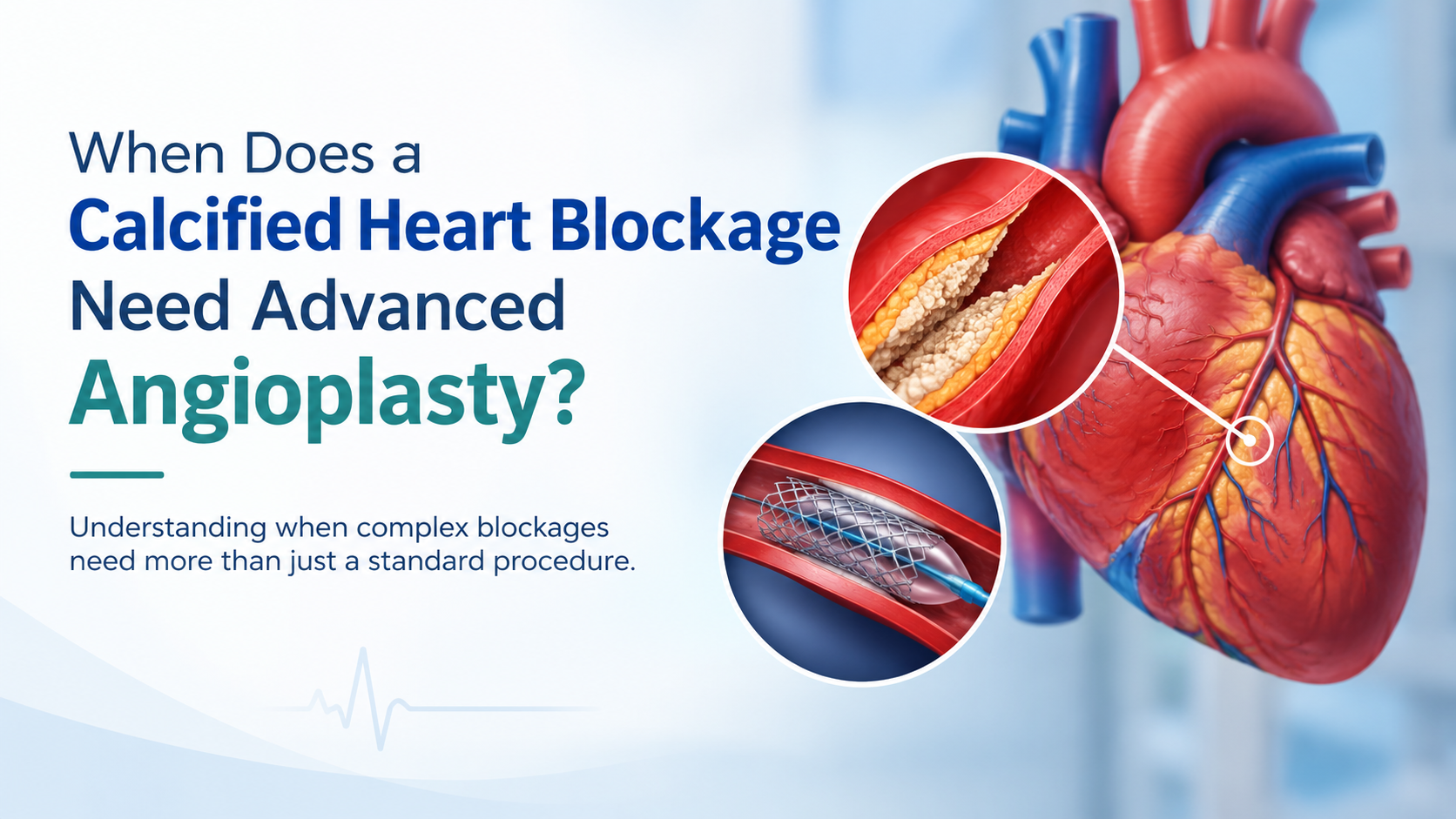
When Does a Calcified Heart Blockage Need Advanced Angioplasty?
When a person is told that there is calcium in the heart arteries, the first thought is often:
“Can this blockage still be treated with a stent?”
The answer is often yes.
But not every calcified blockage behaves the same way. Some calcium deposits are mild and can be managed with conventional balloon angioplasty. In other patients, the calcium is so hard or extensive that a regular balloon may not expand the artery properly, or the stent may not open fully.
This is when advanced angioplasty techniques and careful lesion preparation may become important.
The decision is not based only on the presence of calcium. Doctors consider the severity and location of the blockage, the amount and pattern of calcium, the condition of the artery, symptoms, heart function and the overall treatment plan.
Why does calcium make angioplasty more difficult?
Think of a healthy artery as a flexible tube.
When a coronary artery becomes heavily calcified, parts of its wall can become hard and rigid. If a significant blockage develops in this area, the cardiologist may face several challenges during angioplasty.
The calcium may:
- Make it difficult for a balloon to expand the blockage
- Make it harder to deliver a stent to the required location
- Prevent the stent from expanding completely
- Increase the complexity of the PCI procedure
- Require additional techniques to prepare the artery before stenting
A stent needs adequate expansion to work effectively. Therefore, in heavily calcified lesions, the goal is not simply to place a stent.
The artery may need to be prepared properly before the stent is implanted.
Does every calcified blockage need advanced angioplasty?
No.
This is an important distinction.
Calcium can range from mild to severe. A patient with a small amount of calcium may respond well to conventional balloon angioplasty and stenting.
Advanced calcium-modification techniques are considered when the calcium is significant enough to interfere with balloon expansion, stent delivery or proper stent expansion.
In other words:
Calcium alone does not automatically mean advanced angioplasty is required.
The treatment is selected according to the individual artery and blockage.
How do doctors determine whether advanced treatment is needed?
A coronary angiogram provides important information about the location and severity of a blockage. However, calcium can sometimes be difficult to fully assess from angiography alone.
In selected patients, intravascular imaging can provide additional information.
Two important imaging techniques are:
Intravascular Ultrasound — IVUS
IVUS uses a small ultrasound probe inside the artery to provide detailed information about the vessel.
It can help the cardiologist understand:
- The amount of calcium
- The distribution of calcium around the artery
- The size of the artery
- The characteristics of the blockage
- How well the stent has expanded after implantation
Optical Coherence Tomography — OCT
OCT uses light to provide high-resolution images from inside the coronary artery.
It can help assess the location, thickness and extent of calcium and can assist with treatment planning in suitable cases.
These imaging techniques can help the interventional cardiologist decide whether the lesion requires calcium modification and whether the stent has been adequately expanded after treatment.
When might advanced angioplasty be considered?
Advanced techniques may be considered when there is moderate to severe coronary calcification and conventional balloon treatment is unlikely to prepare the lesion adequately.
For example, a patient may have:
- A very hard calcified blockage
- A lesion that does not expand adequately with a balloon
- Calcium extending around a large portion of the artery
- Difficulty delivering a balloon or stent across the blockage
- Previous unsuccessful angioplasty because of severe calcification
- An already implanted stent that remains under-expanded because of calcium
In such situations, the cardiologist may consider different calcium-modification techniques.
What advanced techniques can be used?
There is no single technique that is appropriate for every calcified artery.
The choice depends on the anatomy and the type of calcium.
Intravascular Lithotripsy — IVL
Intravascular lithotripsy (IVL) uses specialised pulses of energy to create fractures in calcified plaque within the artery wall.
Once the calcium is modified, the artery can become more compliant, allowing better balloon expansion and potentially better stent expansion.
IVL has become an important option for selected heavily calcified coronary lesions.
Rotational Atherectomy
In rotational atherectomy, a specialised rotating device is used to modify hard calcified plaque.
It can be particularly useful in lesions where a balloon or other equipment cannot adequately cross or expand the blockage.
The objective is generally to modify the calcium and create a pathway that allows the rest of the angioplasty procedure to be performed more effectively.
Specialty Balloons
Cutting and scoring balloons have specialised features that help modify resistant plaque.
They may be useful in selected lesions, either as part of the initial treatment or after another calcium-modification technique.
The choice depends on the location, severity and characteristics of the blockage.
Other Techniques
In selected complex cases, other technologies such as orbital atherectomy or laser-based techniques may have a role.
However, these are not treatments that every patient with coronary calcium needs. The technique is chosen according to the specific anatomy and procedural requirements.
Why is proper stent expansion important?
A stent is designed to support the artery after the blockage has been opened.
If severe calcium prevents the stent from expanding properly, the result may be less than optimal. Inadequate stent expansion and other problems related to calcified lesions are associated with increased procedural and longer-term risks.
This is why complex angioplasty is often approached in stages:
Assess the calcium → prepare the artery → implant the stent → check the result.
Intravascular imaging can also be used after stent placement to assess whether the stent has expanded adequately and is appropriately positioned.
What if a previous angioplasty attempt was unsuccessful?
A previous unsuccessful angioplasty does not necessarily mean that the blockage cannot be treated.
The important question is:
Why was the previous procedure unsuccessful?
Was the balloon unable to cross the blockage?
Did the balloon fail to expand?
Was the calcium too hard?
Could the stent not be delivered?
Was an already placed stent under-expanded?
A detailed review of the previous angiogram, together with appropriate imaging when possible, can help identify the problem and determine whether a different strategy may be suitable.
For some patients, this could involve IVL, rotational atherectomy, specialty balloons or another approach. In other situations, a different revascularisation strategy may be considered.
Is advanced angioplasty suitable for everyone?
Not necessarily.
The decision depends on several factors, including:
- Severity and location of the blockage
- Amount and pattern of calcium
- Number of blocked arteries
- Symptoms and clinical condition
- Heart function
- Previous procedures
- Overall surgical and procedural risk
- Whether PCI or another revascularisation approach is appropriate
This is why two patients who both have “calcification” on an angiogram may receive completely different treatment plans.
Quick FAQs
Does coronary calcium mean I cannot have a stent?
No. Many patients with calcified coronary blockages can still undergo stenting. The important question is whether the calcium requires additional preparation before the stent is placed.
How do I know if my blockage is severely calcified?
An angiogram may suggest significant calcium, while IVUS or OCT can provide more detailed information about the calcium and the artery.
Is IVL the same as regular angioplasty?
No. IVL is a calcium-modification technique that uses specialised pulses to fracture calcium within the artery, helping the lesion become more suitable for balloon expansion and stenting.
When is rotational atherectomy used?
It may be considered for selected heavily calcified lesions, particularly when conventional balloons cannot adequately cross or modify the blockage.
Does every patient with calcium need IVL or atherectomy?
No. Mild or moderate calcium may sometimes be treated with conventional techniques. Advanced methods are selected when the calcium creates a specific procedural challenge.
Can a calcified blockage be treated if a previous angioplasty failed?
In some cases, yes. The reason for the previous failure needs to be understood, and a different strategy may be considered after reassessment.
Is advanced angioplasty more complicated than routine angioplasty?
Heavily calcified lesions can make PCI more technically challenging. This is why careful planning, appropriate imaging and selection of the right calcium-modification technique are important.
Can bypass surgery be an alternative to angioplasty?
Depending on the number, location and complexity of the blockages and the patient’s overall condition, bypass surgery may be considered in some patients. The appropriate revascularisation strategy should be decided after individual evaluation.
What happens after the stent is placed?
The cardiologist may use angiography and, when appropriate, intravascular imaging to assess the result and stent expansion. Medicines, follow-up and management of cardiovascular risk factors remain important after PCI.
Told That Your Heart Artery Is Heavily Calcified?
A diagnosis of a calcified coronary blockage can sound worrying, but it does not automatically mean that angioplasty is impossible.
Modern interventional cardiology provides several ways to assess and modify difficult calcium before stent placement. The key is understanding the individual blockage and choosing the appropriate technique rather than using the same approach for every patient.
Dr. Girish B. Navasundi evaluates patients with complex coronary blockages, calcified lesions, multivessel coronary disease, CTOs and challenging angioplasty cases.
Senior Consultant & Interventional Cardiologist
Apollo Hospitals, Bannerghatta Road, Bengaluru
Legends Heart Center, Jayanagar, Bengaluru
The question is not simply, “Is there calcium?”
It is:
“How much calcium is present, how is it affecting the artery, and what is the safest way to prepare the blockage for treatment?”
This article is for patient education. Treatment should be individualised after clinical, angiographic and, when appropriate, intravascular imaging evaluation.