 Apollo Hospitals, Opp.iim 154/11,bannerghatta Road. Bannerghatta Road.bangalore-560076
 6366 229563
 Posted on October 2, 2026
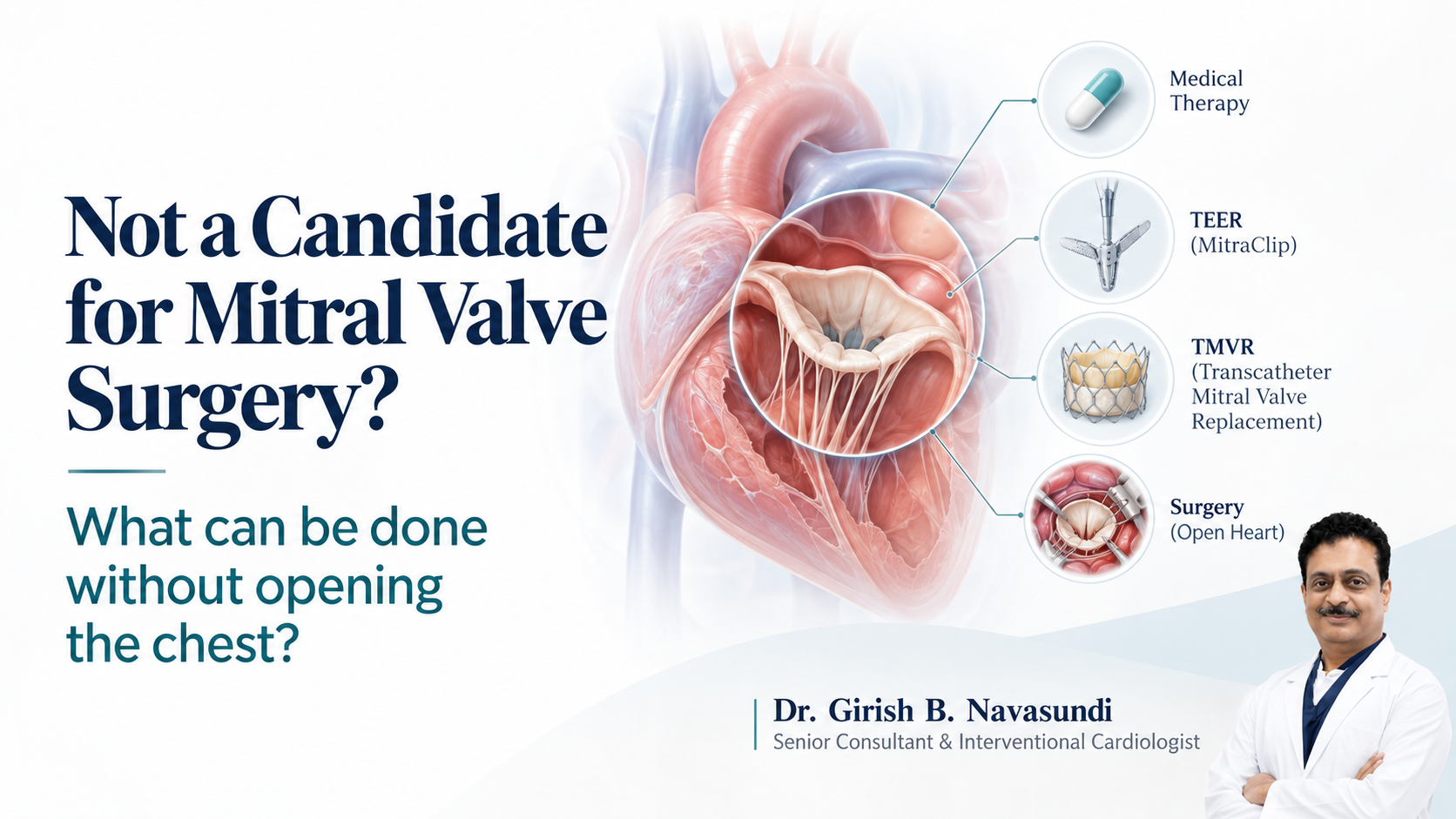
Too High-Risk for Mitral Valve Surgery? What Can Be Done Without Opening the Chest?
A patient guide for people told they are “too high-risk” for mitral valve surgery — and the catheter options that may still help
You were told your mitral valve is leaking badly and needs treatment.
Then came the difficult part:
“Surgery would be too risky in your case.”
For many patients and families, that sentence sounds like a dead end. It often leaves one big question:
“If surgery is too risky, does that mean nothing can be done?”
Not necessarily. Over the last decade, structural heart care has changed dramatically. Today, many patients who cannot safely undergo open-heart surgery can still be offered treatment through a vein in the leg — without opening the chest. India’s structural heart programmes now routinely include mitral TEER and TMVR, reflecting how central these therapies have become.
This guide explains why people are turned down for surgery, what the alternatives are, and — just as importantly — why not everyone qualifies for a catheter procedure.
Why are some patients turned down for mitral valve surgery?
Mitral valve surgery is a major operation. It usually needs general anaesthesia, the heart-lung machine and a recovery period of several weeks. For most fit patients, this is very safe. But some conditions make the risk much higher.
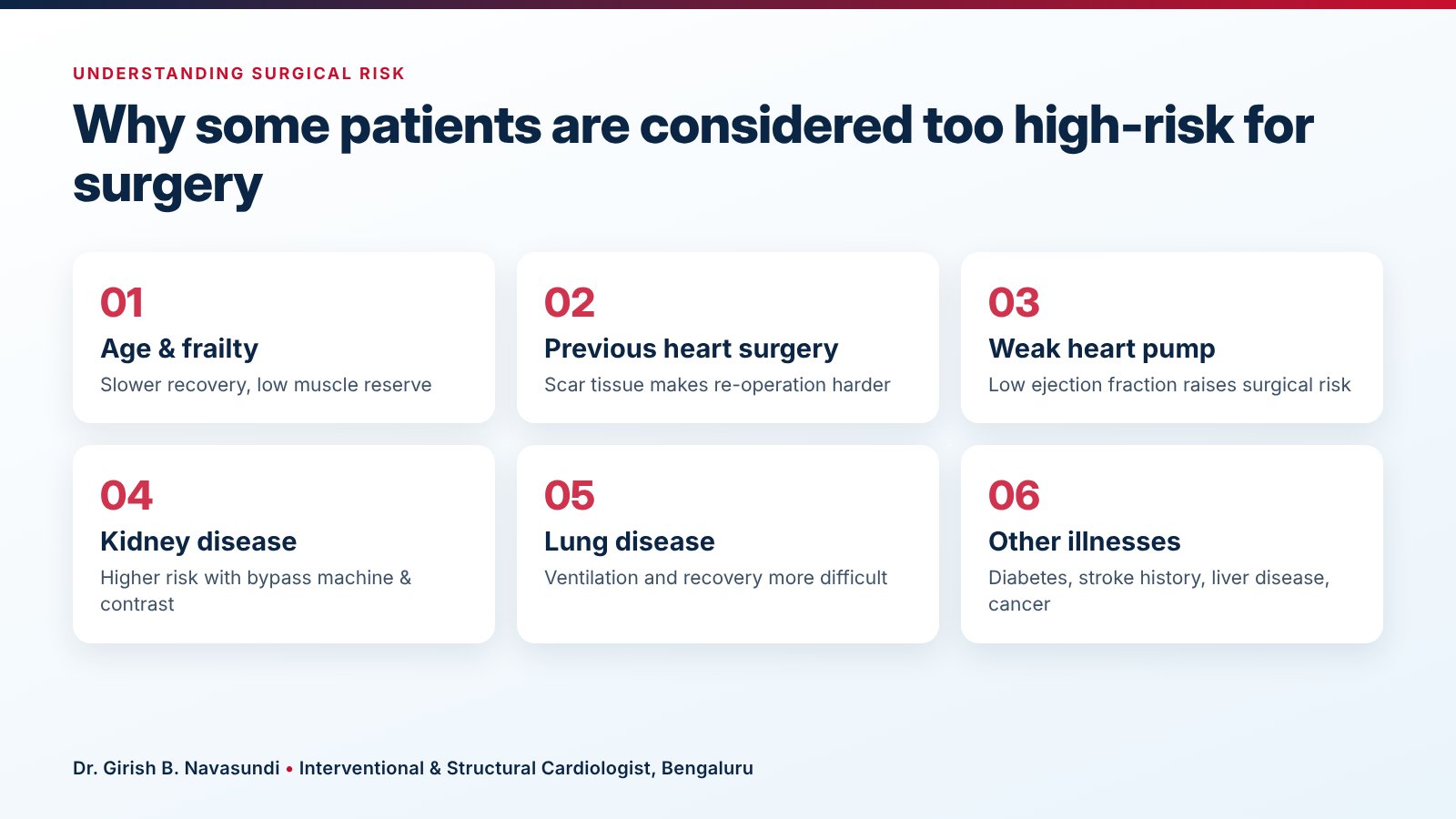
1. Advanced age and frailty
Age alone is not the problem — a fit 80-year-old may do well. Frailty is the real concern: low muscle strength, slow walking, weight loss, and poor reserve to recover from a big operation.
2. Previous cardiac surgery
Patients who have had bypass surgery or an earlier valve operation have scar tissue inside the chest. Re-opening the chest (redo surgery) is technically harder and carries higher risk, particularly if bypass grafts lie behind the breastbone.
3. Poor heart function
When the heart pump is weak (a low ejection fraction), the heart may struggle to recover after surgery. This is common in secondary (functional) MR, where the leak is caused by an enlarged, weak left ventricle.
4. Kidney disease
Chronic kidney disease increases the risk of complications with the heart-lung machine and after surgery, and can slow recovery.
5. Lung disease
COPD, lung fibrosis or high lung pressures can make breathing support and recovery after surgery more difficult.
6. Other illnesses
Previous stroke, liver disease, cancer, poorly controlled diabetes or chest radiation can all add to surgical risk.
Doctors often combine these factors using risk scores (such as the STS score) along with frailty assessment and clinical judgement. The question is not just “Can this patient survive surgery?” but “Will this patient recover well and benefit from it?”
The treatment pathway when surgery is high-risk
Being high-risk does not mean jumping straight to a procedure. The pathway is usually step-by-step, and different patients enter it at different points.
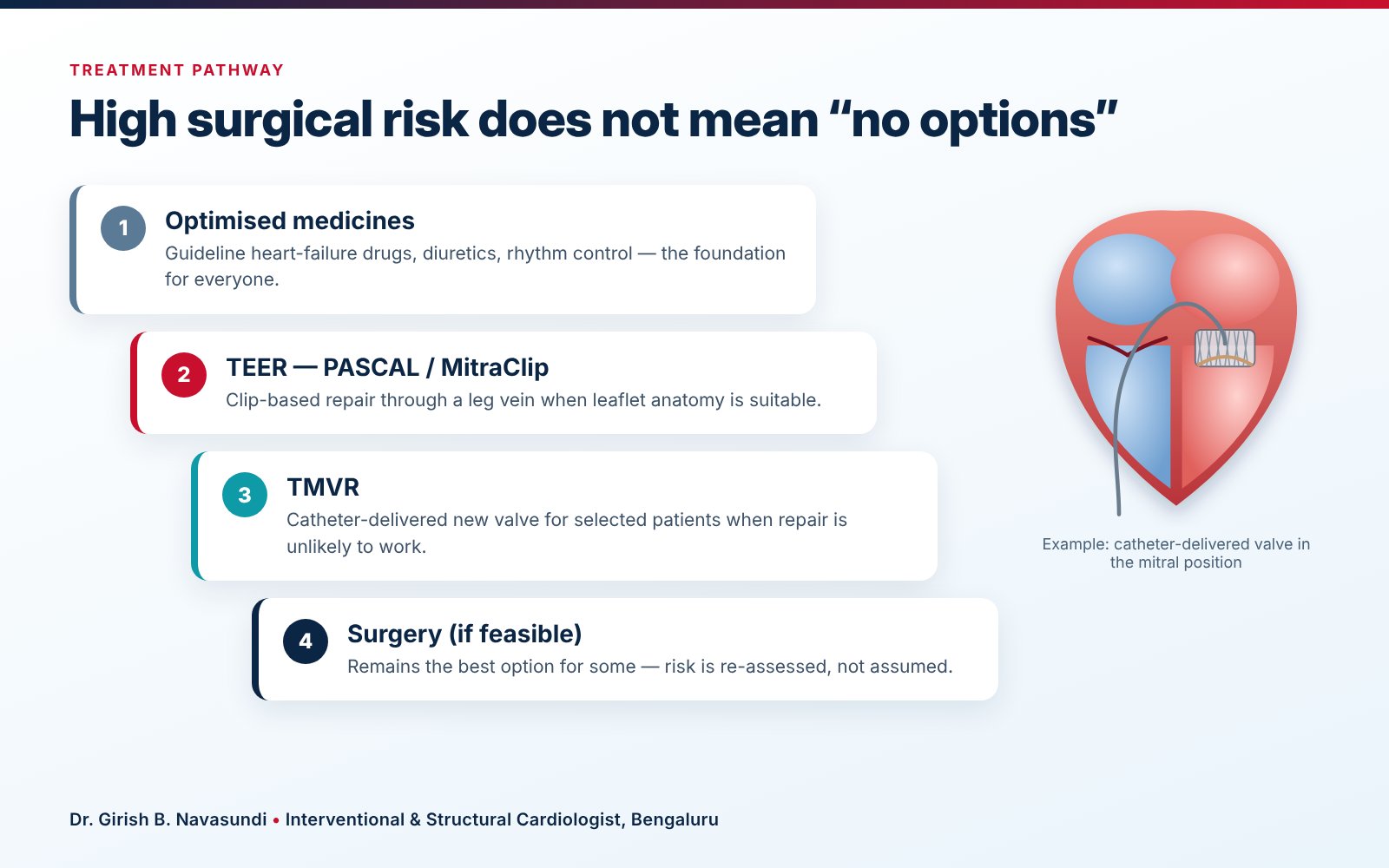
Step 1: Optimised medical therapy
Medicines cannot repair a damaged valve, but they are the foundation of care:
- Diuretics to remove excess fluid and relieve breathlessness
- Guideline-directed heart-failure medicines to support a weak heart
- Rhythm or rate control for atrial fibrillation
- In selected patients, a CRT (biventricular) pacemaker, which can reduce secondary MR
For some patients with secondary MR, optimising these alone reduces the leak meaningfully. For others, symptoms persist — and that is when a valve procedure is considered.
Step 2: TEER — PASCAL and MitraClip
Transcatheter Edge-to-Edge Repair (TEER) is the most established catheter option for mitral regurgitation.
- Performed through a vein in the groin — no chest incision
- No heart-lung machine; the heart keeps beating throughout
- A device (MitraClip or PASCAL) clips the leaking edges of the leaflets together
- Guided in real time by 3D transesophageal echo
- Most patients walk the next day and go home within a few days
TEER can help both primary MR in high-risk patients and selected secondary MR patients who remain symptomatic despite optimal medicines. Growing evidence, including in very elderly patients and more complex anatomy, has steadily expanded who can benefit.
When repair isn’t possible
TEER depends on the valve’s anatomy. It may not be suitable when:
- The valve opening is already narrow (clipping could cause stenosis)
- There is heavy calcium on the leaflets or valve ring
- Leaflets are very short, thick or restricted — as in some rheumatic valves
- The leak is very wide, or comes from several places
- There is a cleft or hole in a leaflet
Step 3: TMVR — when replacement becomes relevant
Transcatheter Mitral Valve Replacement (TMVR) places a completely new valve inside the diseased mitral valve using a catheter. It is a newer field and is considered in carefully selected patients, such as:
- High-risk patients whose valve is not suitable for TEER
- Patients with a failed surgical mitral valve (valve-in-valve) or failed repair ring (valve-in-ring)
- Some patients with severe calcium in the mitral ring (valve-in-MAC)
TMVR needs very detailed CT planning to check the size of the valve ring and to make sure the new valve will not block blood leaving the heart (LVOT obstruction).
Step 4: Surgery — reassessed, not ruled out
“High-risk” is not a permanent label. A Heart Team may find that with better preparation, a minimally invasive approach, or after improving heart function, surgery becomes a reasonable option. In some patients it remains the best long-term solution.
Why not everyone qualifies for a catheter procedure
It is important to be honest: catheter treatments are powerful, but they are not for everyone. A procedure may not be recommended if:
- The anatomy is unsuitable — the valve cannot be clipped safely, or a replacement valve would not fit or would block outflow
- The benefit is unlikely — for example, if the heart muscle is too severely damaged, or other illnesses limit life expectancy and quality of life
- The leak is not the main problem — symptoms may be driven by lung disease, coronary disease or another condition
- Access is difficult — vein or septal anatomy may make the catheter route challenging
A good evaluation tells you not just what can be done, but what is worth doing.
What does the evaluation involve?
- Transthoracic echo to confirm severity and heart function
- 3D transesophageal echo (TEE) to study the leaflets for TEER suitability
- Cardiac CT for TMVR sizing and outflow-tract assessment
- Coronary angiography if blockages may be contributing
- Frailty, kidney and lung assessment
- Heart Team discussion including the patient and family
Questions to ask your doctor
- Is my MR primary or secondary?
- Exactly why am I considered high-risk for surgery?
- Is my valve suitable for TEER on TEE?
- If not, could TMVR be an option?
- Have my medicines been fully optimised?
- What improvement can I realistically expect?
Frequently Asked Questions
If I am too high-risk for surgery, are there still treatment options?
Often, yes. Depending on your valve and overall health, options may include optimised medicines, TEER with PASCAL or MitraClip, or TMVR in selected cases.
Can the mitral valve be treated without opening the chest?
Yes. TEER, and many TMVR procedures, are performed through a vein in the leg using a catheter, without a chest incision or the heart-lung machine.
Am I too old for a mitral clip procedure?
Age alone rarely rules it out. Many patients in their 80s and even 90s have been treated successfully. Frailty, valve anatomy and overall health matter more than age.
Is MitraClip available in India?
Yes. Mitral TEER, including MitraClip and PASCAL systems, is performed at experienced structural heart centres in India.
What is TMVR, and is it available in India?
TMVR is transcatheter mitral valve replacement. It is an evolving therapy offered in carefully selected patients at specialised centres, often as valve-in-valve or valve-in-ring procedures. Suitability depends on detailed CT planning.
Why might I be told I am not suitable for a catheter procedure?
Usually because of valve anatomy (for example a small valve opening or heavy calcium), because the expected benefit is low, or because another condition is driving the symptoms.
How risky is TEER compared with surgery?
TEER is generally less invasive with a faster recovery, which is why it is valuable for high-risk patients. Like any heart procedure, it still carries risks, which your team will explain for your specific case.
Will I still need medicines after a valve procedure?
Most patients do. Heart-failure and rhythm medicines often continue, especially in secondary MR, though doses — particularly diuretics — may be reduced.
Can I get a second opinion if I have been turned down for surgery?
Yes, and it is often worthwhile. A structural heart Heart Team can review your imaging and assess whether catheter-based options are suitable.
Dr. Girish B. Navasundi evaluates patients with severe mitral regurgitation who have been considered high-risk for surgery, including assessment for TEER and other catheter-based valve therapies through a Heart Team approach.
Senior Consultant & Interventional Cardiologist
Apollo Hospitals, Bannerghatta Road, Bengaluru
Legends Heart Center, Jayanagar, Bengaluru
“Too risky for surgery” does not always mean “no options.” Sometimes it means: the valve needs a different route.
This article is for patient education. Treatment should be individualised after clinical evaluation and imaging.