 Apollo Hospitals, Opp.iim 154/11,bannerghatta Road. Bannerghatta Road.bangalore-560076
 6366 229563
 Posted on October 2, 2026
Severe Tricuspid Valve Leakage: Surgery, Clip or Valve Replacement — What Are the New Options in India?
A patient guide to tricuspid regurgitation, right-heart failure, tricuspid surgery, TriClip and TTVR
Your echo report mentions the tricuspid valve — perhaps a valve you had never heard of before. And then:
“My doctor says the right-sided heart valve is leaking badly, but surgery is risky. What else can be done?”
Until recently, the honest answer was often: “not much beyond water tablets.” That is changing fast. In May 2026, Abbott launched TriClip in India — a transcatheter device that repairs a leaky tricuspid valve through a vein in the leg, for patients who may not tolerate surgery. At the same time, transcatheter tricuspid valve replacement (TTVR) has become one of the most active areas in structural heart care worldwide.
This guide explains what tricuspid regurgitation is, why it matters, and how today’s options compare.
What is tricuspid regurgitation?
The tricuspid valve sits on the right side of the heart, between the right atrium (upper chamber) and the right ventricle (lower pumping chamber). The right side of the heart collects blood returning from the body and pumps it to the lungs.
In tricuspid regurgitation (TR), the valve does not close properly. Each heartbeat pushes some blood backward into the right atrium — and from there, back into the veins of the body.
Why does the tricuspid valve leak?
- Secondary (functional) TR — the most common type. The valve leaflets are normal, but the right heart and valve ring have stretched, usually because of long-standing atrial fibrillation, high lung pressures or left-sided valve disease.
- Pacemaker or ICD leads passing through the valve can interfere with leaflet closure.
- Primary TR — the valve itself is damaged, for example by rheumatic disease, infection or a congenital condition.
Why TR was historically undertreated
The tricuspid valve has been called “the forgotten valve.” For years, it received far less attention than the aortic and mitral valves. Reasons include:
- Symptoms develop slowly and are easily blamed on age, kidneys or the liver
- Isolated tricuspid surgery has historically carried high risk, often because patients were referred late
- Medicines (diuretics) could control swelling for a while, delaying referral
- Until recently, there were no catheter-based options
We now know that severe TR is not harmless. Left untreated, it is associated with worsening heart failure, repeated hospitalisation and reduced survival.
Symptoms: when the right heart starts to fail
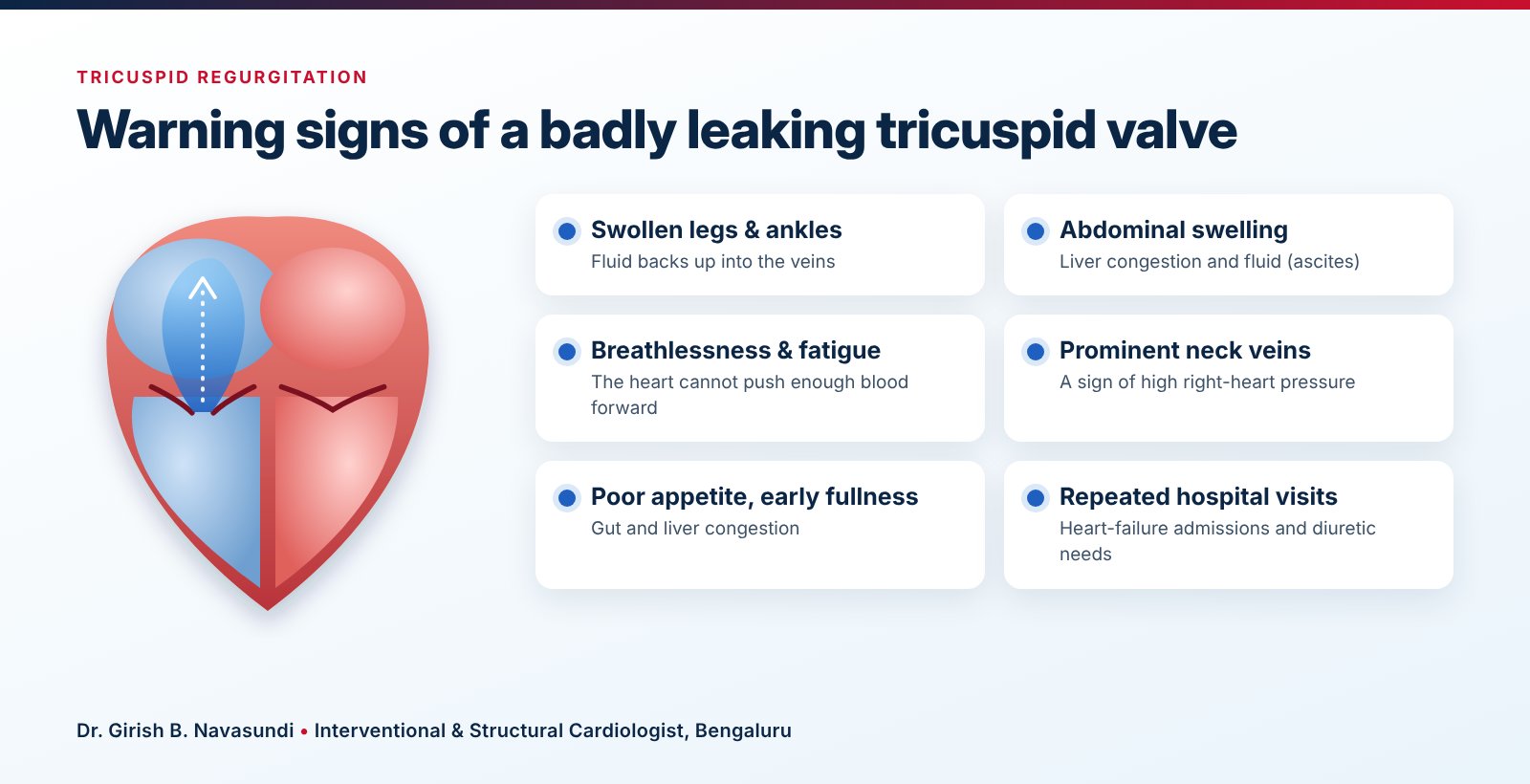
Because the leak pushes blood back into the veins, the symptoms of severe TR are mostly those of right-heart failure:
Swollen legs
Fluid collects in the ankles and legs, often worse by evening. Over time it can climb up the thighs.
Abdominal swelling
The liver becomes congested and fluid can build up in the abdomen (ascites), causing bloating, discomfort, early fullness and loss of appetite.
Breathlessness and fatigue
Less blood is pushed forward to the lungs and body, leading to tiredness, weakness and reduced exercise tolerance.
Right-heart failure
As the right ventricle enlarges and weakens, diuretic doses keep rising, kidney function may worsen, and hospital admissions become more frequent. This is the stage we try to prevent.
The treatment options
1. Medicines
Diuretics relieve swelling, and treating the underlying cause — atrial fibrillation, lung pressures or left-heart disease — is essential. But medicines do not fix the valve, and in severe TR they often become less effective over time.
2. Tricuspid valve surgery
Surgery can either repair the valve (usually with a supporting ring — annuloplasty) or replace it.
- Most commonly performed at the same time as left-sided valve surgery when TR is present
- Can be done as an isolated operation in suitable patients, with better results when done earlier
- Higher risk in patients with advanced right-heart failure, liver or kidney damage, or previous surgery
3. Tricuspid TEER — TriClip
Transcatheter Edge-to-Edge Repair (T-TEER) brings the clip concept, proven on the mitral valve, to the right side of the heart.
- Delivered through a vein in the leg — no chest opening, no heart-lung machine
- A clip grasps the leaking leaflets and holds them together to reduce the leak
- Guided by 3D transesophageal echo
- On average, patients need only around a day in hospital, according to the manufacturer
In the TRILUMINATE Pivotal trial, roughly 90% of patients treated with TriClip had their TR reduced from severe (or worse) to moderate or less at 30 days, with sustained improvement at one year and meaningful gains in quality of life. Two-year findings reported fewer heart-failure hospitalisations.
4. TTVR — Transcatheter Tricuspid Valve Replacement
TTVR places a new valve in the tricuspid position through a catheter. It is especially relevant when:
- The gap between leaflets is too wide to clip
- The leaflets are short, tethered or damaged
- Pacemaker leads make clipping difficult
- A previous surgical tricuspid valve or ring has failed (valve-in-valve / valve-in-ring)
Replacement can eliminate the leak more completely, but it needs detailed CT planning, blood-thinning considerations and, in some patients, a pacemaker afterwards.

Repair vs replacement: who may benefit from each?
| Tricuspid surgery | TriClip (T-TEER) | TTVR | |
|---|---|---|---|
| Approach | Open or minimally invasive surgery | Catheter via leg vein | Catheter via leg or neck vein |
| What it does | Ring repair or new valve | Clips leaflets together | New valve inside the old one |
| Often suits | Lower-risk patients, or those having other heart surgery | High-risk patients with suitable leaflets and moderate gaps | High-risk patients with large gaps or unsuitable leaflets |
| Recovery | Weeks | Days | Days |
| Key considerations | Surgical risk, liver and kidney function | Leaflet anatomy, image quality, pacemaker leads | CT sizing, anticoagulation, possible pacemaker |
The choice depends on the anatomy seen on TEE and CT, the patient’s surgical risk, and the health of the right ventricle — decided by a Heart Team.
Why timing matters
This is perhaps the most important message in this article.
Tricuspid treatment works best before the right ventricle becomes severely enlarged and weak, and before the liver and kidneys are damaged by long-standing congestion. When patients are referred very late, every treatment — surgical or catheter-based — has less to offer.
Consider a specialist evaluation if you have severe TR and:
- Persistent leg or abdominal swelling despite diuretics
- Rising diuretic doses or worsening kidney function
- Repeated heart-failure admissions
- An enlarging right ventricle on echo
- Reduced energy, appetite or exercise capacity
Frequently Asked Questions
What is tricuspid regurgitation?
It is a leak in the tricuspid valve on the right side of the heart, causing blood to flow backward into the right atrium and veins. Severe TR can lead to swelling, fatigue and right-heart failure.
Is severe tricuspid regurgitation dangerous?
Yes, if left untreated. Severe TR is associated with worsening heart failure, repeated hospital admissions and reduced survival. Earlier evaluation gives more treatment options.
Is TriClip available in India?
Yes. Abbott announced the launch of TriClip in India in May 2026 for patients with tricuspid regurgitation who are not good candidates for surgery. Suitability is decided after specialist imaging.
Can the tricuspid valve be repaired without open-heart surgery?
Yes. Tricuspid TEER with TriClip and transcatheter tricuspid valve replacement (TTVR) are performed through a vein, without opening the chest.
What is the difference between TriClip and TTVR?
TriClip repairs the patient’s own valve by clipping the leaflets together. TTVR replaces the valve with a new one delivered by catheter. Replacement is often considered when the leak is too large or the leaflets unsuitable for clipping.
Can I have TriClip if I have a pacemaker?
Possibly. Pacemaker leads can complicate clipping, depending on where they sit in the valve. Detailed TEE assessment will show whether TEER or replacement is more suitable.
Do water tablets (diuretics) cure tricuspid regurgitation?
No. Diuretics relieve swelling but do not fix the valve. In severe TR they often lose effectiveness over time, which is when valve treatment should be considered.
Who is a candidate for tricuspid surgery?
Patients at acceptable surgical risk, especially those having left-sided valve surgery at the same time, or those treated before advanced right-heart failure develops.
How long is the hospital stay after TriClip?
According to the manufacturer, patients on average need about one day in hospital, though this varies with each patient’s condition.
Is it ever too late to treat tricuspid regurgitation?
In very advanced right-heart failure with severe liver or kidney damage, the benefit of any procedure may be limited. That is why timely referral is so important.
Dr. Girish B. Navasundi evaluates patients with severe tricuspid regurgitation and right-heart failure, including assessment for tricuspid surgery, transcatheter repair (TriClip) and transcatheter replacement, through a Heart Team approach.
Senior Consultant & Interventional Cardiologist
Apollo Hospitals, Bannerghatta Road, Bengaluru
Legends Heart Center, Jayanagar, Bengaluru
The “forgotten valve” is forgotten no longer. If your right-sided valve is leaking badly, new options now exist — and timing matters.
This article is for patient education. Treatment should be individualised after clinical evaluation and imaging. Device data cited is from the manufacturer’s published information (Abbott, May 2026).