 By Dr. Girish B Navasundi
Posted on November 8, 2026
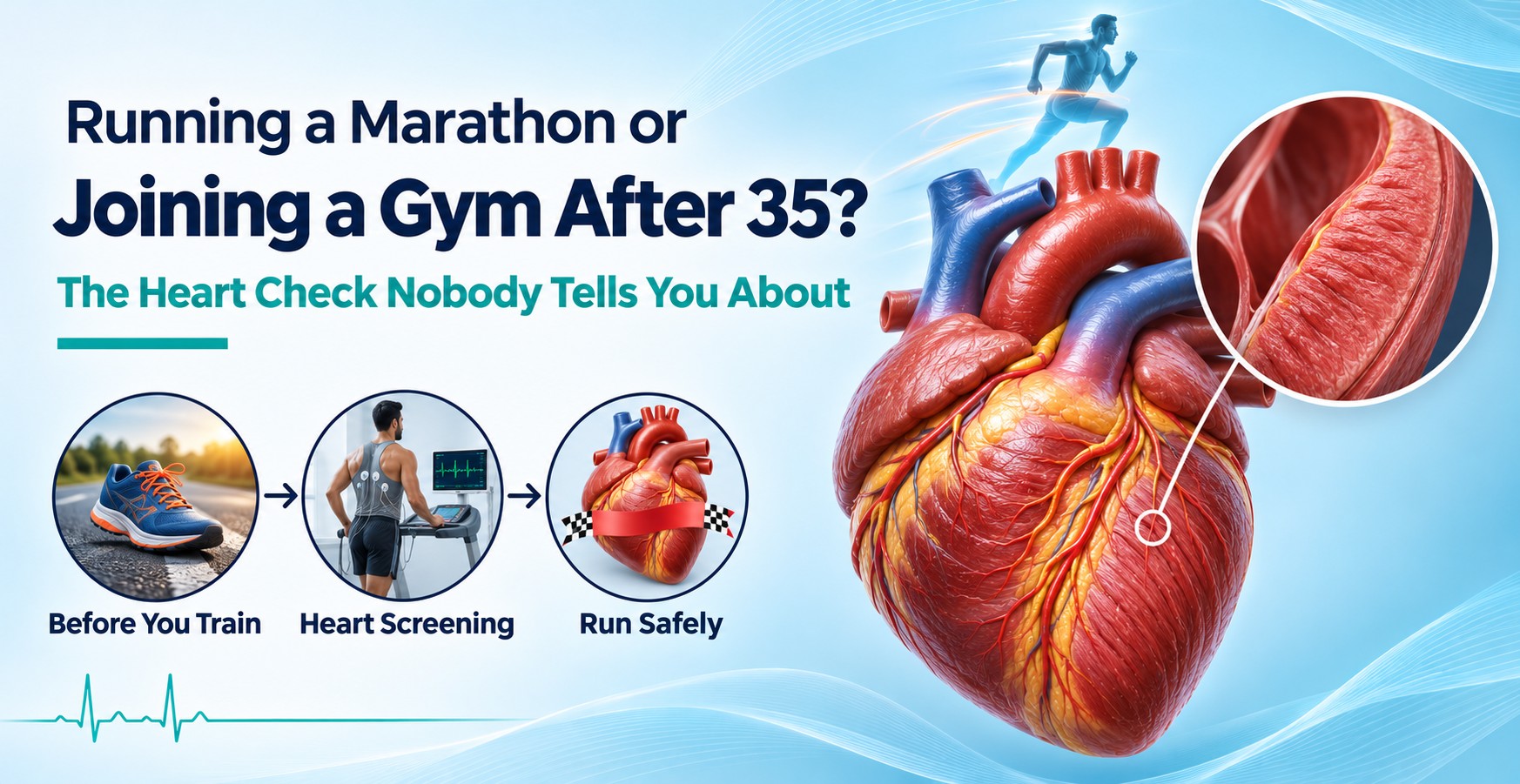
Running the Bengaluru Marathon or Joining a Gym After 35? The Heart Check Nobody Tells You About
Before You Lace Up
“I signed up for the Bengaluru Marathon. Do I really need a heart check-up? I feel perfectly fit.”
Every weekend, Cubbon Park, Lalbagh and the lake trails of Bengaluru fill with runners, cyclists and first-time gym members. Exercise is one of the best things you can do for your heart — but when someone collapses on a run or a gym floor, it shakes everyone. Here’s who should get their heart checked first, what the tests involve, and the warning signs your body gives before it’s too late.
⏱ 8 min read•✍️ Dr. Girish B. Navasundi, Interventional Cardiologist
At a glance
🏃
Exercise protects
Regular activity lowers heart attack risk. This is not a reason to stop.
🔍
Screen smartly
After 35, or with risk factors, a heart check before intense training is wise.
⚠️
Listen to symptoms
Chest tightness, unusual breathlessness or fainting during exercise is never “normal”.
🫀
Know CPR
Hands-only CPR and an AED can save a collapsed runner’s life.
1“Fit” and “Heart-Healthy” Are Not the Same Thing
A good 10K timing tells you about your stamina. It does not tell you whether a cholesterol plaque is quietly building up in a heart artery, or whether you were born with a thickened heart muscle. Many people who have a cardiac event during exercise had felt completely well — or had ignored small warning signs.
What goes wrong also depends on age:
Under 35
Often an inherited condition, such as an abnormally thick heart muscle (hypertrophic cardiomyopathy)
Sometimes an electrical rhythm disorder present since birth
Family history of sudden death at a young age is a key clue
ECG and echocardiogram are often the key tests
Over 35
Most often coronary artery disease — blockages in the heart arteries
A plaque can rupture during intense exertion and trigger a heart attack
Diabetes, smoking, BP, cholesterol and family history raise risk
Stress testing and risk assessment are often added
The goal of screening is not to stop people from running. It is to make sure they can keep running for the next thirty years.
— Dr. Girish B. Navasundi
2Do You Need a Heart Check Before You Start? A Quick Self-Test
Tick any that apply to you. If you tick even one, talk to a cardiologist before starting a marathon plan, CrossFit, HIIT or heavy weight training:
🏁 Pre-training heart self-check
☐ I am over 35 and starting (or restarting) intense exercise after years of inactivity
☐ I have diabetes, high BP, high cholesterol or I smoke / vape
☐ A parent, brother or sister had a heart attack young (men under 55, women under 65)
☐ Someone in my family died suddenly and unexplained before age 50
☐ I have felt chest tightness, unusual breathlessness, palpitations or giddiness while exercising
☐ I have ever fainted during or right after exercise
☐ I use pre-workout stimulants, “fat burners” or anabolic steroids
☐ I have had COVID or a viral illness recently and feel I haven’t fully recovered
3What Does a Sports Heart Check-Up Involve?
A sensible evaluation is not a long list of expensive tests. It is tailored to your age, risk factors and symptoms. Typically it includes:
1
A detailed conversation and examination
Your symptoms, family history, medicines, supplements and training plans. A heart murmur on examination can be an important clue.
2
ECG (electrocardiogram)
A 2-minute test that can pick up rhythm problems, signs of thickened heart muscle and some inherited conditions.
3
Echocardiogram
An ultrasound of the heart that shows its pumping, valves and wall thickness.
4
Treadmill stress test (TMT)
Shows how your heart behaves under exertion — very useful before endurance events, especially above 35–40.
5
Blood tests
Sugar (HbA1c), cholesterol profile and, where needed, other markers.
6
Further tests only if needed
CT coronary angiography, calcium scoring or a Holter monitor are reserved for people whose risk or results call for them.
4Myths Heard at the Starting Line
✗ MYTH
“I run 5 days a week, so my arteries must be clean.”
✓ FACT
Exercise lowers risk but does not cancel genetics, diabetes, smoking or very high cholesterol.
✗ MYTH
“Chest tightness while running is just lack of stamina.”
✓ FACT
New chest discomfort during exertion is a classic warning sign of a blocked artery and needs evaluation.
✗ MYTH
“A gym assessment is the same as a heart check.”
✓ FACT
Body-fat and strength assessments do not evaluate your heart’s arteries, rhythm or muscle.
✗ MYTH
“Pre-workout supplements are harmless energy boosters.”
✓ FACT
Many contain high doses of stimulants that can raise BP and trigger rhythm problems in susceptible people.
5Safe Training Rules for Bengaluru’s Weekend Warriors
1
Build up gradually
Increase your weekly distance or intensity slowly. Going from the sofa to a half marathon in six weeks is risky for your heart and joints.
2
Respect heat and hydration
Midday sun on long runs can strain the heart. Hydrate sensibly — neither too little nor excessive amounts of plain water.
3
Never “push through” warning signs
Stop and get checked if you feel chest discomfort, unusual breathlessness, palpitations or giddiness.
4
Skip the race if you are unwell
Fever or a recent viral illness is a reason to sit out a hard session or race.
5
Know where the medical tents are
On race day, note the medical stations along the route and run with a friend if you can.
🚨 Stop exercising and seek help immediately if you feel
• Chest pain, pressure or tightness
• Breathlessness out of proportion to effort
• Racing, pounding or irregular heartbeat
• Giddiness, blurred vision or near-fainting
• Pain spreading to the arm, jaw or back
• Unusual sweating or sudden exhaustion
If someone collapses and is not breathing normally: call 108, start hands-only CPR and use an AED if available.
6The Skill Every Runner and Gym-Goer Should Learn
When a person collapses from cardiac arrest, survival depends on what bystanders do in the first few minutes. Hands-only CPR — pushing hard and fast in the centre of the chest, about 100–120 times a minute — keeps blood flowing to the brain until an AED (defibrillator) or ambulance arrives.
Running clubs, gyms and apartment associations across Bengaluru can make a real difference by learning CPR and keeping an AED on site. For people at high risk of dangerous rhythms, an implantable device may be advised — read about how ICDs prevent sudden cardiac death.
📝 Key takeaways
→ Exercise is good for the heart — screening is about running safely, not stopping.
→ Above 35, or with risk factors or family history, get a heart check before intense training.
→ Under 35, inherited heart conditions are the main concern; over 35, blocked arteries.
→ Never ignore chest discomfort, palpitations or fainting during exercise.
→ Learn hands-only CPR and know where the AED is.
?Frequently Asked Questions
Should I get a heart check-up before running a marathon in Bangalore?
If you are over 35, starting intense training after a gap, or have diabetes, BP, high cholesterol, smoking or a family history of heart disease, a heart check-up before training is strongly advisable.
Which test is best before starting the gym?
There is no single test for everyone. An ECG and clinical examination are the starting point; an echocardiogram and treadmill test are added based on your age, risk and symptoms.
Can a normal ECG guarantee I won’t have a heart attack while running?
No. A resting ECG can be normal even with significant blockages. That is why a stress test is often added in people above 35–40 or with risk factors.
Is it safe to run after angioplasty or a stent?
Many patients return to running after angioplasty, but only after their cardiologist confirms recovery, medicines are optimised and an exercise plan is agreed.
I felt chest tightness on my last long run but it settled. What should I do?
Stop intense training and get a heart evaluation before your next hard session. Symptoms that settle with rest can still come from a narrowed artery.
Where can I get a heart check-up before a marathon in South Bengaluru?
Dr. Girish B. Navasundi sees patients at Apollo Hospitals, Bannerghatta Road and Legends Heart Center, Jayanagar — convenient for runners from JP Nagar, Banashankari, BTM Layout, Koramangala, HSR Layout and Electronic City.
Training for your next big run?
Get your heart checked before you push your limits. A personalised pre-participation heart evaluation with Dr. Girish B. Navasundi helps you train with confidence. Bring any previous ECGs, reports and your list of supplements.
Apollo Hospitals, Bannerghatta Road · Legends Heart Center, Jayanagar, Bengaluru
GN
Dr. Girish B. Navasundi
Senior Consultant & Interventional Cardiologist · 21+ years
Senior Consultant Cardiologist with a special focus on preventive cardiology, coronary artery disease and complex coronary intervention at Apollo Hospitals and Legends Heart Center, Bengaluru.
This article is for patient education only and does not replace a personal consultation. Treatment is individualised after full clinical evaluation. References: AHA/ACC Scientific Statements on Cardiovascular Screening of Competitive Athletes; ACSM Guidelines for Exercise Testing and Prescription; ESC Guidelines on Sports Cardiology and Exercise in Patients with Cardiovascular Disease.
 Apollo Hospitals, Opp.iim 154/11,bannerghatta Road. Bannerghatta Road.bangalore-560076
 6366 229563