 Apollo Hospitals, Opp.iim 154/11,bannerghatta Road. Bannerghatta Road.bangalore-560076
 6366 229563
 Posted on September 7, 2026
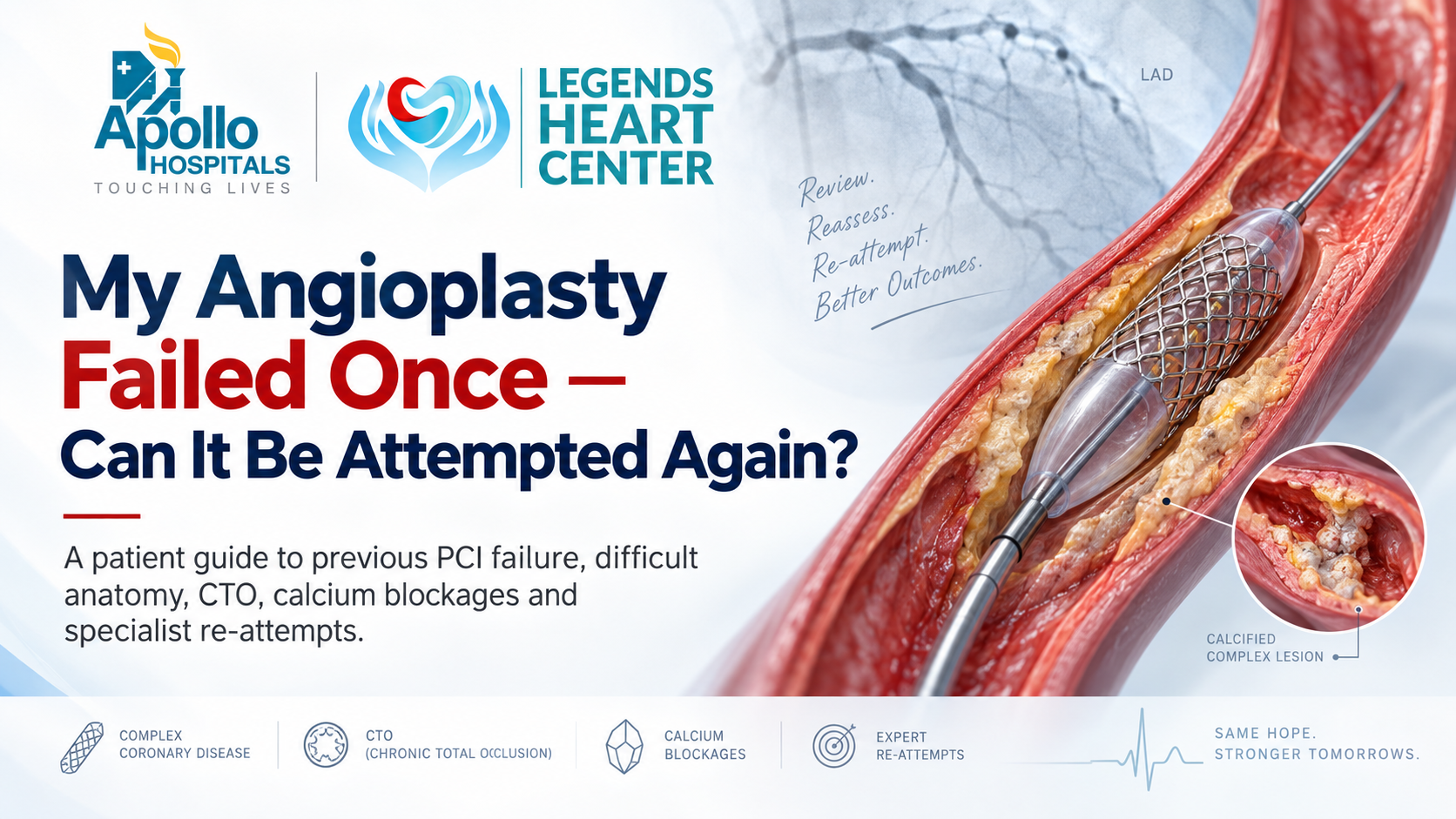
My Angioplasty Failed Once — Can It Be Attempted Again?
A patient guide to failed PCI, complex blockages, CTO, severe calcium and planning a specialist re-attempt
Being told that an angioplasty could not be completed can be discouraging.
You may have gone into the procedure expecting the artery to be opened, only to hear afterward:
“We couldn’t cross the blockage.”
Or:
“The artery was too calcified.”
Sometimes the explanation is simply:
“The anatomy was too difficult, so we stopped.”
A failed angioplasty does not automatically mean that the artery can never be treated.
In complex coronary disease, there are situations where stopping the first procedure is actually the safer decision. A later procedure may be reconsidered after the angiogram is reviewed in detail, the reason for failure is understood, and a different strategy is planned.
The most important question is therefore not:
“Why didn’t the first angioplasty work?”
It is:
“What made it difficult, and would a carefully planned second attempt offer enough benefit to justify the risk?”
First: What Does a “Failed Angioplasty” Actually Mean?
A failed PCI does not always mean something went wrong.
Sometimes the cardiologist begins the procedure, evaluates the anatomy in real time and decides that continuing would expose the patient to unnecessary risk.
For example, the procedure may be stopped because:
- A guidewire cannot safely cross the blockage
- The artery is completely blocked
- The lesion is heavily calcified
- A balloon cannot expand adequately
- The artery is extremely tortuous
- An important branch is at risk
- The procedure is taking too long
- Too much contrast has already been used
- The patient’s blood pressure or clinical condition changes
- The operator determines that a different strategy or equipment is required
In such situations, stopping can be a deliberate safety decision rather than a failure of care.
Why Can Some Heart Blockages Be So Difficult to Treat?
Not every coronary blockage behaves the same way.
A straightforward narrowing may allow a wire, balloon and stent to pass relatively easily.
A complex lesion can be very different.
Several anatomical problems may exist together.
1. The Artery May Be 100% Blocked
A completely blocked artery that has been closed for a prolonged period is called a Chronic Total Occlusion, or CTO.
A CTO is not simply a very tight narrowing.
The normal channel through the artery may no longer be visible.
The blockage can contain:
- Dense fibrous tissue
- Calcium
- Old organised material
- Long segments of disease
A standard angioplasty wire may therefore be unable to cross it.
This is one of the most common reasons why a procedure may require specialised techniques.
2. The Blockage May Be Heavily Calcified
Calcium can make an artery rigid.
Even if the guidewire successfully crosses the lesion, a conventional balloon may not be able to expand it adequately.
This creates an important problem.
A coronary stent needs to expand properly and sit firmly against the artery wall.
If severe calcium prevents this, placing a stent prematurely may result in stent under-expansion, which can create problems later.
The cardiologist may therefore decide that the calcium needs to be modified before proceeding.
3. The Artery May Be Very Tortuous
Some coronary arteries have multiple sharp bends.
Advancing equipment through these arteries can be difficult because the catheter, balloon or stent may not have enough support to reach the blockage.
A lesion that appears technically straightforward on one image may therefore become challenging once treatment begins.
4. The Blockage May Be Very Long
A short lesion and a 40–50 mm diseased segment are not the same procedure.
Long blockages can require:
- More guidewire manipulation
- Longer stents
- Multiple stents
- More vessel preparation
- More imaging
- Greater attention to stent expansion
Long lesions are particularly challenging when severe calcium or vessel tortuosity is also present.
5. The Blockage May Sit at a Branch Point
A coronary artery often divides into two branches.
If the narrowing sits directly at that junction—a bifurcation lesion—the cardiologist has to treat the main vessel while protecting the important side branch.
Sometimes a one-stent approach is possible.
More complex lesions may require a dedicated two-stent strategy.
The concern is not simply whether the main artery can be opened, but whether both important pathways can be preserved safely.
6. Previous Stents May Have Created a New Challenge
Some patients return with a narrowing inside or around a previously implanted stent.
This may occur because of:
- Restenosis
- Stent under-expansion
- Significant underlying calcium
- Disease at the stent edge
- Multiple layers of previous stents
Simply placing another stent is not always the best answer.
The reason the previous treatment failed must first be understood.
Does One Failed Attempt Mean Another One Will Also Fail?
No.
The first procedure can provide extremely valuable information.
It shows the interventional cardiologist:
- Where the wire could not pass
- How the blockage behaves
- Whether severe calcium is present
- Which direction the artery takes
- Whether collateral vessels are available
- How much guide-catheter support is needed
- Whether specialised imaging may help
- Which equipment should be available during a second procedure
This allows a repeat procedure to be approached as a newly planned intervention, rather than simply repeating the same steps.
The Second Attempt Should Not Simply Be “Try Again”
This is one of the most important points for patients.
A meaningful re-attempt usually begins before the patient enters the catheterisation laboratory.
The previous angiogram should be reviewed carefully.
The cardiologist may analyse:
- The exact location of the blockage
- Its length
- Calcium burden
- Vessel diameter
- Side branches
- Collateral circulation
- Previous stents
- Distal vessel quality
- The route taken during the previous attempt
From there, an alternative strategy can be created.
If the Problem Was a CTO, What Can Be Different the Second Time?
CTO intervention has evolved considerably beyond simply pushing a wire from the front.
Depending on the anatomy, the operator may use different strategies.
Antegrade wire escalation
The blockage is approached from the front using progressively specialised guidewires.
Antegrade dissection and re-entry
In selected cases, the guidewire may deliberately travel around part of the blockage before re-entering the true artery channel further downstream.
Retrograde CTO approach
Some blockages can be approached from the opposite direction through collateral vessels.
This can be useful when the conventional forward route is unsuccessful.
A failed antegrade attempt, therefore, does not automatically mean that every possible CTO strategy has been exhausted.
If Calcium Stopped the First Procedure, What Can Be Done?
Severe coronary calcium often requires lesion preparation before stenting.
Different technologies may be considered depending on the type, depth and distribution of calcium.
Intravascular Lithotripsy — IVL
IVL uses pressure waves delivered from a specialised balloon to fracture calcium inside the vessel wall.
This can make a rigid artery more compliant so that a stent can expand more effectively.
It is particularly useful for selected calcified lesions.
Rotational or Orbital Atherectomy
Atherectomy devices can modify heavily calcified plaque using specialised mechanisms.
These are generally reserved for selected lesions where conventional balloons cannot adequately prepare the vessel.
Specialised Cutting or Scoring Balloons
These balloons can help modify resistant plaque in some cases before stenting.
Laser Angioplasty
Excimer laser coronary angioplasty can be useful in certain difficult coronary situations.
However, laser is not a universal treatment for every calcified or completely blocked artery.
Its value depends on the exact lesion and the reason the previous PCI failed.
This is why the technology should follow the anatomy—not the other way around.
Why IVUS or OCT May Change the Strategy
A conventional angiogram shows the outline of the coronary artery.
But in complex PCI, the operator may need to understand what is happening inside the artery.
That is where intravascular imaging becomes valuable.
IVUS — Intravascular Ultrasound
IVUS can help assess:
- Vessel diameter
- Plaque burden
- Calcium
- Stent expansion
- Stent position
- Left-main anatomy
- Why a previous stent may have failed
OCT — Optical Coherence Tomography
OCT provides extremely detailed images of the artery.
It can help evaluate:
- Calcium characteristics
- Stent under-expansion
- Stent malapposition
- Edge problems
- Restenosis mechanisms
A repeat procedure is often more successful when the cardiologist understands why the previous treatment did not work, rather than treating only what appears on the angiogram.
What If the Heart Is Weak?
Some patients needing a complex repeat PCI also have reduced heart pumping function.
This can make the procedure higher risk.
For selected patients, the cardiology team may plan:
- Staged treatment
- Additional haemodynamic monitoring
- Shorter procedures
- Mechanical circulatory support in carefully selected situations
Devices such as an intra-aortic balloon pump or other circulatory-support systems may occasionally be considered.
They are not needed for every complex PCI.
Their use depends on the patient’s heart function, coronary anatomy and overall procedural risk.
Should Every Failed Angioplasty Be Attempted Again?
No.
The fact that a procedure is technically possible does not necessarily mean that it should be performed.
A second attempt should ideally have a clear clinical purpose.
Doctors may consider questions such as:
Are symptoms still significant?
Persistent angina, breathlessness or severe activity limitation may support reconsidering treatment.
Is enough heart muscle at risk?
Treating an artery that supplies viable, ischemic heart muscle may provide more meaningful benefit.
Is the heart muscle still alive?
In some CTO cases, viability assessment may be useful.
Are medications already optimised?
Some patients can be managed effectively without another intervention.
Would bypass surgery provide a better result?
Complex PCI is not automatically preferable simply because it is less invasive.
Does the expected benefit justify the procedural risk?
This remains the most important question.
What If Bypass Surgery Has Also Been Ruled Out?
This is an important group of patients.
Some people have complex coronary disease but are considered too high-risk for bypass surgery because of factors such as:
- Advanced age
- Poor heart function
- Severe lung disease
- Kidney dysfunction
- Previous bypass surgery
- Frailty
- Multiple medical conditions
For selected patients, high-risk complex PCI may then be considered.
You may also hear the term CHIP PCI — Complex High-Risk Indicated PCI.
For patients, “complex angioplasty” or “high-risk angioplasty” is usually easier terminology.
The principle is the same: treatment is carefully planned for patients whose coronary anatomy and medical condition make routine intervention inappropriate.
What About a Previous Failed Bypass Graft?
A patient who has previously undergone CABG may later develop disease in:
- The bypass graft
- The original native coronary artery
- Both
A failed graft does not always mean another bypass operation is necessary.
In some patients, the interventional cardiologist may consider treating the native coronary artery, even if it is complex or completely blocked.
This can sometimes involve CTO techniques.
Again, the decision depends on the individual’s anatomy and overall health.
What Makes a Repeat Procedure More Complex?
A second attempt may require more time and planning than routine angioplasty.
The operator may need:
- Special CTO guidewires
- Microcatheters
- Guide-extension catheters
- Intravascular imaging
- Calcium-modification technology
- Multiple access strategies
- Additional contrast planning
- Mechanical support in selected cases
For this reason, the question is not simply whether another cardiologist is willing to attempt the procedure.
It is whether there is a clear alternative strategy for overcoming the problem encountered the first time.
A Patient Example
Imagine a patient with a completely blocked right coronary artery.
The first angioplasty attempt is stopped because the wire cannot cross the blockage.
The patient continues to experience exertional chest discomfort despite medical therapy.
During review of the previous angiogram, another strategy may become apparent.
The blockage may have:
- A difficult entry point
- Severe calcium
- An ambiguous vessel course
- Collateral circulation from another coronary artery
Instead of simply repeating the original wire approach, the repeat procedure may involve:
- Different guide-catheter support
- A microcatheter
- Specialised CTO wires
- IVUS guidance
- A retrograde strategy if appropriate
The important difference is not simply more effort.
It is better information and a different plan.
When Might a Second Opinion Be Particularly Valuable?
A complex PCI review may be reasonable if you have been told:
“We couldn’t cross the blockage.”
Especially when the artery is a CTO.
“The artery is too calcified.”
Modern calcium-modification technologies may deserve consideration.
“The balloon wouldn’t expand.”
This may indicate severe calcification or another mechanism that needs to be understood.
“A stent couldn’t be delivered.”
Additional support techniques may sometimes help.
“You’ve already had bypass surgery, so there are no options.”
Post-CABG patients can sometimes have native-vessel or graft PCI options.
“The anatomy is too complex.”
Complexity can mean many different things. Understanding exactly what makes the anatomy difficult is essential before deciding that no further treatment is possible.
Bring the Actual Angiogram, Not Just the Report
This is especially important after an unsuccessful angioplasty.
A written report might say:
“Attempted CTO PCI unsuccessful.”
That does not tell the next cardiologist:
- Where the wire stopped
- How long the blockage is
- Whether calcium is present
- Whether another pathway exists
- What equipment was used
- Whether a retrograde approach is possible
If possible, bring:
- The actual coronary angiogram/CD
- Previous angioplasty report
- Previous stent details
- CABG records, if applicable
- Echocardiogram
- Recent kidney-function tests
- Current medication list
The images may be far more valuable than the written summary alone.
Questions to Ask Before a Second Angioplasty Attempt
1. Why did the first procedure fail?
Ask for the specific technical reason rather than only hearing that the blockage was “difficult.”
2. What will be different during the second attempt?
There should ideally be a reasoned alternative strategy.
3. Is this a chronic total occlusion?
If yes, ask whether specialised CTO techniques may be relevant.
4. Is severe calcium part of the problem?
If yes, ask whether calcium-modification treatment will be needed.
5. Would IVUS or OCT help?
Imaging may clarify anatomy and improve treatment planning in selected cases.
6. Is the heart muscle supplied by this artery still benefiting from blood flow restoration?
This helps determine whether reopening the vessel is clinically worthwhile.
7. Would bypass surgery be a better option?
A repeat PCI is not always the preferred treatment.
8. What improvement should I realistically expect?
The purpose may be symptom improvement, better exercise capacity or another specific clinical objective.
9. What are the additional risks of trying again?
A re-attempt may be more complex than routine PCI, so the risks should be discussed clearly.
10. What happens if the artery still cannot be opened?
It is useful to understand the alternative treatment plan before the procedure begins.
Frequently Asked Questions
Can a failed angioplasty be attempted again?
Yes, in selected patients. A repeat attempt may be considered when there is a reasonable likelihood of technical success and meaningful clinical benefit.
How long should I wait before trying again?
There is no universal waiting period. Timing depends on why the first procedure was stopped, kidney function, symptoms, clinical urgency and the planned strategy.
Is a second attempt more dangerous?
It may be more technically complex. Risk depends on the artery involved, heart function, calcium, CTO complexity, kidney function and the overall health of the patient.
If the wire couldn’t cross once, how will it cross the next time?
Different guidewires, microcatheters, imaging and alternative CTO approaches may allow a different strategy.
Can laser angioplasty solve a failed PCI?
Sometimes laser has a role, but not in every failed angioplasty. The treatment must be chosen according to the specific mechanism of failure.
Can calcium make angioplasty impossible?
Severe calcium can make PCI difficult, but modern calcium-modification techniques have expanded treatment possibilities in selected patients.
Is a 100% blocked artery always treatable?
No. Some CTOs can be opened with specialised techniques, while others may not be suitable or may not provide sufficient clinical benefit to justify intervention.
Can angioplasty be done after bypass surgery?
Yes, selected patients can undergo PCI after previous CABG. The cardiologist may treat either a bypass graft or the original native artery depending on the anatomy.
Should I automatically seek another angioplasty after the first failed?
No. The priority is to understand whether another intervention is likely to improve your symptoms or clinical outcome and whether the expected benefit justifies the risk.
One Failed Attempt Is Not Always the End of the Discussion
Complex coronary disease sometimes requires more than one strategy.
A first angioplasty may reveal important information about a CTO, severe calcium, difficult vessel anatomy or an existing stent problem.
For the right patient, that information can be used to design a more deliberate second procedure.
But the objective should never be:
“Open the artery at any cost.”
The better objective is:
“Understand why the first procedure failed, determine whether reopening the artery will genuinely help, and then choose the safest strategy available.”
Had an Angioplasty That Could Not Be Completed?
Dr. Girish B. Navasundi evaluates patients with complex coronary disease, including difficult coronary blockages, CTOs, calcified lesions, multivessel disease, previous interventions and high-risk PCI situations.
Dr. Girish B. Navasundi
Senior Consultant & Interventional Cardiologist
Apollo Hospitals, Bannerghatta Road, Bengaluru
Legends Heart Center, Jayanagar, Bengaluru
If you are seeking an opinion after an unsuccessful angioplasty, bring your original angiogram images/CD and previous procedure records whenever possible.
A failed first attempt answers one question:
“What did not work?”
A careful review can help answer the more important one:
“Is there a different and appropriate way forward?”
This article is intended for patient education and does not replace personalised evaluation by a cardiologist. Not every failed PCI should be re-attempted, and treatment decisions depend on symptoms, coronary anatomy, heart function and overall clinical risk.