 Apollo Hospitals, Opp.iim 154/11,bannerghatta Road. Bannerghatta Road.bangalore-560076
 6366 229563
 Posted on September 18, 2026
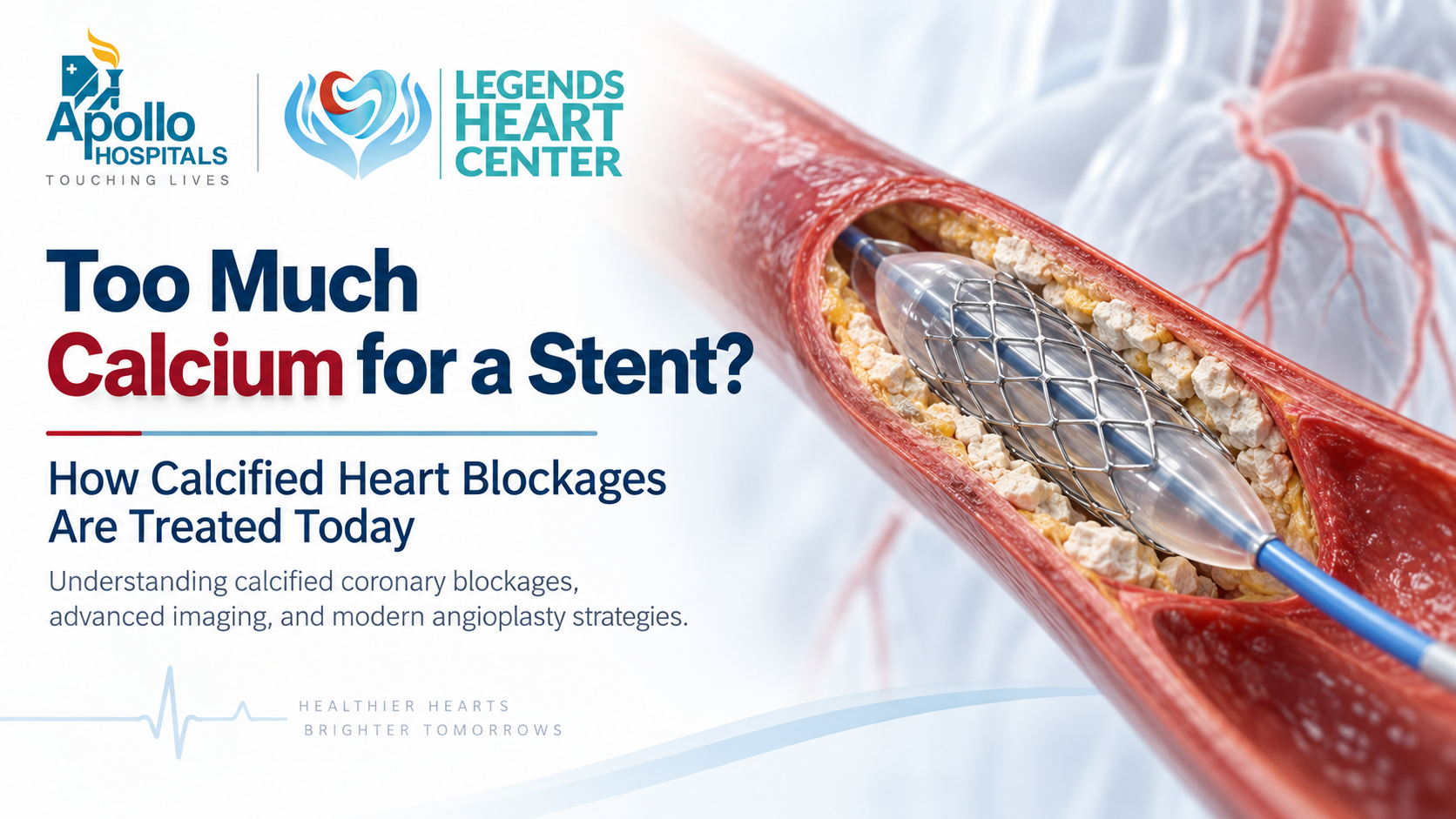
Too Much Calcium for a Stent? How Calcified Heart Blockages Are Treated Today
A heart blockage is not always soft plaque.
Sometimes the artery becomes heavily calcified — almost rigid.
That changes everything.
A balloon may not expand properly. A stent may not open fully. And if a stent is placed without preparing the artery correctly, the result may be less durable.
So when a patient hears:
“Your artery has too much calcium.”
it does not automatically mean angioplasty is impossible.
It means the procedure may need a more advanced strategy.
Why is calcium a problem during angioplasty?
A heavily calcified coronary artery can behave like a stiff pipe.
During routine angioplasty, a balloon is inflated to widen the narrowed artery before a stent is placed.
But severe calcium may prevent the artery from expanding.
This can lead to:
- Poor balloon expansion
- Difficulty delivering the stent
- Incomplete stent expansion
- Higher risk of restenosis
- Need for a more complex PCI strategy
The goal is therefore not simply to push harder with a balloon.
The artery often needs to be prepared first.
How do doctors know how much calcium is present?
An angiogram can suggest calcium, but it may not show its full extent.
Advanced imaging such as IVUS or OCT can help reveal:
- How much calcium is present
- How thick it is
- Whether it surrounds the artery
- Vessel size
- Where the stent should be placed
This helps the cardiologist choose the right treatment.
What treatments can modify calcium?
Intravascular Lithotripsy — IVL
IVL uses pressure waves delivered through a specialised balloon to fracture calcium inside the artery wall.
This can make the artery more flexible and allow the stent to expand better.
Rotational Atherectomy
A specialised device is used to modify very hard calcified plaque.
It may be considered when conventional balloons cannot adequately prepare the lesion.
Cutting or Scoring Balloons
These balloons are designed to create controlled modification of resistant plaque.
They may be useful in selected lesions.
Laser Angioplasty
Laser can have a role in certain difficult coronary situations, but it is not the standard solution for every calcified blockage.
The treatment depends on the exact anatomy and mechanism of the problem.
Why does stent expansion matter so much?
A stent works best when it is fully expanded and well positioned against the artery wall.
If severe calcium keeps the stent compressed, the patient may face a greater chance of future problems.
That is why modern complex PCI often focuses on one principle:
Prepare the artery first. Implant the stent second.
Does every calcium blockage need advanced treatment?
No.
Mild calcium may be managed with conventional angioplasty.
Advanced calcium-modification techniques are generally reserved for lesions where the calcium significantly affects the ability to safely and effectively perform PCI.
What if a previous angioplasty failed because of calcium?
A previous unsuccessful procedure does not always mean another attempt is impossible.
A specialist review may help determine:
- Why the balloon did not expand
- Whether a stent was under-expanded
- How severe the calcium really is
- Whether IVUS or OCT would help
- Whether IVL, atherectomy or another strategy may be appropriate
A repeat procedure should be based on a different plan, not simply repeating the same attempt.
Quick FAQs
Can calcium in heart arteries be removed completely?
Usually the goal is not to remove every bit of calcium. The aim is to modify enough calcium so the artery and stent can expand properly.
Is calcified angioplasty more risky?
It can be more complex than routine angioplasty, which is why careful planning and appropriate technology are important.
Can IVL replace all other calcium treatments?
No. IVL is useful in selected lesions, but other techniques may be more suitable in different situations.
Can a calcified blockage still be stented?
Yes, many calcified lesions can be treated, but the artery may need preparation before stenting.
Should every heavily calcified artery be treated with PCI?
No. Treatment depends on symptoms, anatomy, heart function, other blocked vessels and whether bypass surgery may offer a better option.
Told Your Artery Is “Too Calcified”?
Severe calcium can make angioplasty difficult, but today it can often be approached with advanced imaging, calcium-modification techniques and carefully planned complex PCI.
Dr. Girish B. Navasundi evaluates patients with complex and calcified coronary blockages, multivessel disease, CTOs and previous difficult angioplasty procedures.
Senior Consultant & Interventional Cardiologist
Apollo Hospitals, Bannerghatta Road, Bengaluru
Legends Heart Center, Jayanagar, Bengaluru
A calcified blockage does not always mean “no option.”
Sometimes it means:
the artery needs a different strategy before the stent goes in.
This article is for patient education. Treatment should be individualised after clinical and angiographic evaluation