My Father Is 80 and Needs a Heart Valve Replacement — Is TAVR Safe at His Age?
By Dr. Girish B Navasundi Posted on October 29, 2026
My Father Is 80 and Needs a Heart Valve Replacement — Is TAVR Safe at His Age?
For Families of Elderly Heart Patients
“Appa is 80. Can he really go through a heart valve operation?”
When an elderly parent is told they need a valve replacement, the whole family feels the fear. Today, many older patients don’t need open-heart surgery at all. Here’s how TAVR works, who it suits, and the questions to ask before you decide.
⏱ 7 min read•✍️ Dr. Girish B. Navasundi, Interventional Cardiologist
At a glance
🫀
No open chest
The new valve goes in through a small puncture, usually in the groin.
😌
Often no general anaesthesia
Many TAVR procedures are done under local anaesthesia with mild sedation.
🚶
Walking in 1 to 2 days
Most uncomplicated patients are up and walking quickly.
📋
Fitness over age
The heart team looks at overall health, not just the number 80.
1What Is Happening Inside the Heart?
The aortic valve is the main door through which your heart pumps blood to the entire body. With age, calcium deposits can make this door stiff and narrow. Doctors call this aortic stenosis.
Families often notice the signs long before anyone names them, and usually blame them on “old age”:
😮💨
Breathlessness
While walking, climbing stairs or even talking.
💢
Chest tightness
A heavy or squeezing feeling on exertion.
💫
Giddiness or fainting
Especially on standing or walking.
🪫
Tiredness
“He has slowed down a lot” is often the first clue.
💡 Important: once severe aortic stenosis starts causing symptoms, medicines cannot open the valve. Without valve replacement, the outlook becomes poor within a few years. Timely evaluation matters, even at 80 or 90.
2TAVR in 4 Simple Steps
1
A small entry point
A thin tube (catheter) is passed through an artery in the groin. No chest incision is needed.
2
A guided journey to the heart
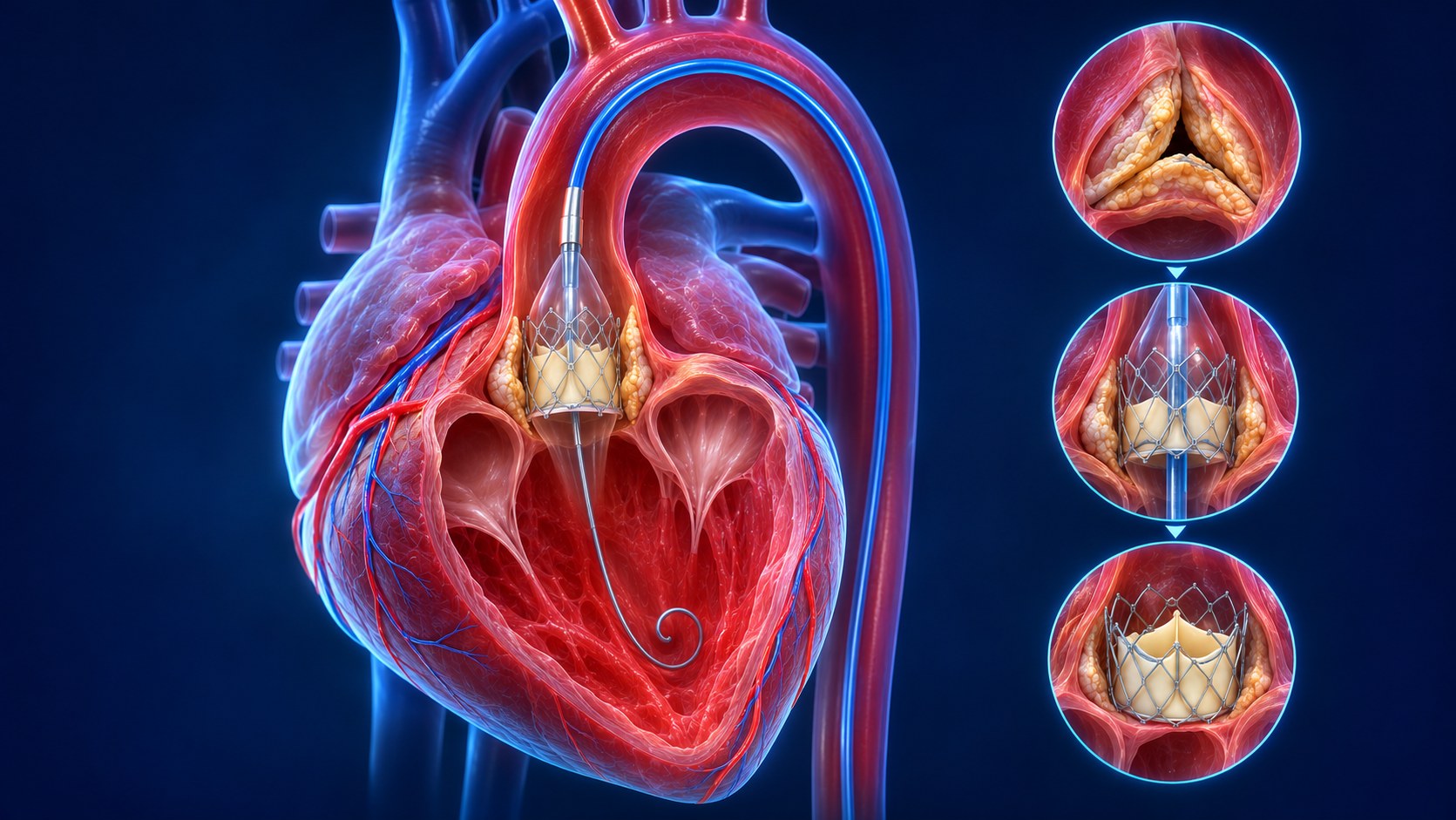
Under X-ray guidance, the folded new valve travels up the aorta, around the aortic arch and down to the heart.
3
The new valve is opened
It is expanded right inside the old, narrowed valve, pushing the calcified leaflets aside.
4
It starts working immediately
Blood flows freely through the new valve from the very first heartbeat. The catheter is removed.
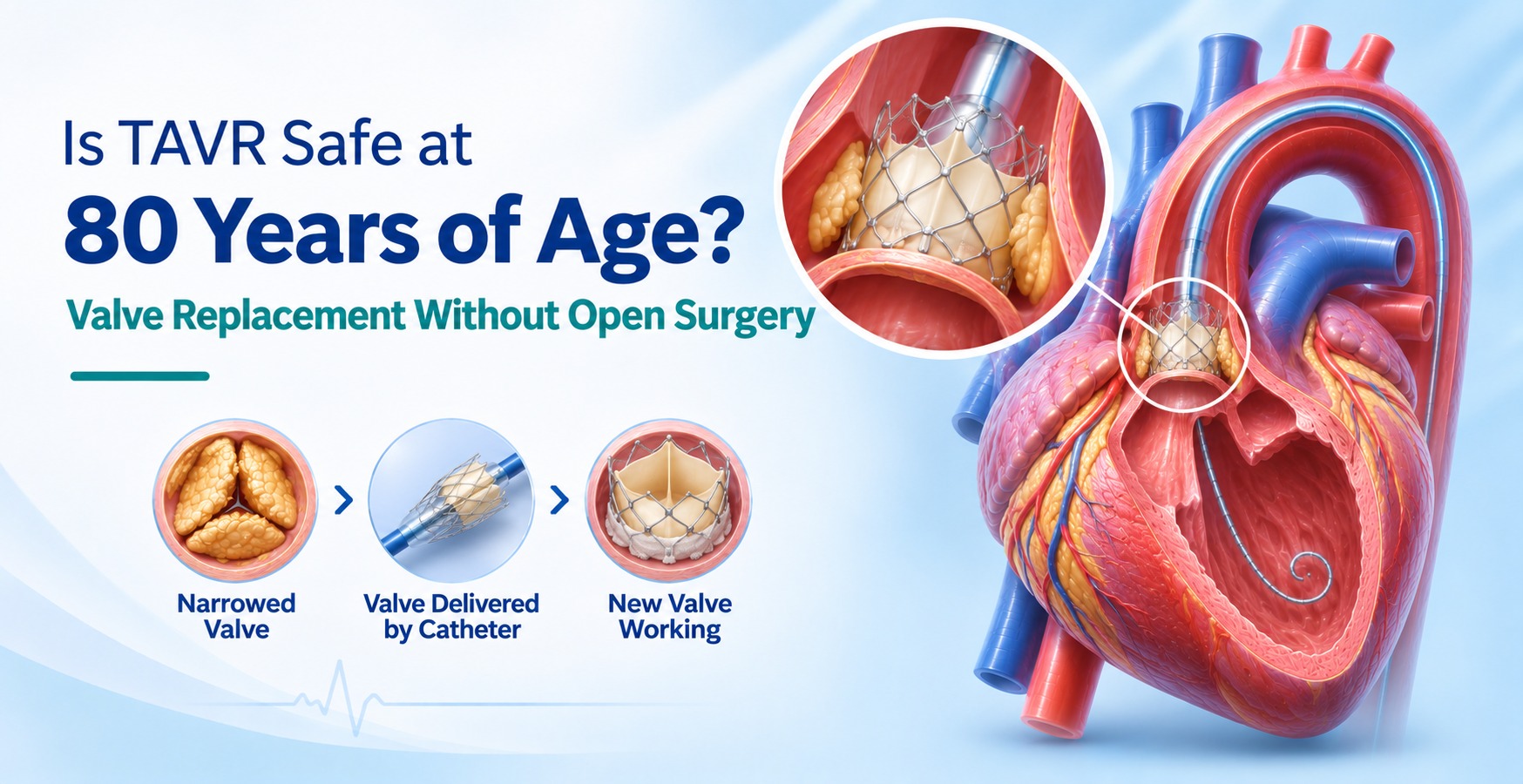
The new valve is guided up through the aorta and expanded inside the old, narrowed valve.
3TAVR vs Open-Heart Surgery: How Do They Compare?
TAVR (keyhole valve)
Open-heart valve surgery
Chest incision
No. Small groin puncture
Yes. Breastbone is opened
Heart-lung machine
Not needed
Needed
Anaesthesia
Often local + sedation
General anaesthesia
Typical hospital stay
A few days
About a week or more
Back to light routine
Usually 1 to 2 weeks
Usually 6 to 8 weeks
Most suited for
Elderly or higher-risk patients with suitable anatomy
Younger patients, or when other heart surgery is also needed
Recovery times vary from person to person. Your heart team will explain what to expect for your parent.
4So, Is TAVR Safe at 80?
“Age alone is not the deciding factor. The real question is: is he suitable, and will it help him live better?
TAVR was first developed for elderly and high-risk patients. Today, international guidelines generally favour TAVR over open surgery for most patients above 80 with severe symptomatic aortic stenosis, provided the anatomy is suitable. What the heart team really looks at:
✓Frailty and mobility: can your parent walk and manage daily activities?
✓Valve and artery anatomy on CT: valve size, calcium pattern, width of the groin arteries.
✓Expected benefit: will it genuinely improve quality of life?
5How Is My Parent Evaluated?
🩻
Echocardiogram
Confirms how tight the valve is and how well the heart pumps.
🖥️
TAVR CT scan
Precisely measures the valve and arteries to choose the right valve size and route.
🩺
Coronary angiogram
Checks for blockages in the heart arteries.
🧪
Blood tests & ECG
Kidney function, haemoglobin, rhythm and overall fitness.
👥
Heart team meeting
Cardiologist, cardiac surgeon and the family decide together.
6Let’s Talk Honestly About Risks
No heart procedure is completely risk-free, and families deserve straight answers. Possible risks of TAVR include:
⚡
Pacemaker
The new valve can affect the heart’s electrical system. One of the more common issues, and manageable.
🩹
Groin bleeding
Bleeding or problems at the artery entry site.
🧠
Stroke
Uncommon, but important to discuss.
💧
Small valve leak
A small leak around the new valve, usually mild.
🫘
Kidney strain
From contrast dye, especially if kidneys are already weak.
💡 Careful CT-based planning and an experienced team reduce these risks. Ask which risks apply most to your parent.
7Recovery: What Families Can Expect
1
Day 0 to 1
Short ICU or monitored stay. Many patients sit up and start walking with support.
2
Day 2 to 4
Discharge in many uncomplicated cases, with medicines and instructions.
3
Week 1 to 2
Gradual return to light home activities.
4
Weeks to months
Many patients notice easier breathing and more energy. Regular echo follow-up continues.
85 Questions to Ask the Heart Team
✓Are the symptoms clearly due to the valve?
✓Is my parent suitable for TAVR, surgery or both, and why?
✓Will it be done through the groin, and under local or general anaesthesia?
✓What are the specific risks for my parent, including the chance of a pacemaker?
✓What will recovery and follow-up look like?
?Frequently Asked Questions
Is TAVR possible above 85 or 90?
Yes. TAVR is performed in patients in their late 80s and 90s who are otherwise reasonably fit and likely to benefit. The decision is based on overall health, not age alone.
How long does a TAVR valve last?
Current evidence shows good valve function over many years of follow-up. For most elderly patients, the valve is expected to last well beyond their need.
Will there be stitches on the chest?
No. In the usual groin approach there is no chest incision, only a small puncture.
My parent has kidney problems. Is TAVR still possible?
Often yes, with special precautions to minimise contrast dye and protect the kidneys. This is assessed individually.
Will my parent need blood thinners afterwards?
Usually yes, for a period of time. The exact medicine and duration depend on rhythm, bleeding risk and other conditions.
⭐ Key Takeaways
→ Severe symptomatic aortic stenosis needs valve replacement. Medicines alone won’t fix it.
→ TAVR replaces the valve without opening the chest, often without general anaesthesia.
→ For most patients over 80 with suitable anatomy, guidelines favour TAVR.
→ The decision is about overall fitness and benefit, not age alone.
Worried about a parent’s heart valve?
Get a clear, honest TAVR evaluation from Dr. Girish B. Navasundi, a certified TAVR specialist. Bring the latest echo report, any CT or angiogram, and the list of medicines.
Apollo Hospitals, Bannerghatta Road · Legends Heart Center, Jayanagar, Bengaluru
GN
Dr. Girish B. Navasundi
Senior Consultant & Interventional Cardiologist · 21+ years
Senior Consultant Cardiologist and certified TAVR specialist, Lead Consultant for Structural Heart Disease and Heart Failure, Apollo Hospitals and Legends Heart Center, Bengaluru.
This article is for patient education only and does not replace a personal consultation. Treatment is individualised after full clinical evaluation. References: ACC/AHA Guideline for the Management of Valvular Heart Disease; ESC/EACTS Guidelines for the Management of Valvular Heart Disease.
 Apollo Hospitals, Opp.iim 154/11,bannerghatta Road. Bannerghatta Road.bangalore-560076
 6366 229563
 Posted on October 29, 2026