How Long Does a Heart Stent Last? Can It Get Blocked Again?
By Dr. Girish B Navasundi Posted on October 27, 2026
How Long Does a Heart Stent Last? Can It Get Blocked Again?
Life After Angioplasty
“Doctor, will my stent stop working after a few years?”
It’s the question almost every patient asks on the way home from the hospital. Here’s the honest, reassuring answer, and the simple things that decide how well your heart does for the next 10, 20 or 30 years.
⏱ 6 min read•✍️ Dr. Girish B. Navasundi, Interventional Cardiologist
At a glance
🔩
Built for life
A modern stent is permanent. It does not wear out, rust or expire.
🛡️
Rarely re-blocks
Re-narrowing inside modern drug-eluting stents is uncommon.
💊
Medicines matter most
Blood thinners and cholesterol tablets protect the stent and the rest of your arteries.
🚶
You stay in control
Lifestyle decides more of your future than the stent does.
1So… How Long Does a Stent Actually Last?
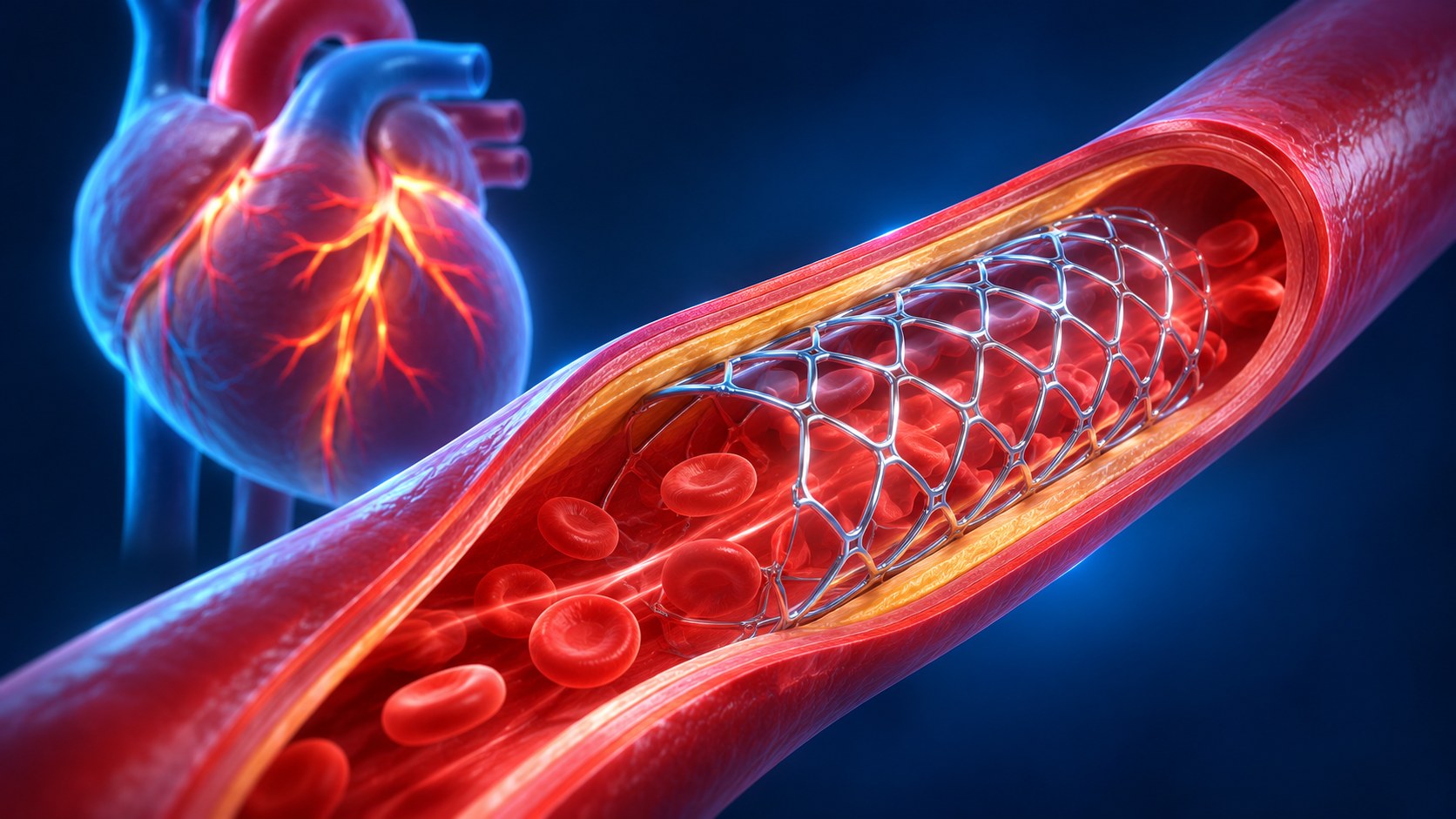
Here’s the good news: a stent is designed to stay in your heart for the rest of your life. It is a tiny mesh tube made of medical-grade metal alloy. Once it is expanded inside the artery, the inner lining of the artery slowly grows over it within a few months, and the stent becomes part of the vessel wall.
Most stents used today are drug-eluting stents (DES). They release a medicine over the first few months that reduces scar tissue growth. After that, the metal scaffold simply stays in place, holding the artery open.
“A stent doesn’t have an expiry date. There is no routine need to “change” or “remove” it after a few years.
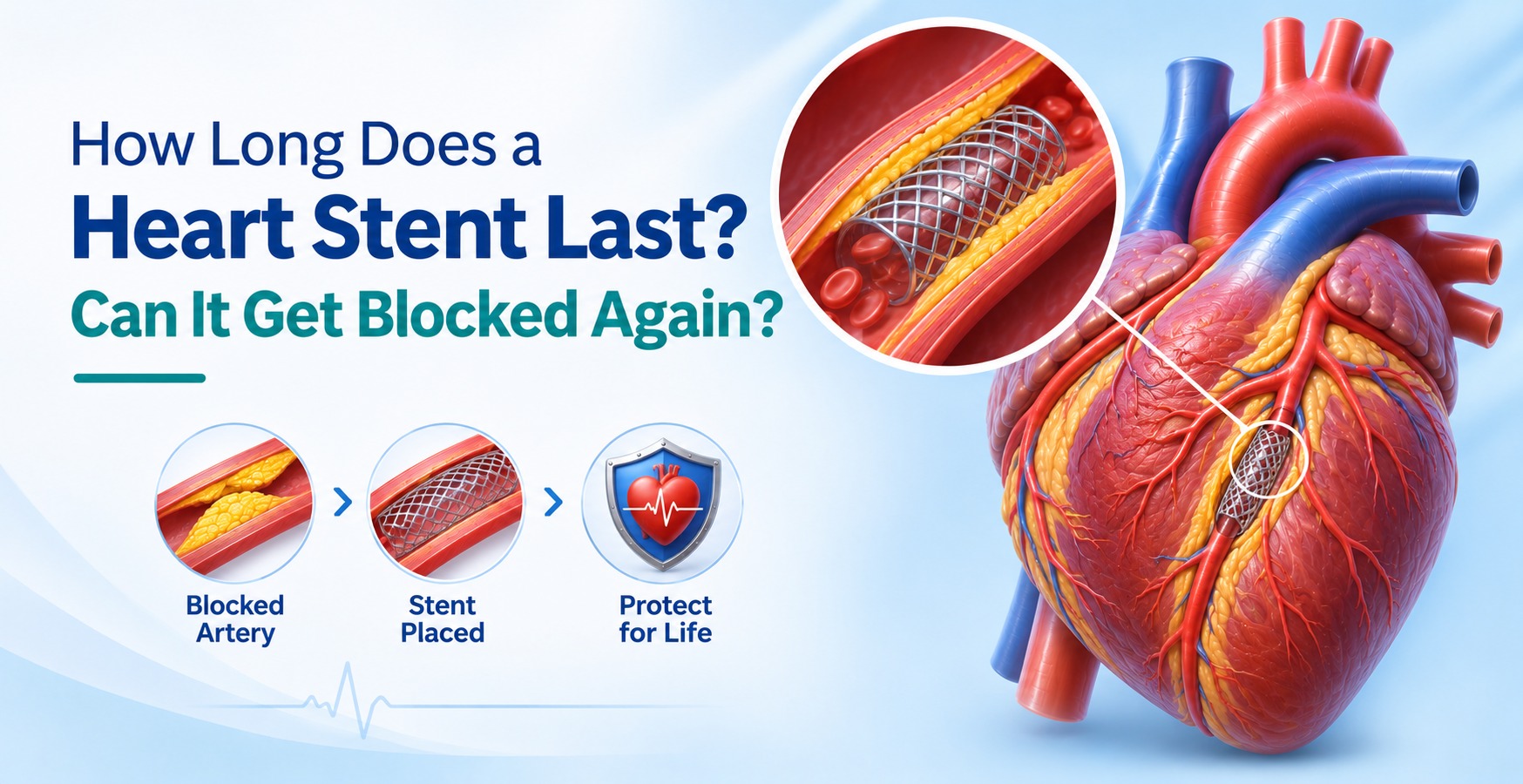
A stent holds the plaque against the artery wall so blood can flow freely again.
2Myths Patients Believe About Stents
✗ MYTH
A stent has to be replaced every 5 to 10 years.
✓ FACT
Stents are permanent. They are not batteries or tyres.
✗ MYTH
Once I have a stent, my heart problem is cured.
✓ FACT
A stent treats one narrowed segment. The underlying disease needs lifelong control with medicines and lifestyle.
✗ MYTH
I can’t have an MRI or go through airport security.
✓ FACT
Modern coronary stents are generally MRI-safe, and airport scanners pose no risk. Just carry your stent card.
✗ MYTH
I can stop my blood thinners once I feel fine.
✓ FACT
Stopping too early is the most important avoidable cause of a clot inside the stent. Never stop without your cardiologist’s advice.
3Then Why Does Chest Pain Sometimes Come Back?
If symptoms return after angioplasty, there are three possibilities. Knowing them helps you act calmly and correctly.
🔁
In-stent restenosis
Scar tissue slowly grows inside the stent and narrows it. Much less common with modern drug-eluting stents. It usually causes a gradual return of chest discomfort on exertion and can usually be treated again.
🩸
Stent thrombosis
A clot forms inside the stent. It is rare but serious, and most likely in the early weeks and months, especially if blood thinners are stopped.
📍
A new blockage elsewhere
The most common reason for new symptoms years later. Coronary disease can progress in other arteries if risk factors aren’t controlled.
💡 Think of it this way: the stent fixes one road. Your medicines and lifestyle keep the entire highway network clear.
4Your Blood Thinners: The Stent’s Best Friend
After a stent, most patients take two antiplatelet medicines (usually aspirin plus clopidogrel, ticagrelor or prasugrel) while the artery lining heals over the stent.
Situation
Typical approach*
Planned (elective) angioplasty
Dual antiplatelets often for about 6 months, then one long term
Stent placed during a heart attack
Dual antiplatelets usually for about 12 months
High bleeding risk
A shorter duration may be chosen by your cardiologist
After the dual therapy period
Usually one antiplatelet continued for life
*Durations are individualised. Always follow your own cardiologist’s plan.
💡 Going for a tooth extraction, endoscopy or any surgery? Do not stop your blood thinners on your own. Ask the treating doctor to speak with your cardiologist first.
5Your Stent-Protection Checklist
✓Take your statin every single day. Your LDL target after a stent is much lower than the “normal” range on lab reports.
✓Keep BP and sugar under control. Both damage artery walls silently.
✓Quit all tobacco: cigarettes, beedi, gutka and chewing tobacco.
✓Walk 30 minutes on most days once your doctor clears you. Cardiac rehab is ideal.
✓Eat smart: less fried food, ghee, sweets and salt, and more vegetables, dal, whole grains and fruit.
✓Keep your follow-ups, even when you feel perfectly well.
🚨 Warning signs after a stent: act immediately
• Chest pain or pressure lasting more than a few minutes
• Pain spreading to arm, jaw, neck or back
• Sudden breathlessness or heavy sweating
• Fainting, or symptoms like the ones before your angioplasty
Do not wait. Go to the nearest emergency department or call an ambulance (108).
If chest discomfort or breathlessness is slowly returning when you walk or climb stairs, it is usually not an emergency, but book a review with your cardiologist soon.
6Will I Need an Angiogram Every Year?
No. Routine repeat angiograms are not needed if you are doing well. Follow-up is based on symptoms, ECG, echo, blood tests and, when needed, a stress test. A repeat angiogram is advised only if something suggests a new problem.
?Frequently Asked Questions
Will I feel the stent inside me?
No. Patients cannot feel a stent once it is in place.
Can a stent move or fall out?
No. Once expanded, it is firmly embedded in the artery wall.
Can I fly, travel and go back to work?
Most people return to normal routines within days to a week after a planned angioplasty, and a little later after a heart attack. Your cardiologist will advise you on air travel.
Can I exercise or go to the gym?
Yes. Regular exercise is strongly encouraged. Start gradually and ask your cardiologist before heavy weight training or competitive sport.
Is it safe to have an MRI?
Modern coronary stents are generally considered MRI-safe. Inform the scan centre and carry your stent card.
⭐ Key Takeaways
→ A stent is permanent and does not need to be replaced.
→ Re-blocking inside modern stents is uncommon; new blockages elsewhere are the bigger risk.
→ Never stop blood thinners without your cardiologist’s advice.
→ Daily statins, BP and sugar control, no tobacco and regular walking protect your heart for decades.
Had a stent and want peace of mind?
If symptoms have returned, or you’d like a review of your medicines and long-term heart protection plan, Dr. Girish B. Navasundi can help. Bring your angiogram CD, discharge summary and current medicines.
Apollo Hospitals, Bannerghatta Road · Legends Heart Center, Jayanagar, Bengaluru
GN
Dr. Girish B. Navasundi
Senior Consultant & Interventional Cardiologist · 21+ years
Evaluates and treats patients with coronary artery disease, complex angioplasty, structural heart disease and heart failure at Apollo Hospitals and Legends Heart Center, Bengaluru.
This article is for patient education only and does not replace a personal consultation. Treatment is individualised after full clinical evaluation. References: American College of Cardiology; American Heart Association; European Society of Cardiology.
 Apollo Hospitals, Opp.iim 154/11,bannerghatta Road. Bannerghatta Road.bangalore-560076
 6366 229563
 Posted on October 27, 2026