 Apollo Hospitals, Opp.iim 154/11,bannerghatta Road. Bannerghatta Road.bangalore-560076
 6366 229563
 Posted on October 2, 2026
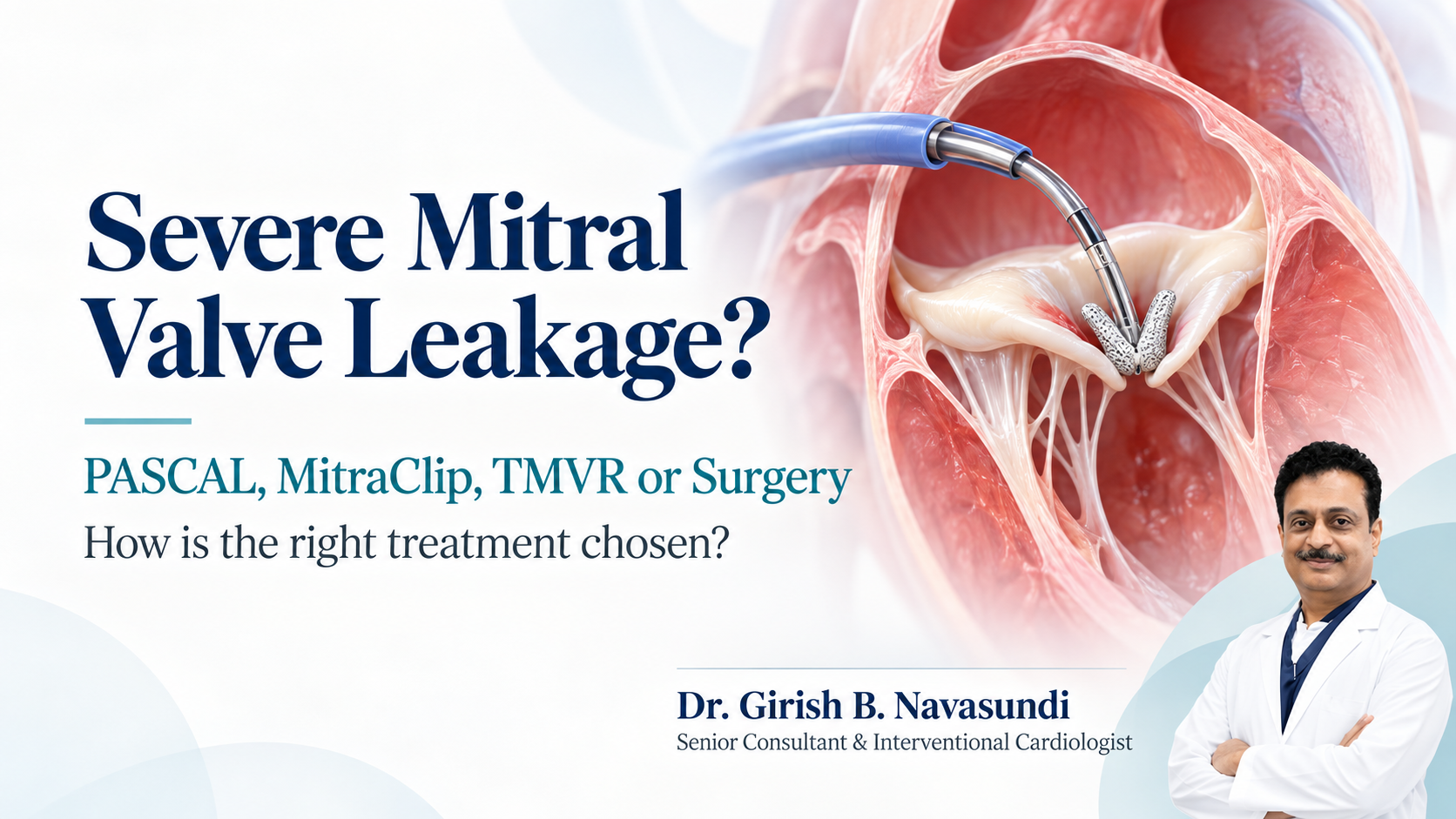
Severe Mitral Valve Leakage: PASCAL, MitraClip, TMVR or Surgery — How Is the Right Treatment Chosen?
A patient guide to mitral regurgitation, valve repair, PASCAL, MitraClip, TMVR and surgery — and how the right option is chosen for you
You have just come out of an echocardiogram, and the report says something like “severe mitral regurgitation.”
Then the questions start:
“My mitral valve is leaking badly. Do I need open-heart surgery, a clip, or a new valve?”
It is one of the most common — and most confusing — questions in valve care. Friends mention “a clip through the leg.” Someone else says “you must have surgery.” The internet adds PASCAL, MitraClip, TEER and TMVR to the mix.
The truth is simpler and more reassuring: there is no single “best” mitral treatment. There is a best treatment for your valve and your body. This guide explains every option in plain language, and how a Heart Team decides between them.
First, what is severe mitral regurgitation?
The mitral valve sits between the two chambers on the left side of the heart — the left atrium (upper chamber) and the left ventricle (the main pumping chamber).
Every time the heart squeezes, the mitral valve should close tightly so blood moves forward into the body. In mitral regurgitation (MR), the valve does not seal properly, so part of the blood leaks backward into the left atrium and lungs.
When the leak is severe, the heart has to work much harder. Over time this can cause:
- Breathlessness on walking, climbing stairs or lying flat
- Tiredness and reduced exercise capacity
- Palpitations or atrial fibrillation (irregular heartbeat)
- Fluid in the lungs and repeated heart-failure admissions
- Gradual enlargement and weakening of the heart
Two very different kinds of leak
Doctors divide MR into two broad types, and this matters enormously for treatment:
- Primary (degenerative) MR — the valve itself is damaged: floppy leaflets (prolapse), a torn chord (flail leaflet), or rheumatic disease, which is still common in India.
- Secondary (functional) MR — the valve leaflets are fairly normal, but the heart muscle around them is enlarged or weak (for example after a heart attack or in cardiomyopathy), pulling the leaflets apart.
A valve that is “broken” may need a different solution from a valve that is “pulled open” by a struggling heart.
Repair or replacement — what is the difference?
All mitral treatments fall into two families:
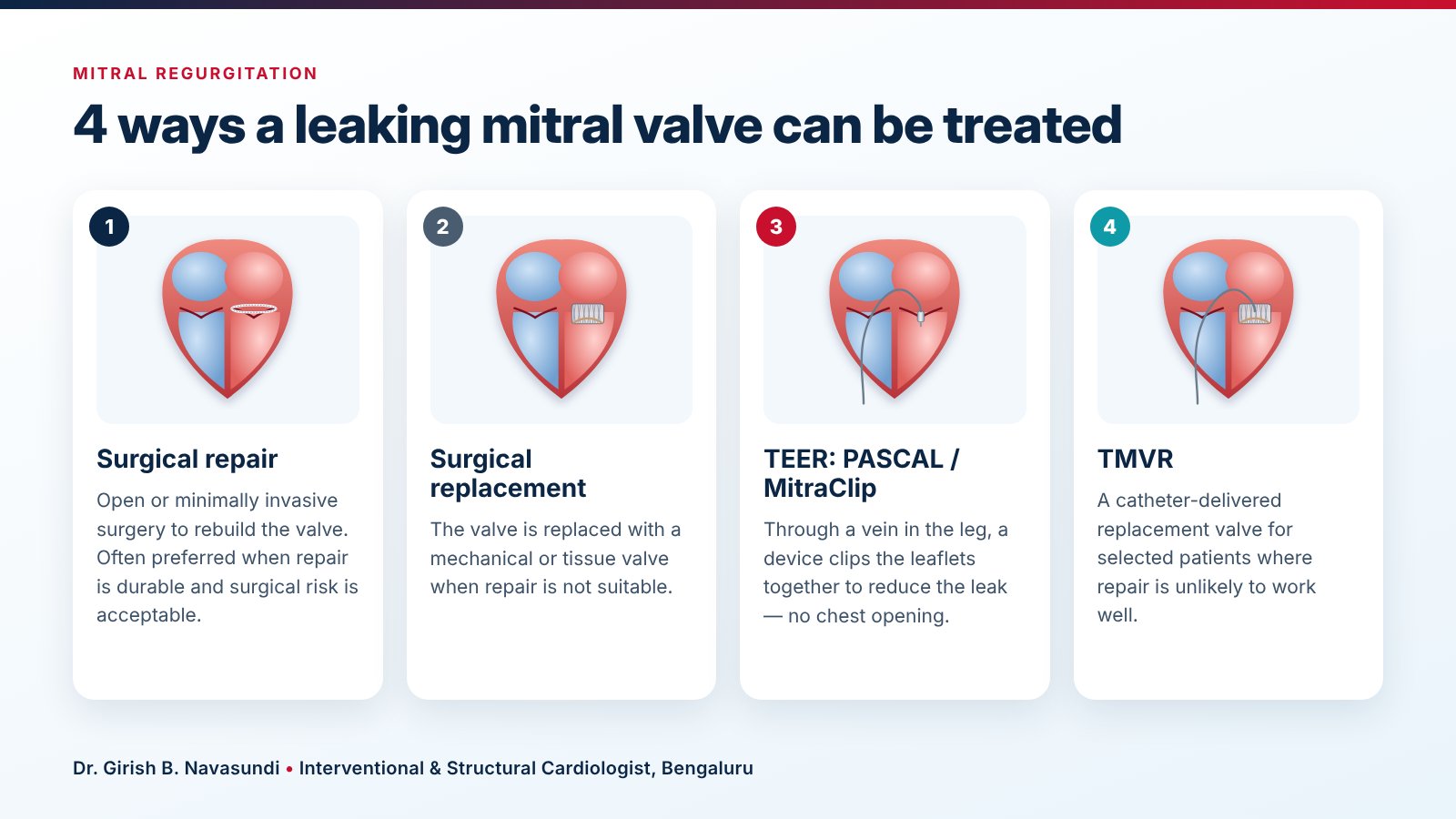
- Repair keeps your own valve and fixes how it closes.
- Replacement takes over the job of the valve with a new one — a mechanical valve or a tissue (biological) valve.
When it is possible and durable, repair is often preferred, because your own valve tissue generally works very naturally. But not every valve can be repaired well, and that is where replacement comes in.
Option 1 & 2: Conventional mitral valve surgery
Surgery remains the gold standard for many patients, especially younger and fitter people with primary MR.
Surgical repair may include reshaping the leaflets, replacing torn chords with artificial ones, and placing a supporting ring (annuloplasty ring) around the valve.
Surgical replacement is used when the valve is too damaged — for example heavy rheumatic scarring or calcium — to be repaired reliably.
Surgery can be done through a conventional chest incision or, in selected centres and patients, through smaller minimally invasive incisions. Either way, it uses the heart-lung machine and needs a general anaesthetic and a longer recovery.
Surgery is often the best choice when:
- The patient is at acceptable surgical risk
- The valve is highly repairable and long-term durability matters
- Other heart surgery is also needed (bypass, another valve, rhythm surgery)
Option 3: TEER — PASCAL and MitraClip
TEER stands for Transcatheter Edge-to-Edge Repair. It is a way of repairing the mitral valve without opening the chest.
How it works
- A catheter is passed through a vein in the groin up to the heart
- It crosses from the right to the left upper chamber through a tiny puncture in the wall between them (transseptal approach)
- Guided by 3D transesophageal echocardiography (TEE) and X-ray, a small device grasps the two mitral leaflets and holds them together where they leak
- The leak is reduced while the heart keeps beating — no heart-lung machine
Many patients are up and walking within a day and go home within a few days.
PASCAL vs MitraClip — are they different?
Both are TEER systems that work on the same principle. MitraClip has the longest track record and the largest body of evidence. PASCAL is a newer system with a different design — including a central spacer and broad, flexible paddles — which can be useful in certain anatomies. Evidence for PASCAL continues to grow, including recent studies in complex valve anatomy and in very elderly patients.
The choice between them is technical. It depends on leaflet length, the size of the gap, the width of the leak and how much valve area can be preserved. In expert hands, the device is chosen to suit the valve — not the other way round.
When TEER anatomy may be difficult
TEER is excellent for the right valve, but less suitable when:
- The valve opening is already small (risk of creating narrowing, or mitral stenosis)
- There is heavy calcium on the leaflets or ring
- The leaflets are very short, thickened or restricted (as in some rheumatic valves)
- The leak comes from several places or a very wide gap
- There is a cleft or perforation in the leaflet
In such cases the Heart Team may consider surgery, TMVR or a combined strategy instead.
Option 4: TMVR — Transcatheter Mitral Valve Replacement
TMVR means placing a new mitral valve through a catheter, without conventional open-heart surgery. Depending on the system, it may be delivered through a vein in the leg (transseptal) or through a small incision near the tip of the heart (transapical).
TMVR is a newer and rapidly developing field. It may be considered when:
- Surgery is high-risk and the valve is not suitable for TEER
- A previous surgical mitral valve or ring has failed (“valve-in-valve” or “valve-in-ring”)
- There is severe calcium on the mitral ring in selected patients (“valve-in-MAC”)
Because the new valve has to fit inside the patient’s own anatomy, detailed CT planning is essential. One key risk is that the new valve can push the front mitral leaflet into the heart’s outflow path (LVOT obstruction). CT lets the team predict and plan for this before the procedure.
Why CT + TEE anatomy matters so much
Two scans form the blueprint for every mitral decision:
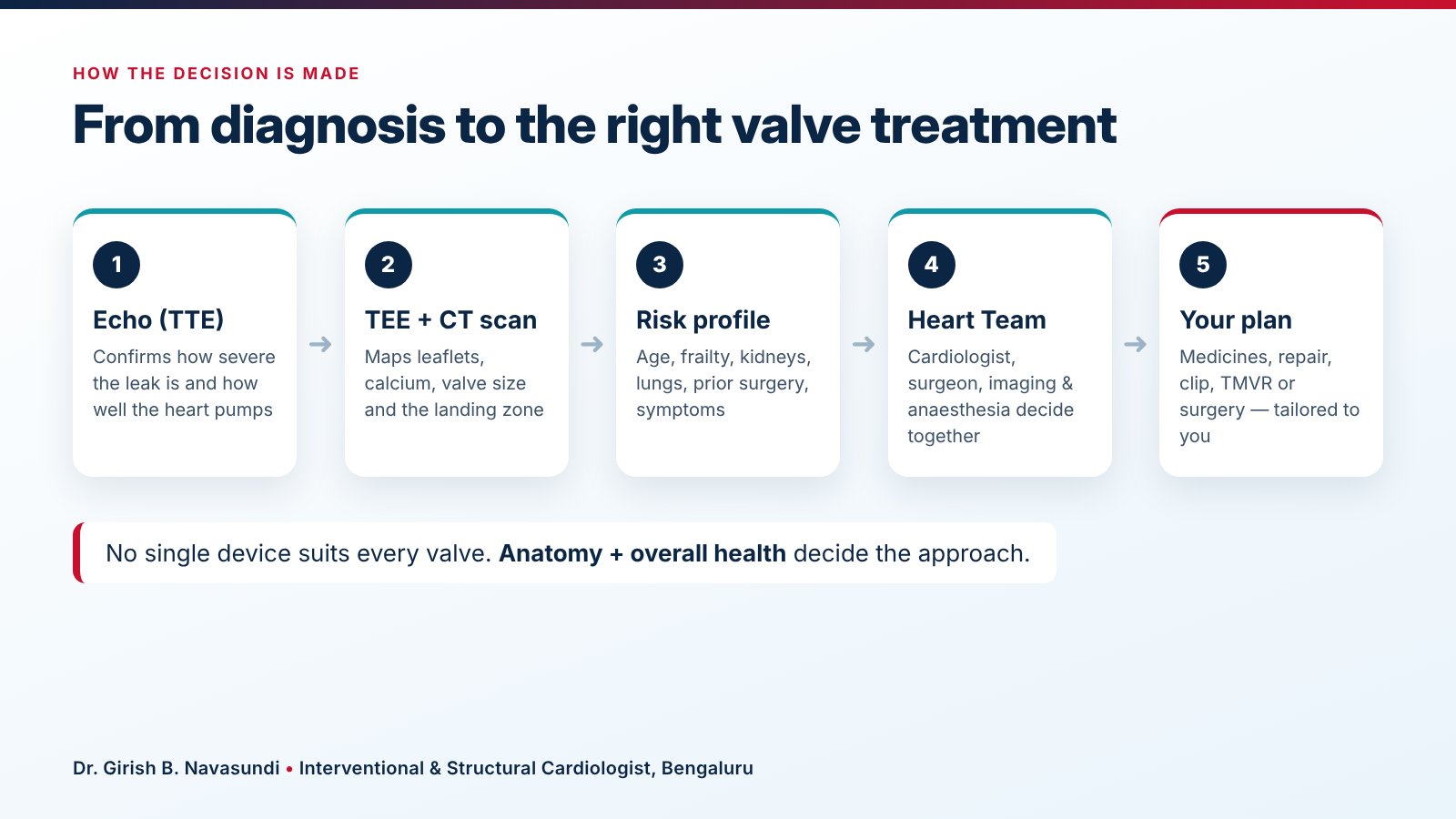
- 3D Transesophageal Echo (TEE) shows the leaflets in fine detail — where the leak comes from, leaflet length, gap and valve area. It is critical for TEER planning.
- Cardiac CT measures the mitral ring, calcium, the outflow tract and the route a catheter must take. It is critical for TMVR planning.
A treatment chosen from a basic echo alone may be the wrong one. The right imaging is what turns a guess into a plan.
How the Heart Team chooses the right treatment
Modern valve care is decided by a Heart Team — interventional cardiologists, cardiac surgeons, imaging specialists and anaesthetists reviewing each patient together. They look at:
| Question | Why it matters |
|---|---|
| Is the MR primary or secondary? | Guides whether to fix the valve, the heart muscle, or both |
| How severe is it, and are there symptoms? | Determines timing of treatment |
| How strong is the heart pump? | Affects surgical risk and expected benefit |
| What does the valve anatomy look like on TEE/CT? | Decides whether TEER, TMVR or surgery is technically suitable |
| What is the surgical risk? | Age, frailty, kidney and lung function, previous surgery |
| What matters to the patient? | Recovery time, lifestyle goals, long-term durability |
A simple way to think about it
- Younger, fit, repairable primary MR → surgical repair is often ideal
- Higher surgical risk, suitable leaflets → TEER (PASCAL or MitraClip) is often considered
- Secondary MR despite optimal medicines → TEER may help selected patients with suitable heart function
- High risk and TEER-unsuitable anatomy → TMVR may be considered
- Complex disease or other surgery needed → surgical replacement or repair
These are general patterns, not rules. Each final decision should be individual.
Do medicines still matter?
Yes. Medicines do not fix a broken valve, but they are vital — especially in secondary MR, where optimising heart-failure medications, controlling rhythm and sometimes using special pacemakers (CRT) can reduce the leak itself. Many patients need medicines and a valve procedure.
When should you not wait?
Seek a specialist opinion soon if you have severe MR and:
- New or worsening breathlessness or tiredness
- A falling ejection fraction or an enlarging heart on echo
- New atrial fibrillation
- Rising lung pressures (pulmonary hypertension)
- Repeated hospital admissions for fluid
Treating at the right time — before the heart muscle is permanently damaged — usually gives the best results.
Frequently Asked Questions
Does severe mitral regurgitation always need open-heart surgery?
No. Surgery is the best option for many patients, but others may be treated with a catheter-based procedure such as TEER (PASCAL or MitraClip) or, in selected cases, TMVR. Some patients with secondary MR improve significantly with optimised medicines first.
What is the difference between mitral valve repair and replacement?
Repair keeps and fixes your own valve; replacement uses a new mechanical or tissue valve. Repair is often preferred when it can be done well and durably, but replacement is better when the valve is too damaged to repair reliably.
Is PASCAL better than MitraClip?
Neither is universally better. Both are TEER devices. MitraClip has the longest evidence base, while PASCAL has a different design that can suit certain anatomies. The choice is made after detailed TEE assessment of your valve.
Are PASCAL and MitraClip available in India?
Yes, mitral TEER is performed in India at experienced structural heart centres. Availability and suitability should be discussed with a structural heart specialist after imaging.
What is TMVR and who is it for?
TMVR is transcatheter mitral valve replacement — a new valve placed through a catheter. It is generally considered for patients at high surgical risk whose valve is not suitable for repair, or for failed previous surgical valves or rings.
How long does recovery take after TEER?
Most patients walk within 24 hours and are discharged within a few days. Recovery is typically much faster than after open-heart surgery, though it varies with overall health.
Why do I need a TEE and a CT scan before treatment?
A standard echo confirms the leak; TEE shows the leaflets in detail and CT measures the valve ring, calcium and outflow tract. Together they determine which procedure is technically safe and likely to work.
Can the mitral valve be treated if I have had heart surgery before?
Often, yes. Previous surgery raises the risk of re-operation, so catheter options such as TEER or valve-in-valve/valve-in-ring TMVR may be considered.
Is a catheter procedure suitable for everyone?
No. Anatomy is the limiting factor. Some valves are best treated surgically, and an honest Heart Team assessment will explain why.
How long will a repaired or replaced mitral valve last?
Durability depends on the type of procedure, the valve disease and the patient’s age. Your team will discuss expected durability as part of choosing the treatment.
Dr. Girish B. Navasundi evaluates patients with mitral valve disease, including severe mitral regurgitation, high-risk surgical candidates and those exploring catheter-based options such as TEER and TMVR, through a Heart Team approach.
Senior Consultant & Interventional Cardiologist
Apollo Hospitals, Bannerghatta Road, Bengaluru
Legends Heart Center, Jayanagar, Bengaluru
A leaking mitral valve is not a one-size-fits-all problem. The right answer comes from understanding your valve, your heart and your goals.
This article is for patient education. Treatment should be individualised after clinical evaluation and imaging.